
The Movie Star Era Is Ending. Animation Is Taking Over Chinese Cinema.
A quiet investment shift is shrinking celebrity paychecks, killing hundred-million-dollar live-action bets, and turning cartoons into the industry’s safest gamble.
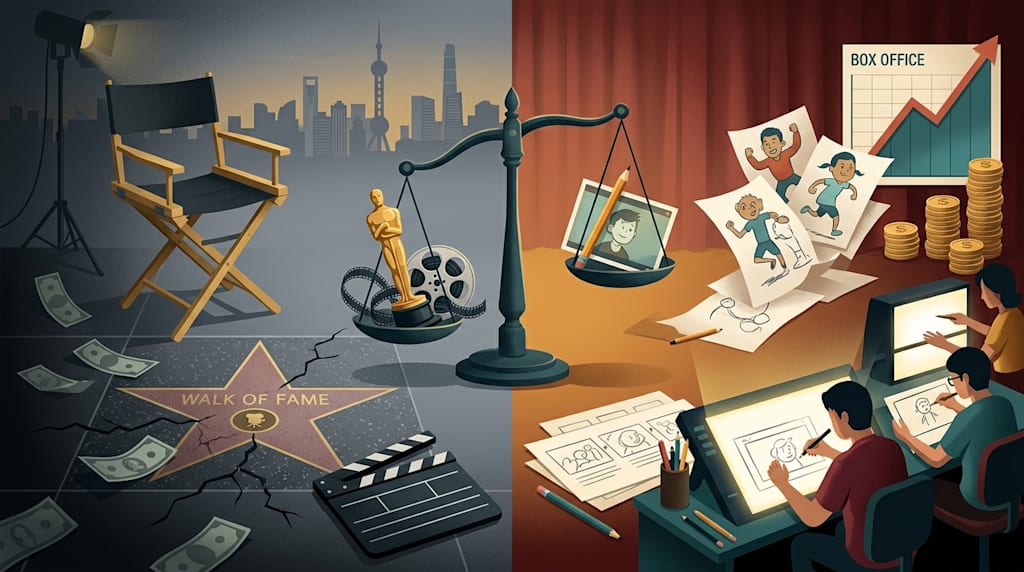
Animation rises, stardom falls: what changed in Chinese film investment
Wang Hailin’s recent remarks are like a nail driven into the lintel of the Chinese film industry:
“As far as I know, the investment direction of films has clearly shifted. Investment in animation has increased. Most live-action films are concentrated in the 20–30 million yuan investment range. This is determined by current project costs, and this figure includes the cost of one or two stars. ... Star value has shrunk dramatically. In the short term, there are basically no films with investments over 100 million yuan. In the past, there were double-digit numbers of such films every year. Now they can be counted on one hand. That is basically the situation.”
If someone had said this five years ago, the industry would have called it alarmism. Today it reads as a diagnosis. The remark describes a change in the industry’s basic logic. Chinese cinema is moving from a cycle built on stars and blockbusters to one built on cost control and risk control. Animation sits on the favorable side of that shift.
The disappearance of hundred-million projects
For a decade, Chinese cinema followed a formula: big IP and top stars, usually with a famous director. Capital paid a premium for that combination because the market repeatedly proved that a bright cast could carry a mediocre film to hundreds of millions in its first week. That formula no longer works.
Audiences have stopped buying names. The box office appeal of traffic stars has been burned through by one bad film after another. Fan lock-ins, ghost screenings, and data fraud once helped. Now they invite backlash. When money is tighter and viewing decisions are more careful, the audience asks a simpler question: is this worth two hours and a few dozen yuan?
Stars have become costs.
Wang Hailin says most live-action films now sit in the 20–30 million yuan range, and that number includes one or two stars. After star fees, little is left for production. Projects above 100 million yuan, once announced by the dozen each year, can now be counted on one hand. Bona Film Group lost 169 million yuan in the first half of 2026. Huayi Brothers faces a bankruptcy petition. Enlight Media has moved its main live-action team toward animation IP. China Film is now almost the only major player still announcing new projects above 100 million yuan.
The problem runs across the industry: a risk revaluation.
High budgets have always carried high risk. Recent years are full of expensive films with all-star casts, heavy marketing, and poor box office. When “big” no longer means “safe,” capital looks for a safer exit. The market is rewarding lower-cost, lower-risk production.
Why animation
Animation is not new. For years it was treated as children’s entertainment and ranked below live-action in investment priority. That ranking has reversed. In the current environment, animation offers a better cost-performance ratio.
Costs are easier to control
Top animated features cost roughly 80 to 180 million yuan. That is comparable to a mid-sized live-action film. Mid-tier animation projects generally cost 20 to 40 million yuan. A live-action film with 20 to 30 million yuan already includes one or two stars, which leaves production squeezed.
One animation producer put it this way: once the script is locked, the team has about a 90 percent chance of finishing on schedule. Live-action production is vulnerable to weather, scheduling, actor availability, and locations. Costs can move at any time. Animation costs are concentrated in art design, animation, and rendering. They can be planned.
Animation losses are also easier to absorb. The same 40 million yuan in a live-action project may buy no influence. In an animated film it can make a backer a significant participant. For smaller capital, animation is a friendlier entry point.
The visual ceiling is higher
Live-action is limited by the real world. Physics, photography, sets, and actors’ bodies set the ceiling. Actors cannot perform every movement. Special effects can cover some gaps, but money does not guarantee a good result.
Animation can create worlds that do not exist. Fantasy, science fiction, fairy tales, and fables have an advantage. Hand-drawn 2D, realistic 3D, watercolor, stop-motion, paper-cut, comic style: any approach is possible. The limit is imagination.
The Spider-Man films are a useful example. The 21st century has produced three live-action Spider-Men. That is plenty of spectacle. The Spider-Verse films still look like they come from another dimension. They do things live-action cannot.
The audience reaches further
Live-action film is often treated as a form that demands seriousness. Its viewers are film fans and general audiences. Animation was long dismissed as children’s fare. As attitudes changed, that lower status became an advantage for family viewing.
The barrier to entry is lower and the audience is wider. A viewer who likes animation can rewatch Monkey King: Hero Is Back and Ne Zha, then take a child to Boonie Bears. An adult who tries to take a child to a live-action film often finds the child resistant. That difference matters.
Performers carry less risk
Voice actors are actors. But when people say “actor,” they usually mean stars and professionals in live-action film and television. Those performers face appearance, aging, injury, scheduling conflicts, and scandal. They are also often expensive.
Animated characters face none of those limits. Voice actors only need to perform the role with their voices. The field has famous voice actors. It does not have star voice actors.
That creates a professional moat. A famous actor who cannot voice act may hurt an animated film. This summer’s Eight Immortals! used Chen Hao for its voice work. Inside Out 2 cast Guan Xiaotong as Joy. The first film used Beidou Penguin and Shan Xin.
Risk is more controllable
Live-action films depend on actors, directors, and screenwriters who can generate negative news. Marketing and public opinion add more risk. One investor watched a live-action film suffer after poor word of mouth, when the lead actor refused to help promote it.
Animation is not immune. The abandoned cat controversy around MTJJ, author of The Legend of Hei, and the later public opinion incident around The Little Monster on Langlang Mountain both hurt their projects. But animation crashes less often.
Production itself also carries risk. Dangerous actions, disaster scenes, violent conflict, and scenes with children or animals can put real people and animals in harm’s way. Animation handles those scenes through drawing or CG.
Revision is easier
When a work needs improvement, or when circumstances force a change, the work grows. Live-action films are limited by footage, shooting conditions, and actor availability. Reshoots are expensive. The Wandering Earth II was still refining details days before release. Blades of the Guardians: Wind Rises in the Desert reshot every scene involving the replaced actress Na Er Na Qian.
Animation is simpler. If a scene does not work, the team adjusts, redraws, replaces, and repeats until it does. In Eight Immortals!, Chen Hao insisted on keeping the voice-breaking adolescent tone for Han Xiangzi. Three boys voiced the character. In a live-action film that would be a flaw. In animation it is a joke.
The market has already voted
Advantages on paper must survive the market. The market has answered.
Ne Zha 2 earned 15.446 billion yuan at the mainland box office, with 324 million admissions. Both are records in Chinese film history. It is the only non-Hollywood film and the only animated film in the current global top five. It will remain a high mark for a long time. Its production cost, including marketing, was about 500 million yuan, far below live-action films released at the same time. Estimated net profit exceeds 5 billion yuan.
The Boonie Bears series has released 12 films. Cumulative box office has passed 9.2 billion yuan. Its steady release schedule and clear family positioning make it the most commercially resilient series IP in Chinese animation. It grew from 247 million yuan for the first film to 1.984 billion yuan in 2024. The industry treats it as a reliable Spring Festival performer.
The Little Monster on Langlang Mountain grossed 1.719 billion yuan. People familiar with the production say its total cost did not exceed 40 million yuan. That makes it one of the highest-return films in recent memory. It is a small-budget win.
A Love Letter to Grandma cost 14 million yuan. Its cast was amateur. Ninety-five percent of its dialogue was in Chaoshan dialect. It had no widely known industry personnel and no large marketing campaign. Word of mouth carried it to a 9.2 Douban score and strong box office. It is the highest-rated domestic drama on Douban in nearly a decade.
Niu Lai is more extreme. It cost about 100,000 yuan. A two-person team made it on second-hand computers. It earned 342 yuan on its first day. Then it became a joke so bad it turned into an online carnival. Box office passed tens of millions of yuan. It is a terrible film. It became a vessel for memes, offline stunts, and social psychology. That happened partly because it is animation. A bad live-action film is concrete even when it is absurd. A bad animated film can be abstract in a way that feels real.
These cases show that animation can produce outsized returns.
Live-action film must change
Live-action films still outnumber animated films in China. Live-action performance has a charm that animation cannot fully replace. Emotional subtlety, live tension, and the chemistry between actor and role are hard to reproduce.
But live-action production has to change.
First, control costs. China Film Chairman Fu Ruoqing has said a film aiming for 1 billion yuan in box office should not cost more than 200 million yuan. Some veteran stars charge more because of seniority, but their cost-performance ratio may be worse. Capital will not pay unlimited premiums for fame.
Second, respect content. The old formula of big IP, traffic stars, and famous directors has failed. Audiences want stories, not casts. Screenwriters need more standing. Scripts need time.
Third, accept diversity. Large investments will not vanish. They will be more careful and concentrated on a few top projects. Chinese cinema still needs films like The Wandering Earth 3. It also needs many small and mid-sized films in different genres and styles.
What changed
Capital is moving from paying for the illusion of certainty to paying for controllability.
Star traffic, big IP, and famous directors once looked like certainty. Capital bet on that illusion, hoping one hit would cover every risk. The illusion has broken. The market now rewards products that control costs, isolate risk, revise easily, and respect content.
Animation fits those conditions.
The film industry is relearning how to live with risk after a bubble. Animation is the current beneficiary. The market does not favor either side out of sentiment. It rewards people who understand audiences, control costs, and respect the rules of creation.
From Monkey King: Hero Is Back to Ne Zha, from Boonie Bears to The Little Monster on Langlang Mountain, animation has repeatedly shown what it can do.
The shift is already visible in release slates. The next test is whether live-action producers can cut budgets without cutting story.
About the Creator
Jin
Writer of reamstories
https://reamstories.com/jin
Enjoyed the story? Support the Creator.
Subscribe for free to receive all their stories in your feed. You could also become a paid subscriber, letting them know you appreciate their work.
Comments
There are no comments for this story
Be the first to respond and start the conversation.