
The Face of the Safe Bet
Why Anime’s “Gentle Ordinary Guy” Is a Market-Tested Blank Form
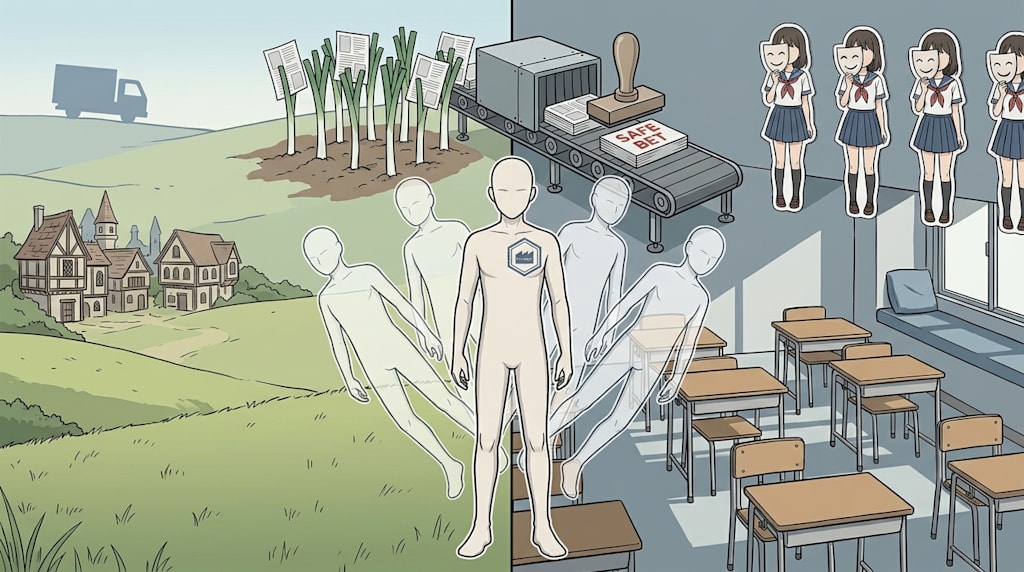
Watch enough recent Japanese anime and you get a specific kind of exhaustion.
In an isekai show, a truck comes over the hill. The male lead opens his eyes on a grassland. His hair has changed color. His soul has not. In a school show, he sits in the back row by the window. By the third week, the three prettiest girls in school have had lunch with him, argued with him, and nearly bumped into him at a hallway corner. The genre changes. The setting changes. The girls’ hair colors change. The male lead looks injection-molded from the same template: not proactive, not offensive, not sharp, slightly self-deprecating, occasionally dense, and always able to say the right thing at the critical moment.
The “gentle ordinary guy” looks like a low-spec starting build. He is a safe generic preset. He is a social nobody. After the story begins, male characters discover that he “has what it takes.” Female characters discover that he “has charm.” He does not need to shine at the opening because the author has reserved the narrative dividend of “being noticed later.” This is the anime male lead who “starts from zero.” His story begins when the anime airs and heads toward a magnificent peak.
That zero is not zero. It is a blank form that has gone through market research. Low aggressiveness keeps the audience from feeling offended. High empathy lets him receive the heroines’ trauma. Moderate self-deprecation gives otaku viewers something to identify with. Hidden talent keeps later cheat-like abilities from feeling abrupt. “Utterly ordinary” becomes a rhetorical device. The attribute set is a hexagon with no weak side. Every side is covered with a cloth that says “I’m ordinary.”
Isekai and school are the same reset
Isekai and school harem look like two genres. Both put the protagonist into a society where the rankings are rearranged.
Isekai is a physical reset. Identity, education, and personal relationships are voided. The protagonist brings modern common sense and an author-granted cheat into a world where social status can be redistributed. School is a miniature reset. A new semester, class assignments, a transfer, or a club interrupts the existing social order. The protagonist can go from “the person nobody notices” to “the person who gets noticed.”
Both settings suit the gentle ordinary guy because they let him be seen at low risk. He does not pay the cost of failure in his original society. He stays gentle, kind, able to cook, and willing to listen in the new environment. Relationship returns follow. “Starting from zero” becomes “starting from safety.” The protagonist has not lost everything. He has been placed in a testing ground with fewer punishments and faster feedback.
Such stories become formulaic because they are not about an ordinary person struggling in real society. They offer a fantasy of relationship reset. You do not change the rules of the world. The world rediscovers you. The protagonist’s gentleness is not a choice with a price. It is an attribute that attracts others. Gentleness turns from a character trait into narrative currency.
Chitose-kun’s problem is not that he is “not ordinary”
Someone might say: write a male lead who is not ordinary. Chitose-kun Is in the Ramune Bottle gets discussed for this. It tries to write a self-important, sunny, outgoing male lead. The first volume tries too hard and provokes backlash.
The market dislikes a narrative posture that treats women as prizes and readers as students. It does not dislike the outgoing normie.
The first volume has lines about “you are the one who made them fall into being paper cutouts,” “she is my sex slave,” and “threesome.” The character is unlikeable. The relationship between author and reader has also gone wrong. The reader is asked to identify with a narrator who says, “I understand the three-dimensional world better than you otaku do.” The reader is asked to accept language that treats women as distributable resources. This arrogance stings more than the harmlessness of the ordinary guy. The ordinary guy pretends to be humble. If the normie male lead does not even pretend, the reader feels offended.
Chitose-kun fails because it writes “not ordinary” as “disrespectful.” A sunny normie can be written. A self-important character can be written. The author must know what kind of person they are writing. They must not treat the character’s arrogance as the work’s charm. Whether the character grows later is another matter. The deathly feeling of the first volume is clear. It pushes the reader away before the reader enters the story.
Otaku paired with a gyaru: low input, high return
Another common formula is “otaku paired with a gyaru.” The shut-in otaku lies flat in the dust. He also dares to make a move on prey at the top of the food chain.
This is contrast moe on the surface. It is also fantasy economics based on low input and high return. The protagonist does not change himself. He does not work out, earn money, or learn social skills. He does not leave his room. He maintains the inner setting of “I’m gentle.” The gyaru discovers how good he is. Input shrinks. Desire grows.
Why does the gyaru like him? Because he is kind. Why is kindness enough? Because the author says it is enough.
These stories attract people through the consolation of being exempt from competition. Romance is secondary. The audience is told: you do not need to enter the dating market and be compared. Stay as you are. A higher-status member of the opposite sex will recognize your inner value. This is sweet anesthesia. After enough anesthesia, it becomes a formulaic empty shell. It is a conservative and pathetic spiritual regression of the times. It also packages “I don’t want to work hard but I still want to be loved” as gentleness. Otaku can have fantasies. Many works give desire and no price.
Why anime is more conservative
Formulaization is not the audience’s unilateral choice. It is the cost structure of the anime industry projected onto narrative.
Anime production is expensive, slow, and involves many parties. The production committee needs to recoup costs. It tends to choose light novel or manga adaptations with a fan base, a predictable genre, and lower risk. A gentle ordinary guy isekai story may not become a masterpiece. It has a stable audience, stable merchandise, and stable discussion. The committee values stability over surprise. Anime becomes a downstream filter. Web novels and light-novel submission sites produce formulas with good data. Manga adaptation filters them again. Anime picks up the safest layer.
Manga looks more diverse. Manga artists bear their own costs, like leeks that grow through their own effort. They try anti-formulas. Manga is not free. Platform data feedback turns anti-formulas into new formulas. One anti-formula becomes popular. Ten imitators appear. Web novels and light-novel submission sites have the most serious homogenization. Anime amplifies the downstream filtered results.
Four questions
Formula is not a sin. A gentle ordinary guy can be written. Isekai can be written. School harem can be written. Otaku paired with a gyaru can be written. Many works retain the shell of the formula and give no weight to characters and relationships.
To judge whether an ordinary guy story has a chance, ask four questions.
Does the protagonist have flaws and pay a price? Is his gentleness a choice with a cost, or an attribute that automatically attracts others?
Do the female characters have independent goals? Do their actions only advance the male lead’s growth?
Does the relationship change both sides? By the end, have both people gained something, or has the male lead simply harvested rewards?
Does the world constrain the protagonist? Do his cheats have boundaries? Do his choices have consequences?
If these four points fail, the hexagon with no weak side is a get-out-of-jail-free card issued by the author. The protagonist’s gentleness pays no price. The heroines’ affection needs no reason. The world’s rules need no obedience. The story becomes the face of the safe bet. It looks like a person and has no body temperature.
Market testing proves that something sells. It does not prove that it is good. Chitose-kun has an audience and backlash. Both are part of the market. Formulaization pursues conservatism, stability, and safety. That is industrial rationality. If all works pursue only safety, the audience will tire of being arranged to identify with a gentleness that has no price. The audience will not tire of gentleness itself.
“Starting from zero” is not the protagonist sitting in the back row at the beginning. He must pay something for his choices. Gentleness without a price is a setting. Cheat-like power without constraint is hypnosis.
Anime can keep selling safe bets. The audience will ask: who is the person on this card?
About the Creator
Jin
Writer of reamstories
https://reamstories.com/jin
Enjoyed the story? Support the Creator.
Subscribe for free to receive all their stories in your feed. You could also become a paid subscriber, letting them know you appreciate their work.
Comments
There are no comments for this story
Be the first to respond and start the conversation.