
The Big Book Review: "Thinking, Fast and Slow" by Daniel Kahneman (Pt.5)
Chapter 35 to Conclusion...

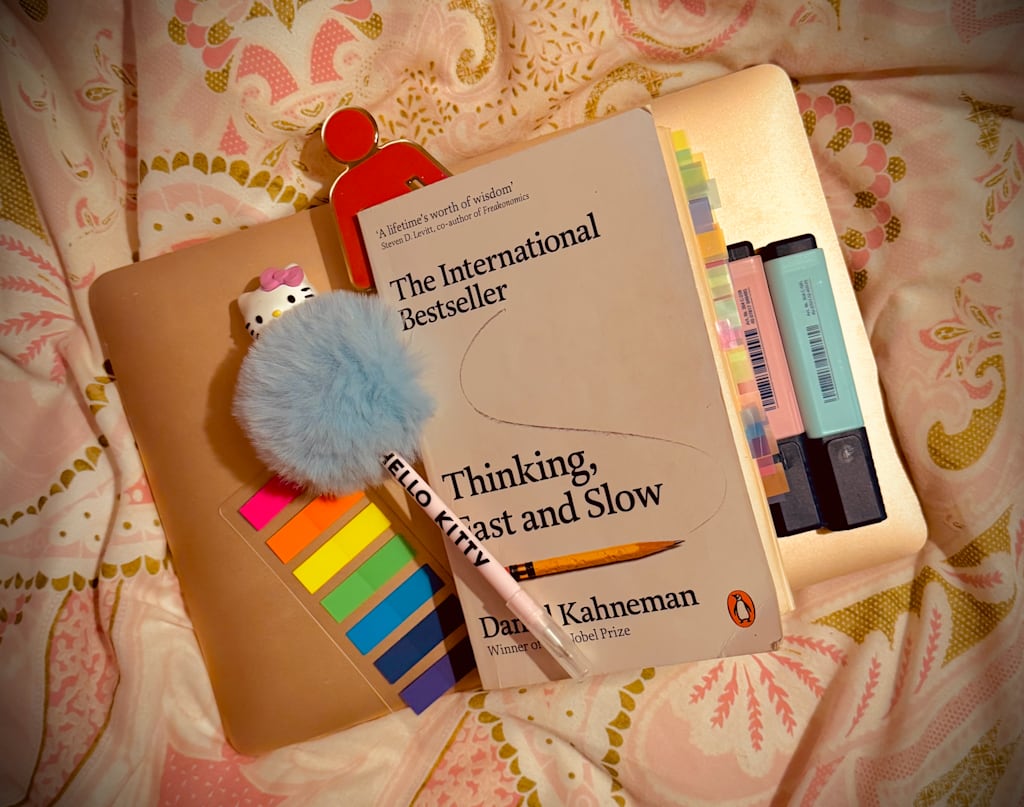
Welcome to our final part on Thinking, Fast and Slow by Daniel Kahneman. I hope you have enjoyed this series. At the end of the piece, I'll be sharing which book we are going to move on to next. I want it to be something a bit different and not another book about the same thing. Hopefully you'll like it. Again, if you haven't read the last four parts then I would recommend it because this section also deals with the conclusions. I've had a great time reading, re-reading, highlighting and annotating this book even though some of the concepts had to be reread quite a few times for in-depth understanding.
"Thinking, Fast and Slow" by Daniel Kahneman (Pt.5)
Entitled Two Selves, chapter 35 introduces the 'Experiencing' and 'Remembering' selves. They interpret life differently, want different things, and often disagree about what happiness is. Kahneman argues that many decisions we make are guided more by the Remembering Self than by the Experiencing Self and that this is sometimes done against our own wellbeing. This is why Kahneman also states that we cannot possibly be the "rational agents" we think we are since rational agents don't act out of the interest of the mind they are trying to protect (p.377).
But what are these 'two selves'?
The Experiencing Self: lives moment to moment, measures happiness in real-time, is dominated by immediate sensations, pleasure, pain and afterwards, forgets most of what has happened.
The Remembering Self: looks backwards to create a narrative, makes most of the future's decisions, is dominated by memory, meanings and endings and cares about the total narrative arc of the self's life, not just individual moments in time.
Memory tends to have the upper-hand when it comes to experiences. Kahneman argues that the memory of an experience is far more telling than the experience itself. We tend to make decisions based on how we think we will remember the event not based on the experience itself. The 'Peak-End' Rule looks at how exactly the 'Remembering Self' is recalling these experiences and takes the most intense moment (the peak) and the ending (the end), combining them to create a 'kind of' memory. For example: long, mildly painful procedure with a gentle ending is judged less bad than a shorter one with a painful ending (p.380).
We then have the duration neglect theory in which the duration of an event contributes very little to how we remember it. This shows, as Kahneman states, that memory is quite irrational when it comes to actually remembering events. Kahneman shows us, in a simple narrative, how he can see that we have difficulties separating memories and experiences in a recollection from someone listening to a symphony:
"He told of listening raptly to a long symphony on a disc that was scratched near the end, producing a shocking sound, and he reported that the bad ending 'ruined the whole experience'. But the experience was not actually ruined, only the memory of it" (p.381).
Calling it a "compelling cognitive illusion", Kahneman describes this confusion as a substitution in which we might be able to believe that past experiences are ruined simply by the memory and the way they are stored in our minds. The 'Remembering Self' is the one that keeps score in our minds, the 'Experiencing Self' often forgetting the actuality of the time altogether and so, he refers to the "tyranny" of the 'Remembering Self' as something that can inadvertantly ruin an entire experience by changing the ending (Peak-End Rule) even though the whole 'experience' may have been perfectly fine (p.381).
The main thing we take away from this chapter therefore, is that we have two selves: one that lives life and one that remembers it. The remembering self dominates choices, even though it ignores the actual flow of experience and judges life by peaks and endings rather than by its full reality.
Chapter 36 is entitled Life as a Story and deals with the concept that we understand our lives not as streams of continuous experience, but as stories with coherent narratives with beginnings, endings, and important moments. This is something that we know now is driven by the 'Remembering Self' and not by the 'Experiencing Self'.
So, Kahneman states that instead of storing complete memories, we store memories of key events - making our memory more effective for storage, but ultimately proving that remembering everything is an effort in futility. Life satisfaction often bases itself in how we remember events rather than how we experienced them and so, creating these narratives is something entirely dependent on the 'Remembering Self'. Kahneman supports this by telling us that the human brain is basically a storytelling machine and that having "self-conscious" parts of experience means that memory, however insignificant, can gain weight (p.389).
This chapter is very short, but if there is one thing we learn from it about the 'Remembering Self' it's that people care more about having a life that “makes a good story” than a life that is actually full of pleasant experiences. The 'Remembering Self' dominates our decisions, shaping both our happiness and the meaning we attribute to our lives.
Experienced Well-Being is the topic of chapter 37 and this deals with how people actually feel throughout their daily lives (moment-to-moment happiness), how to measure those feelings, and what factors genuinely influence the experiencing self. We are taught how to distinguish experienced well-being from life satisfaction, and are shown that they more than often don’t match.
Kahneman starts by presenting his 'Day Reconstruction Method' research method (also called DRM). Participants reconstruct the previous day as a series of episodes and for each episode, they rate emotions (stress, happiness, anger, engagement, etc.). This method reduces memory distortions and focuses on actual experience. What actually makes people happier seems to be the control of one's own time and the quality of that time spent with other people. He also finds that income matters much less when these social bonds and time structures are in place and that nearly everyone overestimates how much money will make a difference (p.393-395). This is what social media refers to as 'being present' in which Kahneman makes an interesting connection to real-world commitments:
"To get pleasure from eating...you must notice you are doing it" (p.395).
What is basically being said is that being 'present' is the quality of the time spent doing the thing and that the 'thing' in question must be done knowingly rather than passively. For example: you can't get much pleasure from eating whilst doing other things (I am aware that whilst typing this I am watching a movie and eating cucumbers, but that's beside the point).
This would obviously means that the 'Peak-End' Rule would distort memory because it would depend on the quantity rather than the quality of positive and/or negative memories. In this respect, the 'Experiencing Self' is much more clear about our well-being at any one time.
This also shows us that Kahneman definitely believes that people are less happy when they let their minds wander. Being engaged in the present moment is the key to experiencing positive well-being. This is something I would personally contest because it has been shown that people who have chronic depression and trauma often let their minds wander to escape the stresses of their real lives. That might be beside the point, but it is important to consider that not everyone is stable enough to commit to attention and experience positive well-being.
Therefore, real happiness comes from how we feel in the flow of daily life, not from big achievements or high income. People overestimate the importance of life circumstances and underestimate the importance of attention, relationships, and moment-to-moment emotional quality. I think this is probably amplified with our current social media-based time, but there's a lot to be said about connection with people on shared interests where in real life we may have none to do this with. We cannot just say 'social media is bad' for everything. It has probably helped far more people than it has hurt.
Chapter 38 is entitled Thinking About Life and deals with how people evaluate their lives when they step back and think about them. Kahneman looks at life satisfaction, the bias of evaluations and the focusing illusion.
He states that when people are asked how they feel about their lives these days, they are not reporting how they feel each day, instead they are giving a story or a thought-out assessment. Life satisfaction often involves us comparing ourselves to others, thinking about our achievements and goals and ultimately, thinking about our meanings. It is not a measure of how happy we actually feel throughout the day.
Kahneman moves on to the 'focusing illusion', which he states is how:
“Nothing in life is as important as you think it is when you are thinking about it" (p.402).
This is basically, by his own examples, when people in cold climates think Californians are happier because of the weather (p.403). The truth is, they aren't. We have already seen that people overestimate how much money will improve life. And therefore, we can assume from Kahneman's research that the mind overweights whichever factor it is currently attending to. Kahneman comes to the conclusion that:
"The focusing illusion can cause people to be wrong about their present state of well-being as well as about the happiness of others, and about their own happiness in the future" (p.404).
Therefore, when we evaluate our lives, we create a story shaped by attention, comparison, and illusion. These judgments reflect the remembering self (not the experiencing self) and often misrepresent our actual lived happiness.
The final chapter is the conclusion and goes through everything succintly so that we can make more sense on how everything connects together. We are shown how the mind works and how there is a balance between fast and slow thinking that we can't ignore. There is a limit on human rationality and though this is the case, we need to analyse it in terms of real-world issues in order to get some workable answers. He states that even though this limit on rationality exists, we can still measure it somewhat through our consistency in our belief systems (p. 411).
However, there is a difference in what the mind wants between the 'two selves'. Kahneman states: The self who lives and the self who evaluates want different things and this can be seen through the way in which life satisfaction is reported, the way in which we remember events and probably explains why two people who experience the same event will still remember it differently.
And thus, through all of this - Kahneman leaves us with something to think about for drawing our own conclusions. This is that human beings are not rational calculators but storytelling, pattern-seeking creatures whose judgments are shaped by shortcuts and systematic biases. To make better decisions, we must design environments and habits that compensate for these flaws - knowing that there are biases is not necessarily enough.
***
Thank you for coming on this journey of five articles dedicated to dissecting Thinking, Fast and Slow by Daniel Kahneman. The next book we will cover in this style will be one of my favourites: The Big Screen by David Thomson. The 'parts' the book is already split up into will make for each article's focus once again.
Next Month: The Big Screen by David Thomson, Part 1: The Shining Light and the Huddled Masses
About the Creator
Annie Kapur
"Et in Arcadia Ego"
***
I am:
🙋🏽♀️ Annie
📚 Avid Reader
📝 Reviewer and Commentator
🎓 Post-Grad Millennial (M.A)
***
I have:
📖 300K+ reads on Vocal
🦋/X @AnnieWithBooks
📸 ThePrancingPonyBakery
🔗 PrancingPonyBakery.com
***
🏡 UK
Enjoyed the story? Support the Creator.
Subscribe for free to receive all their stories in your feed. You could also become a paid subscriber, letting them know you appreciate their work.
Comments
There are no comments for this story
Be the first to respond and start the conversation.