
The Big Book Review: "Thinking, Fast and Slow" by Daniel Kahneman (Pt.4)
Chapter 25 to 34

If you would like to read the previous sections, they are linked below...
***
***
And now, part 4...
***
Welcome back to our analysis of Thinking, Fast and Slow by Daniel Kahneman. I hope you've been enjoying it so far and I also hope you've probably got something from it. I definitely have. If you haven't done so already, you should read the three previous parts in order to best understand this article. Again, I won't be covering concepts that have already been covered in other sections for the sake of the word count but, I think you'll probably enjoy this one all the same. I'll try not to use overly technical language where simpler language will do. This part is entitled Choices, and it covers how we make decisions.
"Thinking, Fast and Slow" by Daniel Kahneman (Pt.4)
Kahneman critiques "Expected Utility Theory" (p.270), developed by Daniel Bernoulli in the 18th century. Bernoulli stated that people make decisions by maximising utility rather than actual money, and that the utility of wealth has diminishing marginal returns. Kahneman shows that although Bernoulli’s theory was elegant and influential, it contains critical errors. These errors prevent it from explaining real human decision-making, especially regarding: risk, loss aversion, and reference points.
In order to see how this works, I think we need to take a deeper look at Bernoilli's theory of 'expected utility'. The thing here is that the value (utility) of money decreases as wealth increases (example: £100 means more to a poor person than to a millionaire) and so, people maximize expected utility, not expected value. Bernoulli argued that this is why people bought insurance and things in that realm. It would also explain why people would be okay taking moderate financial risk, but avoid the ones that are more high-stakes (p.270-3).
He states of Bernoulli's observations:
"Bernoulli observed that most people disliked risk...and if they are offered a choice between a gamble and an amount equal to its expected value, they will pick the sure thing. In fact, a risk-averse decicion maker, will choose a sure thing that is less than expected value, in effect paying a premium to avoid the uncertainty..." (p.273)
Bernoulli's error, Kahneman argues is that he only treats wealth in absolute terms and does not account for the expected gain the individual puts on the wealth itself. Bernoulli also by some degree, ignores the reference point of the individual involved in the financial decision. People care about changes in wealth, not final wealth states and so, a £100 gain feels very different depending on whether you started at £0 or lost £200 first (p.271-2)
He concisely addresses the error using a three-lined psychology experiment in which 'Jack' and 'Jill' have five million each but yesterday Jack had one million and Jill had nine (p.275):
"Bernoulli's theory assumes that the utility of their wealth is what makes people more or less happy. Jack and Jill have the same wealth and the theory therefore asserts that they should be equally happy, but you do not need a degree in psychology to know that today Jack is elated and Jill despondent..." (p.275)
Bernoulli also claimed diminishing utility value explains risk aversion. But Kahneman shows us how people often gamble in order to avoid a sure loss and how it goes up when someone is risk-seeking whilst also in the domain of loss. He also shows that Bernoulli's theory cannot explain why someone would become risk-averse in the face of gains. There is an obvious reversal depending on the framing of the choice (what we saw in the 'Jack and Jill' (p.275) problem).
So, in short: Bernoulli’s theory of expected utility fails because it ignores reference points and loss aversion. People evaluate outcomes as gains or losses relative to their current situation, not in terms of final wealth, and losses hurt far more than equivalent gains.
Chapter 26 deals with Kahneman's rivalling Prospect Theory. This theory explains how people actually make decisions under risk, looking at the impact of loss aversion, reference points, and probability weighting. One of the things I found particularly interesting is that Kahneman stated that people naturally become risk-seeking when all of their options are bad (p.280). But what that means exactly will be explained later in the chapter. But as we already know that according to Kahneman, Bernoulli is wrong because two people with the same final wealth can feel completely different depending on where they started. We can now move on to investigating his counter-theory.
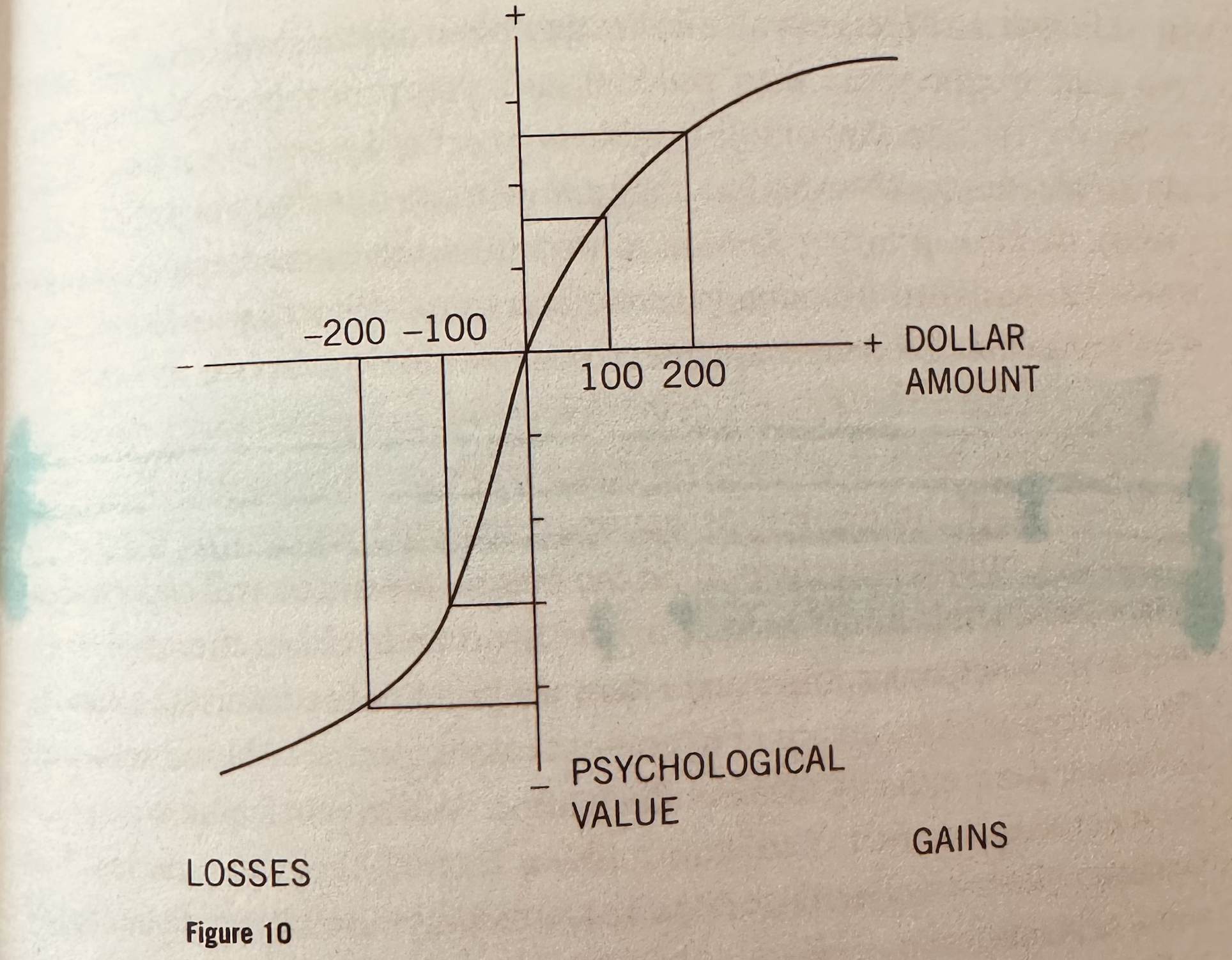
On page 283, there is a graph in an 'S' shape which shows us the 'value function' of prospect theory. There is a clear concave for 'gains' in which the curve rises quickly, then tapers. This would explain risk-aversion in gains. In short, a certain gain feels better than a risky one with equal expected value. There is also a convex for losses. It shows that the curve is steeper and curves downward less sharply. It explains risk-seeking behaviour in losses and how people prefer to gamble to avoid a sure loss. Finally, we can see that the graph is steeper for losses than gains, capturing what 'loss aversion' actually looks like when it's measured. This 'S' shape is quintessentially the base of prospect theory.
Prospect theory emphasises that reference points determine whether outcomes are seen as gains or losses. Kahneman is also able to show that they shift over time depending on expectations and experience and this, not the utility of the wealth like Bernoulli states, is responsible for concluding how framing affects reference points (p.284-5).
But, Kahneman also admits that prospect theory, like Bernoulli's theory, is not free of error. In fact, he states:
"Prospect theory and utility theory also fail to allow for regret. The two theories share the assumption that available options in a choice are evaluated separately and independently, and that the option with the highest value is selected. This assumption is certainly wrong..." (p.287).
Often sidelined by theory-blindness, Kahneman tries to analyse himself within the chapter. Be that as it may, he still sticks with prospect theory as the better of the two.
He concludes that prospect theory describes how people actually make decisions under risk: they evaluate gains and losses relative to a reference point, weigh losses more heavily than gains, and distort probabilities. It replaces the unrealistic rational model with one grounded in human psychology.
Chapter 27 is entitled The Endowment Effect. It describes how simply owning something dramatically increases its subjective value. Kahneman explains the psychological mechanisms behind the effect, shows experimental evidence, and contrasts it with more rational economic expectations.
Kahneman actually demonstrates that this effect is a consequence of loss aversion. This means that giving up something you own is coded as a loss and that acquiring something is a gain (so, we can see why retail therapy often forms out of these framings, it isn't about what you require - it is about gaining things in order to make yourself feel better). We can see that because losses loom larger than gains, people demand much more money to part with an item than they would pay to acquire it. Kahneman shows this with an experiment regarding an expensive bottle of wine:
"Prospect theory suggested that the willingness to buy and sell the bottle depends on the reference point - whether or not the professor owns the bottle now. If he does not own it, he considers the pleasure of getting the bottle. The values were unequal because of loss aversion: giving up a bottle of nice wine is more painful than getting an equally good bottle is pleasurable" (p.293).
Be that as it may, he also admits this effect is "not universal" (p.294). But he continues to also state that people feel a state of ownership within minutes of getting an item. This suggests the endowment effect is psychological, not sentimental. You don’t need a deep connection to the object; the mind attaches value because it is yours. The way poorer people tend to think makes this interesting for Kahneman to analyse in the state of trade and finance. Let's take a look at what he says about the poor, ownership and traders:
"People who are poor think like traders, but the dynamics are quite different. Unlike traders, the poor are not indifferent to the differences between gaining and giving up. Their problem is that all their choices are between losses. Money that is spent on one good is the loss of another good that could have been purchased instead. For the poor, costs are losses" (p.298).
So basically, traders don't adopt the same values that the endowment effect that others do. But even poor people don't adopt the same values when it comes to the universality of the endowment effect. When it comes to the traders, the people adopt an exchange mindset rather than a possession mindset and the effect weakens. But when it comes to the poor, the endowment effect doesn't work because "costs" become "losses" (p.298) This supports the idea that the endowment effect is strongly tied to emotional, loss-averse thinking.
In conclusion, people value things more once they own them because giving them up feels like a loss, and losses are psychologically far more powerful than gains.
Chapter 28 is entitled Bad Events and deals with what Kahneman explains how losses and bad events affect us more strongly than equivalent gains or good events. It is a central feature of loss aversion. The chapter explores the psychological asymmetry between good and bad, how this has evolutionary roots, and how it shapes choices, emotions, and risk-taking.
Kahneman actually states:
"...loss aversion is certainly the most significant contribution of psychology to behavioural economics..." (p.300)
Honestly, this is true because loss impacts us twice as much as gains do psychologically. I think Kahneman best explains bad experiences and disgust using the analogy by the psychologist Paul Rozin:
"...a single cockroach will completely wreck the appeal of a bowl of cherries but a cherry will do nothing at all for a bowl of cockroaches..." (p.302)
The human mind is more sensitive to losses, threats, and negative outcomes. Negative events produce stronger emotional reactions, longer-lasting impacts, and more intense memory traces than positive ones. But being highly sensitive to danger increased survival. Kahneman observes:
"Some distinctions between good and bad are hardwired into our biology. Infants enter the world ready to respond to pain as bad and to sweet...as good. In many situations however, the boundary between good and bad is a reference point that changes over time and depends on the immediate circumstances" (p.302).
This is why loss has a larger negative feeling than gain has in the equal positive. A loss of £100 feels worse than a gain of £100 feels good. Of course, our losses are not just about losing the thing - it is about how our brain is skewed towards pain and recognising it in what Kahneman calls 'negativity dominance'. He explains how this happens not just in humans but in the animal world when he talks about how animals included will try harder to "prevent losses" than "achieve gains" (p.305). This is all to do with holding territory and attempting not to lose it. He works this into how humans live their lives every day, but makes no comment on whether this is wholly a good idea or not:
"Loss aversion is a powerful conservative force that favours minimal changes from the status quo in the lives of both institutions and individuals. This conservatism helps keep us stable in our neighbourhoods, in our marriage, and our job; it is a gravitational force that holds our life together near the reference point" (p.305).
I am not sure that simply abiding by status quos is a good idea, but it is definitely a good reference point, which Kahneman talks about, which is also universally understood by many without being written down. Loss aversion is therefore, an unwritten teaching of society in order to keep us functioning as human beings. Maintaining the status quo is therefore just a small part of that.
It is also universally known that bad events create a much stronger emotional “shockwave” than good events and thus, it would take many more positive events to get 'better' from a single bad event. People often obsess over losses and quickly adapt to gains which shows why 'bad events' therefore have so much of a 'negativity dominance' over our minds. This discrepancy creates persistent regret, fear, and avoidant behaviour and in extreme circumstance, can foster depression and other mental illnesses.
Therefore, we can understand from this chapter that bad is stronger than good: human psychology gives losses and negative events far more emotional weight than equivalent gains or positive events. This built-in bias shapes our choices, pushes us toward caution, and explains many of the patterns identified by prospect theory.
Chapter 29 is about The Fourfold Pattern in which Kahneman introduces the concept of risk attitudes which describes how people behave differently depending on: whether the outcome is a gain or a loss and whether the probability is high or low. This combines loss aversion with probability weighting, our tendency to overweight small probabilities and underweight large ones.
The core ideas of the 'fourfold pattern' is that people underweight high probabilities and feel that losing the almost-certain gain is painful. But then again, a certain loss definitely hurts more. The risk-seeking behaviour shows us that people gamble for a tiny chance to escape the 'loss'. This would explain why people in debt tend to take large risks. People also overweight small probabilities and then combine this with the emotionally vivid fantasy of winning. The low probability gain also produces risk-seeking behaviour. Finally, people overweight the small chance of something terrible happening and prefer certainty over the probability of an unlikely catastrophe (p.310-12).
It's true that people don't have one complete attitude to risk and that Kahneman shows us it totally depends on context and reference point. Threat and bad events takes up more of our time and effort to think about, as Kahneman states this can foster system 2 kicking in for loss aversion techniques:
"When you pay attention to a threat, you worry - and the decision weights on how you reflect how much you worry. Because of the possibility effect. the worry is not proportional to the probability of threat. Reducing or mitigating the risk is not adequate; to eliminate the worry the probability must be brought down to zero" (p.316).
The attention of 'worry' therefore makes sure that we remain risk averse, but to take away all worry will not be possible until we have completely eradicated the risk.
Therefore, risk attitudes are not stable or rational and they shift in predictable patterns based on whether outcomes involve gains or losses, including on how large or small the probabilities are. The Fourfold Pattern reveals why people both buy insurance and lottery tickets, why they take reckless risks to avoid losses, and why real-world behaviour violates our knowledge of classical economic theory.
Chapter 30 is about something a little different to bad events, this time we are on Rare Events. It examines how people overreact to rare events whether they are positive and negative because of probability weighting and loss aversion. Kahneman explains why rare but dramatic events have disproportionate influence on decisions, often leading to mis-pricing of risk in finance, insurance, and everyday life.
Kahneman states:
"Overweighting of unlikely outcomes is rooted in system 1 features that are familiar by now. Emotion and vividness influence fluency, availability and judgements of probability - and thus account for our excessive response to the few rare events that we do not ignore" (p.323)
Basically, people assign much higher weight to low-probability events than warranted by their actual likelihood. But, in contrast, people treat very likely outcomes as less certain than they really are, which can lead to over-gambling or under-preparedness. So our two issues are overweighting and overestimation and though they are opposing in use, they both deal with the same psychological ideas. According to Kahneman, these ideas include cognitive ease and confirmation bias (p.324). This is because the overestimation and overweighting is more likely to happen when the alternative is less understood or specified (p.325). This is just basic common sense, but Kahneman is able to show us how it has been constructed in our minds, and how quickly it gets constructed.
Therefore, rare negative events are overweighted in combination with loss aversion, amplifying risk-avoidant behaviour but rare positive events are overweighted too, which fuels risk-seeking behaviour in gambling and speculative investments. This is because the human brain is wired to exaggerate rare events, both for gains and losses (p.328-9). And Kahneman's main point here is definitely that people overreact to rare events because they overweight small probabilities and amplify the emotional impact of potential losses or gains (p.323).
Chapter 31 builds on this with Risk Policies. It explains why people often make inconsistent decisions under risk and how adopting risk policies (general rules for decision-making) can improve outcomes. Kahneman shows that narrow framing (considering each decision in isolation) leads to excessive caution or emotional errors, whereas broad framing (evaluating a series of decisions together) produces more rational behaviour.
Narrow framing, Kahneman states, reveals something crucial about the consistency of human nature which he calls a "hopeless mirage" (p.335). This is because here, people tend to evaluate risky decisions individually, ignoring how they fit into a broader context. He goes on to observe that "the idea of logical consistency...is not achievable by our limited mind" (p.336). He gives us clear examples as to why depending on purely human judgement can lead to unfairness in justice and judgement and foster behaviours that are either risk-seeking or risk-averse depending on the human themselves.
Therefore, instead of isolation, viewing multiple decisions as part of a series smooths out the impact of losses. On top of this, Kahneman suggests creating general rules for risk to reduce emotional bias (p.336-7). This leads us on to why policy is a good idea. Kahneman observes that separating decision evaluators from decision experiencers (like in organisations) helps reduce bias (p.340). Policy eliminates risk wherever a "problem arises" (p.340).
Therefore, Kahneman teaches us a key thing about policies, why they are used and what they do for our decision making skills (or lack thereof). He shows us that individual decisions under risk are often inconsistent because of narrow framing and loss aversion. Adopting broad, rule-based “risk policies” reduces bias, regret, and irrational avoidance, leading to more rational outcomes over time.
Chapter 32 deals with Keeping Score and looks at how people engage in mental accounting. This involves separating money, outcomes, or decisions into distinct mental “accounts”. Kahneman shows that keeping score in separate accounts leads to irrational choices, because people treat the same monetary value differently depending on context. He begins this chapter with a key, by quite obvious, observation:
"Except for the very poor, for whom income coincides with survival, the main motivators of money-seeking are not necessarily economic" (p.342).
He's basically saying that apart from the very poor, people make decisions based on account-specific gains or losses, not total wealth. This often violates rational economic theory, which assumes money is fungible. Of course, we have learnt that human behaviour is not strictly speaking rational.
Another point made is that losses loom larger than equivalent gains within each mental account. And even though mental accounts "are not acknowledged in standard economic theory" (p.343), it doesn't mean they are not there. They are responsible for our extreme loss aversions when it comes to our finances. For example: a person may refuse a profitable gamble because it would “damage” a particular account, even though their total wealth would increase.
Kahneman moves on to the 'sunk-cost fallacy' which basically states that people continue investing in losing accounts to avoid realising a loss. The mind dislikes closing an account in the red because losses are psychologically amplified. Kahneman sums this up in statements relative to humans universally in our everyday lives:
"The sunk-cost fallacy keeps people for too long in poor jobs, unhappy marriages, and unpromising research projects..." (p.345)
This moves us on to the point of 'regret'. We find that mental accounts are not just financial, they can also be moral, emotional, or symbolic. Therefore regret is not just an emotion, it is "also a punishment that we administer to ourselves" (p.346) - something moral and symbolic. But Kahneman also states about regret that the intuitions of it are "remarkably uniform" (p.347) suggesting that there are familiar triggers and responses we can recognise for it. This is why Kahneman keeps hammering home the idea that even if the loss and gain are equal in amount, the loss will be valued and paid attention to more than twice as much. Again, we see negative dominance as we spend "anticipating, trying to avoid the emotional pains we inflict on ourselves" (p.351).
But, Kahneman also observes the idea that we can innoculate ourselves against regret by being "explicit about the anticipation of [it]" (p.352). The general theory states that if you were to know exactly how much you were to regret something before making further decisions after the fact, you may experience less of the actual regret and thus, negate the detrimental effects it could have on your overall wellbeing. Of course, this is about decision making and how much of a role regret may have in how we do that (p.352). Regret, in my opinion, is the worst and most horrifying of all emotions as it can lead you to make the most terrifying of choices - to perhaps end your life entirely.
Chapter 33 deals with explorin preference reversals. These are situations where people flip their choices depending on how options are presented or framed, even when the objective outcomes are identical. Kahneman shows that these reversals are a systematic violation of usual economic assumptions about our 'stable' preferences.
Reversals are caused by context-dependent evaluation. First we have narrow vs broad framing which is about comparing options together (broad framing). This changes perceived value, leading to preference flips (p.357). Another context is that of loss aversion. Again, small losses loom larger than equivalent gains. Reframing can make the same choice feel like a loss or a gain, causing preference changes. One more context is probability weighting. Once more, this is when people overweight low probabilities and underweight moderate/high probabilities. This means (and obviously so) that changes in probability presentation can reverse preferences. Finally, there is the emotional response factor, and emotional reactions amplify the effect of framing.
Another things Kahneman suggests is that preferences change depending on whether probabilities are described numerically or experienced through repeated trials. He does this by giving us some experiments to think through. It is well-known that repeated trials are worth more in truth than singular ones are, but to consider each in isolation may pose some problems. Though, Kahneman admits that joint evaluation also poses its own problems (p.361).
In this short, but informative bridge-chapter, we see that choices are constructed in the moment, and framing, probability perception, and emotional response can reverse preferences.
Chapter 34 regards Frames and Reality. It explores how the way choices and problems are framed (their presentation or context) can drastically alter decisions, even when the underlying reality is absolutely identical. Kahneman shows that people respond more to the mental frame than to objective outcomes, observing that perception often dominates reality in decision-making. The 2008 Fifa World Cup final with statements such as "Italy won" and "France lost" are used to show what we focus on, why and how we feel about it (p.363). They evoke different responses.
He also observes that this is a fundamental failing of our own minds. System 2, he states, is lazy and therefore won't seek to reframe something if there is no reason to. Most of us, therefore, accept a decision the way it has already been framed for us (p.367). He calls this being 'frame-bound' rather than vested in the reality of the situation. Kahneman takes this into our moral frameworks and evaluates them in an issue about pay and how the reference point impacts how you see the thing itself:
"You have no compelling moral intuitions to guide you in solving [the problem]. Your moral feelings are attached to frames, to descriptions of reality rather than to reality itself. The message about the nature of framing is stark: framing should not be viewed as an intervention that masks or distorts and underlying preference...Our preferences are about framed problems and our moral intuitions are about descriptions, not about substance" (p.370).
He shows us that frames define reference points, relative to which whole gains and losses are evaluated. Outcomes are therefore not judged in absolute terms; they are instead judged relative to expectations, status quo, or recent experiences. But still, it proves that people respond emotionally, not analytically, to framed outcomes. Fear, hope, and regret are amplified by framing, leading to preference reversals and inconsistent choices. But awareness of framing can reduce bias and improve decision quality - though we can't be rid of it entirely.
All in all, this shows that in most cases, reality itself matters less than the mental frame we impose on it.
Conclusion
I hope you have learnt something useful from this analysis on Part 4: Choices of 'Thinking, Fast and Slow' by Daniel Kahneman. Next time, we will be on our final section in which I will also, in the conclusion, introduce the next book we will be looking at. I'll see you next time for 'The Big Book Review'!
About the Creator
Annie Kapur
"Et in Arcadia Ego"
***
I am:
🙋🏽♀️ Annie
📚 Avid Reader
📝 Reviewer and Commentator
🎓 Post-Grad Millennial (M.A)
***
I have:
📖 300K+ reads on Vocal
🫶🏼 Love for reading & research
🦋/X @AnnieWithBooks
***
🏡 UK
Enjoyed the story? Support the Creator.
Subscribe for free to receive all their stories in your feed. You could also become a paid subscriber, letting them know you appreciate their work.
Comments
There are no comments for this story
Be the first to respond and start the conversation.