
The Big Book Review: "The Big Screen" by David Thomson (Pt.2)
'Sunset and Change'

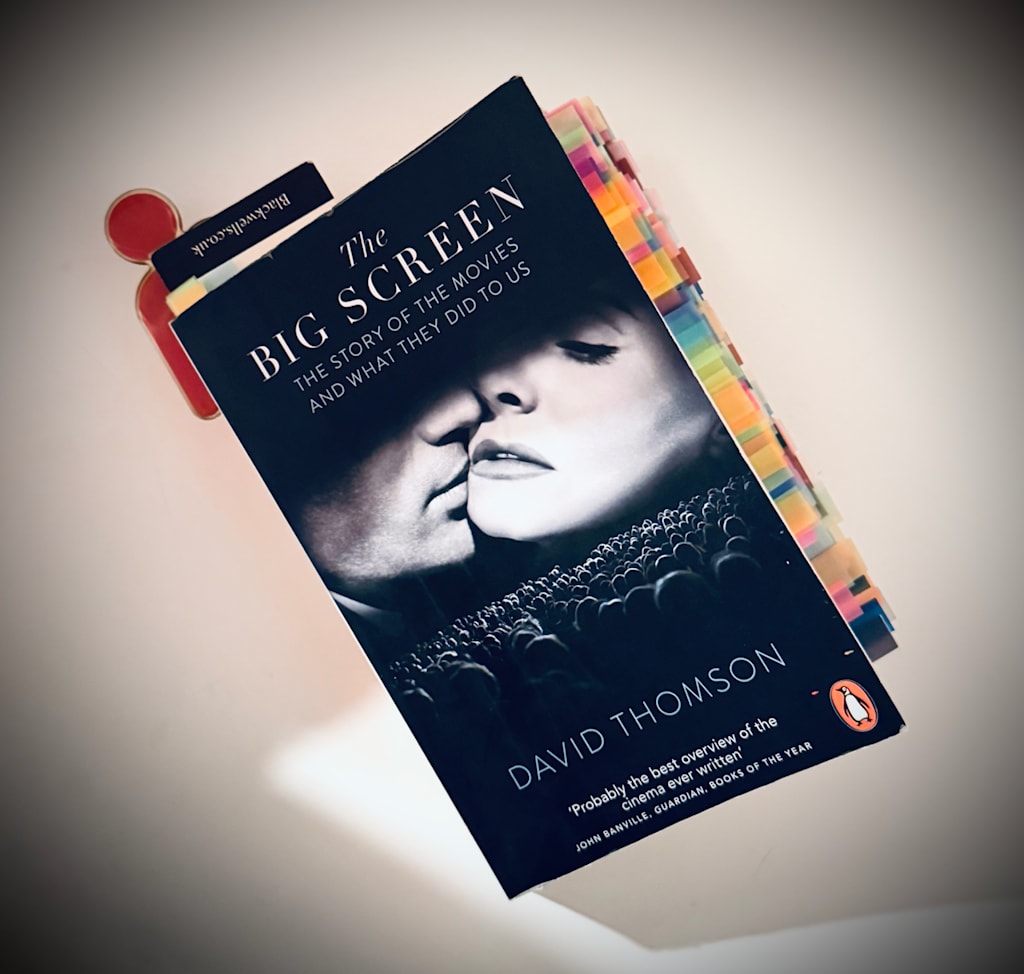
Welcome back to the 'Big Book Review' and this is part 2 of our series on The Big Screen by David Thomson. This, if you haven't read already, was a great book I read some years' ago. If you haven't read Parts 1 and 1.5 then I would go and read those first because even though this does go back and forth when it comes to film, there is an underlying timeline. Anyways, let's get on with it...
The Big Book Review: "The Big Screen" by David Thomson (Pt.2)
'Sunset and Change'
To read that David O. Selznick was looking for the next Gone with the Wind means that film are becoming a capital business instead of an art form. One thing I personally noticed was how Selznick over the course of our covered timeline has become less and less appreciative of the art of film and more and more about the money-grabbing:
"...by 1951 he was in debt, at a loss on how proceed and downcast. He pointed to the empty stages and told Hecht "Hollywood's like Egypt. Full of crumbled pyramids. It'll never come back. It'll just keep crumbling until finally the wind blows the last studio prop across the sands." Even in melancholy, he was still making pictures" (p.243).
And all of this has to do with money. It states that he was saying this in 1951, even though the book acknowledges the success of Hollywood movies in the year 1950 with All About Eve, The Asphalt Jungle and even films like In a Lonely Place (p.244). The book goes on to cover a man who would hopefully change Selznick's view of the on-coming 50s in Hollywood, Billy Wilder. The director of Hollywood's most self-indulgent movie, Sunset Boulevard. The book tells us about how the concept was developed from the influence of Hollywood movie stars themselves:
"Wilder imagined the role of a silent-screen star who is in retreat, alienated from the new Hollywood. She has a name full of echoes, Norma Desmond, and she lives in a mansion on Sunset Boulevard set back from the road, a lost world, Wilder was so clever but he wasn't right straightaway" (p.245).
Even though at the premiere, Louis B. Mayer told Wilder that he had disgraced the movie industry, it still became a huge film (p.247). But Selznick did have one thing correct even though the film industry clearly rose in audience numbers somewhat in the post-war era (p.248). The fact that televisions became more common in households meant that people were not going to the movies as much anymore (p.249) - this was by 1950 and so, the writer acknowledges the gloom of Selznick in that decade:
"Thirty million customers a week were gone in five years - a drop of nearly 40 percent. No wonder Selznick was gloomy that day in 1951; no wonder the studio was empty of work" (p.249).
Movies were now taking a backseat and it is not wise, according to the author, to look at the 1950s as a sort of "Norman Rockwell" painting (p.250) because there was more dissent from the 'classic' and 'traditional' cultures than ever - even before the 1960s wave came. But, the role of television was not just as an entertainment medium - it was a service:
"The penetration of our society by television would far exceed that of the movies, even at their best moment. Television became not an entertainment but a service, and when I speak of the role of a mass medium as a safeguard against disorder and fear, just conemplate a sustained interruption of electric light and Internet service in our cities today. Out of touch, we'd be plunged back into the dark. Chaos is so close and the panic is waiting. Television is nearer to electricity than it is to movie, yet we were all raised to believe it had us watching moving imagery, constant sound and programs or shows" (p.252).
This probably sounds quite prophetic today with our on-demand shows and constant onslaught of slop content. But back when this book was written, television was still at the top tier of entertainment as a medium in the world. It had destroyed cinema and so, the author takes us through the history of how it developed this way in the USA - starting with Samuel Paley and the creation of CBS. And then in the UK with the beginning of the British Broadcasting Corporation - or the BBC (p.252-54).
One of the concepts that the author takes aim at is the advertising cultures present on television stating that it would be silly to expect an advert between tracks on a CD or when you go to see a film, it would be odd to see an advert every 20 minutes (p.255). The television culture of adverts is therefore strange and is connected to the former idea of 'state cinema' (p.254) the author has discussed in previous sections.
Television then begins to dominate the living space of a room where things like fireplaces might have been before and therefore, they interrupt things like conversation and/or gameplay (p.256). During the 1960s, there were many hours taken up by watching television and the book discusses the show I Love Lucy as one of the most watched shows on this device. It became such an important piece of the home by this point that the author states: "we put the television 'on' in the way we turned the lights on" (p.257). Televisions now not only dominate the living space, they are the living space. This has changed in only about a decade or so. Again, no wonder Selznick was so gloomy in 1951. God knows what he thought of the 1960s when television became the main form of entertainment - surpassing cinema by a flying mile.
Of course, covering I Love Lucy and the life of Lucille Ball, the star of the show, is probably the best way of summing up comedic shows on television - it was basically the start of what would become the 'sitcom' genre (p.258-64). It may have not been to everyone's liking (the author makes some reductive comments about comedic television shows, and Susan Sontag is not a fan of the show according to the book), but it was still a huge show with a huge audience which made Lucille Ball a household name with a constant cycle of work. The last one is something film could not provide.
There was another thing that film could not provide and that was the up-close bravado of Las Vegas. It was theatrical and allowed the audience to get lost in the terrors of fame. The author rightly calls it an "assault on nature" (p.265).
The author covers the way in which Las Vegas was not meant to fit in with the rest of America, it's almost like an amusement park for Americans. The author states:
"Las Vegas was noir in neon colour before film noir had dared reach that far. It was first decades, a site of brief but deliberate escape for the common, huddled America, a destination where working class and lower middle class tourists could come along for a long weekend, inhabit an unimaginably large hotel room at a low rate, gamble, get a hooker (or gaze at women who might be hookers), and believe they were brushing shoulders with gangsters and their dames. It was not so far from a movie" (p.267).
He calls Las Vegas a "parody" of Hollywood, which is probably correct but Las Vegas was also a longer version of a movie, which unfortunately when you're gambling, has some real-life consequences.
But what is it all about? It's about the new money of Hollywood, the new economy of the entertainment industry. Las Vegas made far more money than the movies and comedy television was, as the author suggests, easy money for studios and lengthier work for actors. Another form of money-making in Hollywood was star quality. No longer actors just actors, they were movie stars. Questionably, the author states that the first of these great movie stars to make real money (I mean real money) was Jimmy Stewart. His friendship with Lew Wasserman made for good business when it came to cinema (p.273).
And thus, acting became a bigger business as the industry and its requirements grew, we move into a realm called 'method acting'. Something that people today don't fully understand since they think there is only one real method which was made famous currently by Sir Daniel Day-Lewis. However, there are quite a few. This book unfortunately goes through the most famous of them: the Stanislavsky Method of Neorealism (p.276-77).
If you're going to talk about neorealistic acting then you have to mention Humphrey Bogart's name and that's exactly what the author does. He mentions the friendship between Bogart and Nicholas Ray, which like Stewart and Wasserman, was a very lucrative friendship (p.280-1). But perhaps one of the most important points on this topic is when the author covers "the only film ever directed by Charles Laughton" - The Night of the Hunter (1955) (p.284). In my opinion, this film is quite frightening if you go in knowing nothing about it - especially that song he keeps singing.
But eventually we move into neorealistic cinema of the horror genre - the films of Alfred Hitchcock (p.287). Apart from coming to America and not enjoying working under the "dictator" Selznick (p.288), Hitchcock came into his own when directing Notorious since Selznick's time was taken up with something else (p.289). It was next that he went to find Grace Kelly - one of the famous Hitchcock-blondes. We get taken through several of the famed Hitchcock films including Rear Window and the "box-office flop" which is also one of the greatest films ever made, Vertigo (1958). What we can learn is that Hitchcock was a master of "layers of performance" (p.290-1). In my opinion, his best film from this era was Strangers on a Train which has these maxims as well.
But within the realm of Hitchcock movies, we are focused on the acting. We are focused on the presence of the actors and thus, we get a small amount about how Marlon Brando would copy the mannerisms of people he had only recently met - not mocking them, but probably not even consciously realising it (p.293). It is here that the author states that "screen presence [is] being talked about for the first time" (p.296). But it was also then when great actors of the first generation of cinema were beginning to die. We get this extensive list of deaths which I read as fairly depressing (p.298). But there is no greater movie star, nor most devastating movie star death than the person the author goes through in extensive detail next: Marilyn Monroe (p.299) and the author makes a point of telling us very clearly that "Marilyn Monroe was never in charge" (p.300). She would die in grief with her name attached to the Fox company, with her death casting a weird shadow over her movie career even though she was a fantastic comedienne.
From covering Kurosawa's career to that of Truffaut, the author works up to the creation of 'New Wave' cinema (p.302-5). He states that Robert Bresson did not want "beautiful images", he wanted "necessary images" (p. 306) - covering the way in which Bresson wanted these images in his film Diary of a Country Priest. It is a really good film and definitely shows us how cinema was going in an entirely new direction, or at least trying to. This is running simultaneously to the way in which Hollywood was trying to beat the television and how Hitchcock went to Hollywood trying to make his movies without the overpowering Selznick trying to crush him under his money-grabbing thumb. But when it comes to the way Bresson worked in minimalism to his New Wave movies and so, rightly the author refers to it as a "skeleton of a film" (p.307) - but I do think the film is probably the better example of a minimalist movie.
Covering the career of Max Ophuls is the next step for the author - Ophuls is regarded as a failure in American film history (p.308) and so went to France (p.209). But when the author seeks to see the ideas of Bresson and Ophuls, he states that there are ideas that meet though they aren't the same in their substance:
"Bresson and Ophuls could hardly be further apart. Yet in their different ways, both had reached a point of seeing that the old cinema not simply was in decline, but might be a reflection of a decline of civilisation itself" (p.310).
Of course, when it comes to existential dread in cinema, nobody does it quite like Ingmar Bergman (p.311) and there's no film quite like it like The Seventh Seal (1957) (p.313). But it was also the way in which people were taking films more seriously as philosophy and education. The Seventh Seal (1957) may have been one of the first ones, but definitely what the author states about Anatomy of a Murder (1959) should concern a lot of people:
"Innocent viewers believed the show was educational, in that it gave guidance on how trials worked, and of how reliably justice was done" (p.317).
And so, the seriousness of cinema was both a blessing and a curse. Hollywood was changing and so the audience must change with it. This is something Francois Truffaut (p.323) knew very well as a man who practically lived for the movies. But it was Jean-Luc Godard who would enter the Sorbonne to study but then, spend most of his time watching movies (p.327). The author states:
"The Godard films of the early 1960s are a compressed history of the medium, and revivals over the years have usually played well with these new audiences. It is fanciful...to claim that any body of work since has surpassed it..." (p.334)
And there are few people you can talk about when it comes to artistic ability and the 1960s other than Andy Warhol (p.339). Godard may have captivated the new audiences, but Warhol confounded them. I would say that Godard was the architect and Warhol was the magician. The fact that Andy Warhol comes directly after an analysis of how the Zapruder film had an impact on filmmaking should tell you something of Warhol's role in developing realism. I personally don't like watching the Zapruder film, it makes me feel a bit sick and sad.
But even if working with Andy Warhol was exhausting as is written, I have read enough about Warhol to know that many people actually adored him in real life. There is one thing that all of these 1960s artists seem to have in common with each other (even Warhol who thought he was so different and out-there): the role of "existential disquiet" (p.345) seems to have the centre stage at this point.
Conclusion
You're probably thanking god that this article is shorter than the last one. But by the 1960s, we can definitely see how everyone starts to take film more seriously as an art form. The first generation of movie stars have died and Hitchcock, Bergman, Godard and Warhol emerge as people who are exploring it as the artists of the movie, with the 'method' actors working in the foreground.
Next time, we'll explore the next section entitled: Film Studies. In which film becomes an area of thought, study and philosophy.
About the Creator
Annie Kapur
"Et in Arcadia Ego"
***
I am:
🙋🏽♀️ Annie
📚 Avid Reader
📝 Reviewer and Commentator
🎓 Post-Grad Millennial (M.A)
***
I have:
📖 300K+ reads on Vocal
🫶🏼 Love for reading & research
🦋/X @AnnieWithBooks
***
🏡 UK
Enjoyed the story? Support the Creator.
Subscribe for free to receive all their stories in your feed. You could also become a paid subscriber, letting them know you appreciate their work.
Comments
There are no comments for this story
Be the first to respond and start the conversation.