
The Big Book Review: "The Big Screen" by David Thomson (Pt.1.5)
'The Shining Light and the Huddled Masses' - "Renoir" to "Sing a Noir Song"

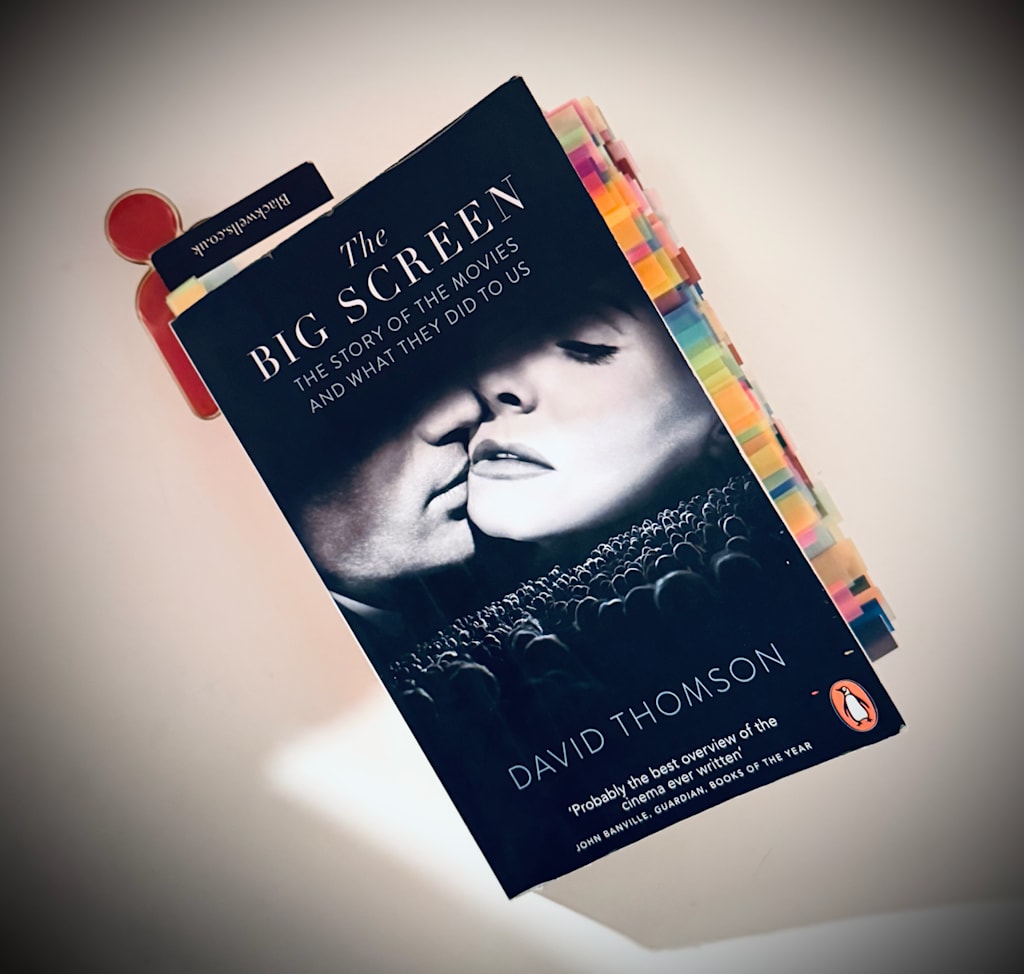
Read part 1 above...
***
Welcome back to the second part of the first section of The Big Screen by David Thomson. My decision to split these two sections of the same part up came from the simple thinking that the first article of this book review series got a bit long and, at almost 5'500 words I don't think you would read it all if it were any longer. I can't make it too much shorter either because this is called the big book review after all. It's not called big for no reason. So there you go, there's my introduction.
Let's continue...
The Big Book Review: "The Big Screen" by David Thomson (Pt.1.5)
'The Shining Light and the Huddled Masses'
Chapters: "Renoir" to "Sing a Noir Song"
'Renoir'
Thomson explains Renoir's position as a difficult one as he was the son of a painter who clearly loved the paintings more than the family he was the patriarch of. Apart from artistic influence, his father seemed rather detached from his family. This is even though the paintings in which Renoir is present are the image of the "perfect childhood" (p.142). Be that as it may, Thomson also explains that the family maid is the one who introduced Renoir to film - he did not enjoy it apparently (p.144). The very presence of a family maid, I believe, is indicitive of probably not the perfect childhood but perhaps one that was better than most children of his own time for obvious reasons.
We are introduced to Catherine, the apparent love of his life (who's real name is not Catherine), a woman who looked like an American movie star (p.144) and when she was once in Jean Renoir's films, she was attested to be thoroughly average because of the films' failures. Ultimately, he would not cast her but another actress, something she was not happy about (p.145). It was not his decision to recast her, but he had to yield to higher pressures. When recounting his time in which his happiness seemed to have died, Renoir would state that cinema, to the both of them was a "jealous god" (p.145).
Renoir made La Chienne and of it, came praise and money and success, things Renoir had thought about for some time in his early career. Thomson states of Renoir:
"In Renoir, that urge exists...but an ironic distancing still prevails. We feel we are being shown a story. We feel the intelligence and direction. We feel the irony..." (p.146).
He also states of his movies this seemingly contradicting statement (though the more you think about it, the more you see it is a possibility - however only slightly possible - rather than an impossibility):
"No judgement is called for. No certainty is offered about the proper way to live..." (p.147)
He hurtles ironies at the middle class, making them satirical versions of themselves. And yet, throughout his movies which seek to reveal the "illusions of depth" (p.148), he still believed in the length of film being that of the shorter kind (p.149). I personally believe that this was probably best for Renoir's time and film, but I would love a movie to be intense, immersive and involved. The best ones always are. In my opinion (and just my own opinion, others may think differently) I have never been able to immerse myself in the movies of Renoir. I do not, however, have a bad comment to make on his filmmaking style. His films would often reflect himself, even if there was harm involved (p.152-3) in the making of these movies. The harm was real, and that to us today would be quite distressing.
***
'American' and 'Ambersons'
Orson Welles is described by Thomson as an "expert" and a "magician" (p.156) whilst also probably being the closest person to Charles Foster Kane if not for Hearst. Any film student worth their salt has seen Citizen Kane numerous times and knows that (even in Thomson's own words) it is "crammed with unbearable feelings" (p.156).
Thomson describes the beginnings of Welles' endeavour into the world of Charles Foster Kane as one wrought with back and forths in which Welles would first want to make Heart of Darkness but move on to a film he would start by calling American. We all know how this turns out:
"Welles' plan was to make a picture - it was to be called 'American' at the outset - based on the idea of a great American press lord..." (p.159)
Thomson argues that it is almost obvious that Welles himself would play the lead character, not only because it was decided in advance, but because of the very mannerisms that Welles possessed in real life:
"...the way Orson talked, breathed, laughed and lost his temper, energised the script. Kane became a great role because it had its essential actor" (p. 160).
It is quite shocking to me that the film itself made no real waves in the business. It is described by Thomson quoting Pauline Kael as not really being 'triggering' (in our modern terminology) in the way that Orson Welles had hoped it to be upon one William Randolph Heart. But it was not really remembered in the coming years, nor did it win Best Picture. Finally, it didn't actually leave Orson Welles much richer afterwards either (p.162). It seems to have been a passion project that was revitalised because of its subject and of course, those brilliant montages and film techniques. It seems like the man, Orson Welles, was far more fascinating that Charles Foster Kane ever was (p.163).
However, the author definitely credits Citizen Kane with bridging the gap between "German expressionism and American film noir" and of course, we know that "noir just mean existential agony" (p.164) according to Thomson. I find this a good observation that seems to tie up any misunderstood loose ends about what noir actually deals with. It seems to me that this is the one genre of film that is misunderstood the most. So when it comes to film noir, it would not be Citizen Kane that was hailed as the best, but Touch of Evil (p.165) which was successful in displaying what noir truly meant.
So even though Orson Welles did make a movie we regard as great, from what I can understand of the critique Thomson makes of the movie, he implies that it is (quoting Pauline Kael again) "a masterpiece, but a shallow masterpiece..." (p.166)
*
It was true that Orson Welles is probably best remembered for his incredible performance in the movie The Third Man (1949) - one of my personal favourite films of all time. He gives a magnificent speech about the cuckoo clocks, he makes a rather threatening (though overly friendly) character riding a ferris wheel with his adversary/friend. Though, he also directed a movie called The Magnificent Ambersons, which would go on to win a fair amount of awards - including Best Picture at the Academy Awards.
However, Thomson does admit that after the first seventy-five minutes or so, including the soundtrack, the film "curls up and dies" (p.168). The movie was described as "long, dark and depressing" and in 1942, would "open to failure" (p.169). One thing I understand about the different cuts of this film is that there are many 'legends' to Orson Welles that many of us who weren't a part of that world would not understand. Thomson describes Welles as getting "into fights when he should have backed down" (p.169) and eventually, he had overstayed his welcome elsewhere and should've "returned to Los Angeles" (p.169) whilst he still had the chance.
A classic egocentric man who is a product of the American Dream and downfall - someone who starts everything, can never finish it and leaves without giving us a map of where we should find all these things or what we should do with them once we do. Unfinished, packed full of stuff and all of it unusable - just like Xanadu.
***
'Howard Hawks: The 'Slim' Years'
Thomson's story of this director starts with a woman called Nancy Gross who meets Howard Hawks and "they were soon in love" (p.171). Of course, Hawks was already married but his wife was not well and that means, if you're a man anyway, you don't take care of her - you go an womanise instead because your carnal instincts tell you to. In my personal opinion one of Howard Hawks' great faults was his lack of actual skill, it could also be seen in his questionable character and morals, but that's a conversation for another time.
To Have and Have Not was perhaps his biggest success and of course, that had nothing to do with him but rather of the phenomenal talents of Humphrey Bogart and Lauren Baccall (p.172-3). Whilst Hawks and Nancy were busy calling each other 'Steve' and 'Slim', Baccall and Bogart fell in love which kind of surprised Hawks (p.173). At the same time, 'Slim' knew she was fighting for the attention of Hawks whilst he was still technically married to his sick wife. She would call him a complicated man who "tried to make everything as smooth as his camera style" (p.173).
Then again, she was not blameless, she would go on to have an affair with Ernest Hemingway and Montgomery Clift (p.174). This to me, basically the life of Howard Hawks and Nancy 'Slim' Gross. It is filled with affairs and the requirement to make everything 'smooth' but in reality there are few films that are worth remembering (this is just my opinion). Even though Thomson describes him as "(defying) the ordinary and (celebrating) fun" (p.177) he was still an avid gambler, a questionable person and somewhat horrid to his wife, who didn't deserve the treatment she received in this turbulent marriage.
***
'Films Were Started'
This chapter is about British Cinema and of course there will be numerous references throughout the chapter to Alfred Hitchcock. Thomson describes the early experiences of British Cinema as restrained:
"There was an English skepticism that reckoned it was 'silly' to look like Errol Flynn or Hedy Lamarr" (p.178).
We get to revisit Viriginia Woolf's "disdain" for cinema and investigate the fact that Graham Greene's own father told him to watch the Tarzan movies in order to learn things - only to realise they were not factual in the slightest (p.179). But apart from looking at the old filmmakers of early cinema and a few more mentions of Alfred Hitchcock for good luck, Thomson moves on to describing the life and times of Alexander Korda, how he eventually came around to making The Private Lives of Henry VIII and essentially made a star of Charles Laughton (p.181).
However, apart from Korda who would never see a success like The Private Lives of Henry VIII ever again, there was another way to get successful in the film industry. Thomson takes us on a journey through the life and career of Michael Balcon, the Birmingham-born filmmaker. In the 1920s, he would form 'Gainsborough Pictures' (p.182) and would go on to make films with Alfred Hitchcock in the 1920s. We see the way in which he changed slightly, transformed a little by a certain story:
"Balcon trusted only modest budgets and simple, suspenseful stories, but he is the producer who let Hitchcock rewrite John Buchan's The Thirty-Nine Steps, introducing female characters and a kind of voyeurism that still seems saucy" (p.182).
This is honestly a pivot and I think Balcon was correct in making it. The Thirty-Nine Steps is an excellent film, even if it does differ from the book. Eventually, he would also go on to work with John Grierson and with him, would formulate a British style of documentary and social criticism (p.184). He would then work with Humphrey Jennings on the documentary Fires Were Started. Jennings would be a critical documentary maker during the war era (p.185).
But of course, the chapter would not be a chapter about British Cinema if it did not cover the life and career of the great David Lean. I personally believe that David Lean was more than a filmmaker, he was in fact one of these people that the author keeps referring to as "magicians" of the screen. David Lean was a magician. The author argues that Lean's best movies were made in the 1940s (p.187) and yet, I seek to disagree. His 1960s output is far more intriguing. Though if you do want to understand Lean, you must look back to the 1940s.
Carol Reed is another British filmmaker who is covered quite a bit in the chapter. Of course, Reed is the director of The Third Man (1949) and it is here were we get that explanation of Welles' greatest output being the one that Carol Reed directed (p.188). But after this, Thomson quotes to state that "The fun had gone out of the film industry" (p.188). I see this to mean that as British film became more commercial, it was subjected to this same mass-marketing paperback-bin style churning which almost sent The Third Man (1949) on its way if it weren't for Orson Welles - the only American they would listen to (p.188).
British film was promising therefore, until it no longer was. Nothing lasts forever. We know that.
***
Brief Encounter
"...was British restraint modest, brave and civilised or did the British really feel so little?" (p.191)
Well, Thomson here is talking about the display we have in the film Brief Encounter in which the audience experience part of the "hysteria" and "dysfunction" of the story. It seems to me that this film pays attention to this dysfunction as it was inspired by real life. In real life, for example, David Lean was a serial womaniser.
There is not much to say about this film and its short chapter other than the fact that affairs in real life, including those of David Lean and Noel Coward were more interesting than the ones on film, but also may have inspired all the different aspects of secrecy and dependency they tended to.
It is still considered one of the greatest British films ever made and tends towards the aspects of female sexuality that other films, both in our own country and in America, were still too scared to explore (p.192-4).
In my personal opinion though, Brief Encounter is not a movie important enough to dedicate an entire chapter to. But that is for another time.
***
War
A chapter about the impact of the Second World War on cinema begins with Speilberg's movie Empire of the Sun starring the then child-star Christian Bale (p.197). This is where I have to critique the author because this throws off the reader a bit. This chapter is about movies from the Second World War era, but rather begins with a film which tells the story of the Second World War. It is jarring if you yet don't know what angle the chapter is going to take.
So far as the movie industry did not 'know' they were making propaganda and thus, couldn't be held accountable for how people felt about the films (as we have seen depicted in the other chapters), we have an entirely different opinion of film here. Thomson shows us how the industry changed because of the war:
"We know well enough that opposed government produced films to "raise" morale, to make the war seem winnable and necessary. But the cinema itself - the place and its community - was just as important as air-raid shelters" (p.198).
So in the end, it was about propaganda. It was always about propaganda as in my opinion, cinema is simply one big propaganda machine. Movies aren't magic - they are really long adverts for philosophies of people who make a lot of money to tell you how to think. It has only got worse over time with the 21st century era of movies being so on-the-nose that many people would not be able to argue against my point. Even Thomson shows that he can't argue against my point with his implication that Hollywood's attempts to become earnest and moral just made the entire industry seem "fatuous" and idiotic (p.200). This is basically what has happened in the 21st century to cinema - too much of it is preachy and ridiculous rather than entertaining and, as Thomson pointed out in a previous chapter: simply "bliss".
But Thomson also admits that "no one dreamed of 'Casablanca' becoming the war statement it became" (p.201) as if to state that Casablanca was first and foremost a war statement at all and not at first glance, a lesson in great acting by the stellar cast which included some of the biggest names from USA and European cinema. As you can see, I have a problem with how this chapter is worded. Yes, it is propaganda, but it isn't pointless propaganda - it at least entertains the audience first and then moves on to its "war statement".
But he does admit that there was help from Hollywood for the war effort, again an exercise in propaganda. He states that women like Bette Davis were into organising foods and men like Jimmy Stewart and Clark Gable joined the army (p.203). I mean if your average man saw stellar stars like Clark Gable and James Stewart putting on the military uniform, they definitely would start believing that the war would be "winnable". We know in the 21st century that it is rare as unicorns for Hollywood to do anything in earnest - everything that comes out of that place is propaganda. Everything. A lesson that the audience of the 1940s would have done well to learn instead of getting themselves blown up because 'Mr Smith Goes to Washington' joined the army and they wanted to be cool too.
Thomson admits that the realities that came out of the war were very different to how they were depicted on the screen and in these "realities" (p.203) (as he calls them), nobody ever wins in war - they just all lose at different rates. Jean-Pierre Melville (p.205) knew this in France where the war had "devastating" effects (p.204). His films understood the darkness and the character it took to create something believable. However, Thomson also acknowledges that the later Hollywood films regarding war had another job to do, which might be more important than anything else for the industry:
"War films today have yet to deal with the public's loss of faith in movies themselves, and the comical yet hideous notion of how tidily battle can be handled..." (p.207)
We know today, long after the publication of this book, that the public has pretty much lost its faith in the industry of cinema, if they haven't lost their faith in the finished product. Movies themselves are still an art form, but the industry is destined to fail if they keep treating such devastating impacts upon the human condition with 'comical tidy' uncertainty.
All war on cinema is a projection of the Hollywood machine: it is a complete misunderstanding of war itself, and it only gets worse the further we move from it in time. Should Hollywood just stop making war films?
***
Italian Cinema
Italian cinema was initially formed out of the war and began its trip of neorealism from then on. But how do we define 'neorealism'? Thomson describes it to us in an extensive quotation which reads:
"Realism and fantasy, like the entire history of film and screens, is the story of personality and circumstances making their imprint on action. So 'Italian Neorealism' is a label, part of the marketing hype of the movies" (p.209).
And there we have it, another aspect of film propaganda, but at least this one admits it. But learning that Mussolini was the man who basically started the Venice Film Festival was a fact I did not know and yet, it makes perfect sense (p.210). What better way to get your propaganda out than to create a festival for movies in which you award the industry itself for how good the propaganda is?
The author goes through the lives of Poggioli and Visconti, possibly two people who were the most important for forming how we understand Italian Cinema today (p.210-12). Visconti was important as well because the author seeks to emphasise that even though Mussolini was in power, the filmmaker had left-wing views, thus came into a clash with his country's base values. Though, he didn't leave Italy at all (p.211). This is indicative of someone who wants to create propaganda for the opposing side. Working with Jean Renoir was not a mistake and he even got himself into an important book about film. Was he in any real danger of arrest and/or execution? As a filmmaker who's success was wavering at best, probably not. Self-indulgence in art is therefore, not without its political backdrop. Not even for the opposing politics.
It would be Roberto Rossellini, the "lively opportunist" (p.213) who would eventually work with Ingrid Bergman with devastating results to their private lives (p.224-5). She would leave her child and husband to live with him, they would have children (one of which is the actress Isabella Rossellini) and then, they would drift apart. This would leave Bergman's image in tatters and she would not work in Hollywood for a long time as she had tarnished her image of being a sweet, moral woman with the fact that she had such a private life. Rossellini on the other hand, well he wasn't much better off as he didn't have very much grand success above being a man involved in neorealism.
Bicycle Thieves is admittedly one of the most important films in film history, let alone in just Italian film history. It is by a flying mile, the greatest Italian film ever made. It is important as Thomson states "no relief comes from the film" (p.219) - and the audience have no idea what is going to happen once it ends. It is an episode, a moment, a mistake - it is not a lifetime and so, our attachment to the father is left on a cliff's edge.
Being deeply tied to its history is one thing, but Italy was so changed by the war that its movies often reflected their anger, their politics and their rejection of fascism. When it came later, to Pasolini, Italian cinema had finally come to competing on the world stage. In my opinion, Pasolini is possibly the bravest filmmaker to ever grace the studio. Of course, for his output - Pasolini was brutally murdered.
***
Ingrid Sees a Movie
A chapter about Ingrid Bergman is absolutely required when you are looking at the history of cinema. It simply cannot be done without her. She is by far, the greatest actress to ever appear in film in my opinion. Thomson describes how Kay Brown went to pick up Ingrid Bergman and bring her to America and it was immediate that she was noticed as quite tall and naturally beautiful (p.223).
Of course this is where we get the meeting of Bergman and Rossellini (p.224-5). The affair was torrid (as I discussed in the previous section). But it is important to understand why it was so public and it wasn't just because the notion that Bergman had left her husband and child for him (p.226), but also because it was around this time that people (meaning the general public) also became more interested in the public lives of actors. A type of 'celebrity culture' was forming. Thomson describes the relationship:
"The Bergman-Rossellini story played out as scandal and tragedy, but with the benefit of time, we must see it as a farce too, and the comedy begins with the tangle of opposed desires..." (p.225).
After the relationship's spark began to die, Ingrid Bergman was of course, shunned from Hollywood (as she was the woman and his erratic behaviour was left unaddressed even though she was also clearly the more talented one of the two) (p.227). Bergman's split from Rossellini was so public that she basically had to crawl her way back to Hollywood and only when she was middle-aged, could she have another shot at it.
At least she got a second chance. The same cannot be said for many women in her position.
***
Sing a Noir Song
Starting with the film New York New York is probably not the best idea when you're again, stil focused on an entirely different era at hand (p.227). I understand Thomson's point of view, but it isn't interesting in the slightest and probably doesn't illustrate his point as well as he thinks it does. He is perhaps correct though to state that Noir entered the public consciousness from France. I think this is rather obvious given that the term 'noir' is a French word. Nonetheless, the author gives us the different ideals that depict what 'Noir' truly is: "oneiric, strange, erotic, ambivalent, cruel" (p.228). These are illustrated with a movie that shows us how the noir aspects of the film play out in front of us, though they are brief, they definitely do the job better than beginning the chapter with a seemingly partially relative movie.
We are taken through many films including Woman in the Window, Sunset Boulevard and even Psycho, in which we explore the culture developments which led to the noir genre becoming more popular in the USA.
The chapter also looks at the rise of the technicolour musical as being an "inevitable" result of the talkies and mentions in detail how The Jazz Singer basically lifted everything off the ground. In this, of course we get an in-depth analysis of the career of Judy Garland, especially on the set of Meet Me in St. Louis - which was a fantastic musical directed by a man who would become her husband, Vincent Minnelli (p.235-7). But Thomson also acknowledges that by the time the musical died, there was an unreliability about Judy Garland (who was near her death) and of course, Fred Astaire and Gene Kelly were ageing quickly (p.238). There was no way it could survive the turning tides with the younger generation believing that musicals were too sentimental.
Conclusion
As we move into Part 2: Sunset and Change - we will see exactly where Hollywood and movies went next. I'm glad you've got this far if you have and I promise you will not be disappointed. If you're following along then I'm glad to say that the next part will be done in one article as it is a bit shorter.
About the Creator
Annie Kapur
"Et in Arcadia Ego"
***
I am:
🙋🏽♀️ Annie
📚 Avid Reader
📝 Reviewer and Commentator
🎓 Post-Grad Millennial (M.A)
***
I have:
📖 300K+ reads on Vocal
🦋/X @AnnieWithBooks
📸 ThePrancingPonyBakery
🔗 PrancingPonyBakery.com
***
🏡 UK
Enjoyed the story? Support the Creator.
Subscribe for free to receive all their stories in your feed. You could also become a paid subscriber, letting them know you appreciate their work.
Comments
There are no comments for this story
Be the first to respond and start the conversation.