
The Big Book Review: "The Big Screen" by David Thomson (Pt.1)
'The Shining Light and the Huddled Masses' - "A Cheap Form of Entertainment" to "France"

Sorry about the lateness, this one went through a LONG editing process...
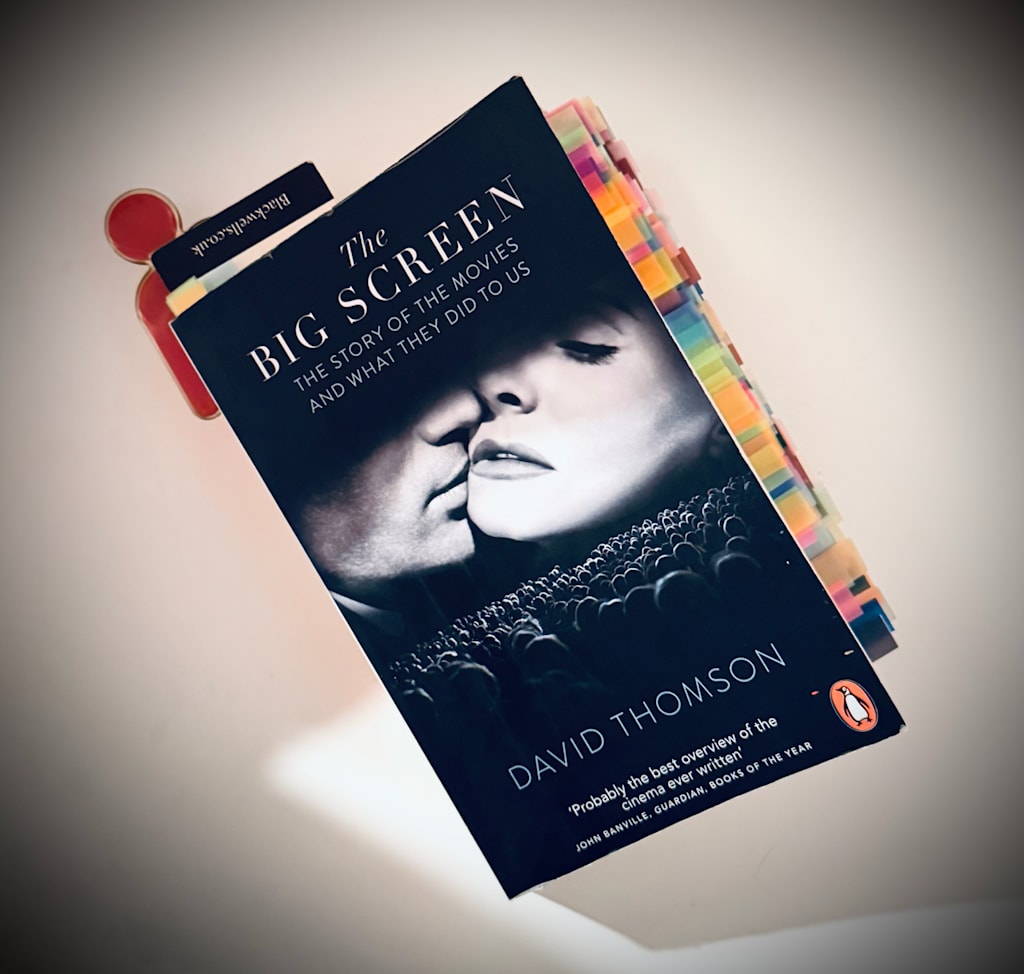
Welcome back to 'The Big Book Review' and now that Thinking, Fast and Slow is over, we are moving on to a favourite of mine that I once read whilst in university some years' ago - David Thomson's The Big Screen. It is a book about the history of the movies and we will be following the 'parts' the book is split into (with some splitting of the first since it is so long). The first section is entitled The Shining Light and the Huddled Masses and goes back and forth over the USA and Europe to analyse how movies were born and why. We will be covering the chapters A Cheap Form of Entertainment all the way to France. That is the first eight chapters.
The Big Book Review: "The Big Screen" by David Thomson (Pt.1)
Part 1: 'The Shining Light and the Huddled Masses'
Chapters: "A Cheap Form of Entertainment" to "France"
A Cheap Form of Amusement
Thomson frames early cinema as an extension of pre-existing amusements (vaudeville, carnivals, street curiosities) arguing that film began not as art but as novelty. This can be seen in a quotation he uses from two men discussing the future career of Mary Pickford (who went on to become the 'First Lady' of American Cinema):
"The poor kid is actually thinking about taking up moving pictures seriously...I remember what faith you had in her future...and now she's throwing her whole career in the ash-can and burying herself in a cheap form of amusement." (p.15)
It was William de Mille, older brother of Cecil, who said this to Dave Belasco. It would be Mary Pickford in her autobiography who called cinema 'sunshine and shadow' (referring to the way in which cinema can tell various stories of various different things in the same film).
This is where we start off in the world of cinema, navigating the two sons of a preacher (the de Mille brothers) and a stage actress once named Gladys Smith who went on to be 'Mary Pickford'. But, movies were a business and Thomson definitely gives us a taste of what that looks like by taking us through the life of Louis B. Meyer - founder of MGM Studios. Thomson describes him as "barely educated" but someone who was clearly the smartest person in the room. He is also said to have a "cruel side, a violent temper, an unbridled ego" (p.16). But, he did build the Orpheum at the end of the day. We can see that early cinema offered opportunities to individuals from modest backgrounds as every major figure in the business was said to have come from this similar background of nothingness at this time. A background like Louis B. Meyer's.
Eventually, we move on to the story of one of the most controversial films ever to grace the screen: Birth of a Nation by D.W Griffith (p.18). We then get the background and life of this strange director, looking at his years working at Biograph and noting that "directing was still a stooge's job" in around 1908 (p.18). But, apart from this, I think I was most surprised about his output - even if early cinema had far shorter films than we do today. The story goes:
"In his five years at Biograph, Griffith directed more than four hundred short films, torn between the possibilities of a 20th century medium and the sentiments of popular Victorian Theatre" (p.19).
Apart from telling Lillian Gish not to call movies 'flickers' (p.20) in a way that was probably more unkind than reminding, I was personally not too interested in the fact that he preferred looking at women than men and had a reputation of being difficult to work with. D.W Griffith is a filmmaker I find to be overrated for who he was and though I can admit his films may have had an impact on early cinema, there are far better directors who were not from America that had a more lasting impact - impacts we still see today in our modern cinema.
But as we move away from D.W Griffith, we look at why Los Angeles was chosen as the ultimate filming location (and ultimately where the future 'Hollywood' would be - or rather, 'Hollywoodland'). Thomson refers to an essay by Lawrence Weschler on L.A light and the way in which L.A simply was in terms of different terrains and places. All perfect for early filmmaking:
"Robert Irwin tells Weschler the light in L.A is so 'radically different from day to day and then so incredibly specific on any given day.'" (p.23)
We get reminded that Woodrow Wilson watched Birth of a Nation in the White House and that membership to the KKK, lynchings of African-American people and the race divide all grew after the release of the movie. But, as we move along, we see that movies have always been political, as if we did not know that already. Movies are political propaganda and, as the chapters progress in this section - we will see that much stronger than in the early cinema of the USA.
The next section of this chapter deals with the brilliance of Chaplin's authority on the stage from a young age (p.25). We get a look into his life that definitely draws on his autobiography and references the movie from the 1990s starring Robert Downey Jr. As we have already noted though, movies are political and with the horrific picture by D.W Griffith, Thomson has already showed us one side to it. The other side is that:
"Chaplin would inevitably become a political figure, an example to the world" (p.26).
Thomson refers to the narcissism of Chaplin and looks at how the comedian was profoundly attracted to money. But Thomson also notes how Chaplin made his money as Charlie Chaplin and Charles Chaplin were two different people, they did not even look remotely alike (p.27). As Charlie played 'The Tramp' who was known to be poor, humble, charitable and loving. Charles was narcissistic, charismatic and of course, insanely rich. As Charlie's 'The Tramp' was a shy and cautious man when approaching a woman, Charles was a womaniser.
But whilst Chaplin "behaved like Proust" (p.28), Buster Keaton wasn't lucky enough to have that kind of economic power. We get an insight into his life in which Thomson describes him as a somewhat pitiful figure even though he was very talented. Where Chaplin "set his own terms" (p.29), Keaton was shunned from his own career because of his womanising and drinking - Louis B. Meyer did not approve of it.
It's only after this tragedy of a career that we get an insight into our second lady, far different to the clean and 'traditional' image of Mary Pickford. Her name was Louise Brooks. Of course only "few audiences got her" (p.31) as she was usually playing women of the night. It would be G.W Pabst's Pandora's Box that would give her a true career, but also characterise her in a way that made her unpopular with more traditional and conservative audiences. She began to mirror the behaviours of the main character of the movie (the famed 'Lulu') and many people had told her she would end up like the character in the end. And in fact, she did in many ways (p.32).
***
The Era of Sunrise
This chapter is about the famed film 'Sunrise' (1927) directed by one of my personal favourite directors: F.W Murnau and how he came to have a business relationship with William Fox (the founder of Fox Broadcasting). Thomson gives us a concise history of how William Fox made his own filmmaking studio and began to expand it from 1915 onwards. But what I was far more interested in was the life of Murnau, of course. Even though I know his history, there is really nothing like learning about the man who would make several incredible movies in the 1920s.
Of course, as Murnau was homosexual, Thomson does emphasise that we don't know why Murnau accepted going to America - who were not accepting of his lifestyle, at least not as much as his homeland. But there had to be some real money involved. Thomson calls it "naive idealism" (p.34), but there could be a whole host of reasons. As Fox employs Murnau, he seems to have been free to make the kind of film he felt like with hundreds of thousands of dollars. It was an expensive affair. But it would be a great film at the end of the day. Thomson tells us the story of how the film was made (p.36-7) and how Fox eventually approved of the Germanic nature of the film.
It was true that Sunrise created a sensationalism about America, often leading people to believe that they could come there and fall in love. This was of course, teetering on The Great Depression and so, there was a lot to be careful about (p.39-40).
Murnau's Sunrise definitely changes the movies in a way that appearances became more important - even though they were already important. Thomson writes:
"...the movies were a sensational public spectacle where audiences were encouraged to gaze at good looking people...and dream of their chances..." (p.40).
From looking at Max Factor and costume design, we get to see how exactly this was formed. And eventually how de Mille urged Gloria Swanson to do a bath scene in a film (p.41-2). Thomson's lesson is that Sunrise was basically "the glow of desirability" (p.42).
But on the other side of this new-age for Hollywood, we also get a whole host of horrors and scandals. The trial of Fatty Arbuckle and a string of suicides, murders and other shocking things committed by beloved folks in the new movie world (p.45-7).
This is where William Hays comes in and starts to make waves in the world of the movies. He creates what is known as the Hays Code in 1930 (p.46) in order to keep movies moral and traditional following this slew of scandal and terror. So, Thomson states we are moving towards Sunrise, it is swiftly followed by a morality check only three short years' later. In order to reignite the movie phase though, Louis B. Meyer would create 'the Academy' in order to "identify excellence" (p.48).
So when Murnau unfortunately dies in a tragic accident, there was something Hollywood was left with - that thing was whether it wanted to continue to lie to itself about what it was.
***
The Cinema of Winter
If there was a German doing Sunrise then there was also a German cinema culture. As you know, I am a huge fan of the Weimar Cinema era and the movies that came out of it. This chapter therefore, was my favourite from the whole book.
We are first subjected to the national gloom:
"...the collapse of the country at the end of the war struck the nation's confidence. There was a dismay of an army that believed it had never been defeated. There were the actual losses of the war and the inroads of influenza in 1918-19" (p.52).
A terrifying image to say the least, but we then get a host of analyses by Christopher Isherwood, writer of Goodbye to Berlin - which would provide the inspiration for the musical Cabaret starring Liza Minnelli. But what Thomson teaches us is that melancholy on the screen was almost natural for Germany at this time (p.54). And we begin with one of my personal favourite movies: The Cabinet of Dr Caligari by Robert Wiene.
From the analysis of its darkness to its impact on the American movies such as Alfred Hitchcock's Psycho (1960), David Thomson looks at how Caligari basically encased all of the fears and nightmares of the post-war failures of Germany. The national gloom was the atmosphere of Weimar German cinema more than anything, but more here than anywhere else (p.54-6). Thomson rightly states that "...the shaping of the story is uncanny and the anxiety set up by the film never disperses..." (p.57).
We are then introduced to another great director (and favourite of mine) - Fritz Lang. One thing about Lang that we are taught is that he regularly lied about things, making up stories to make himself seem more interesting. Perhaps there is some of this fantasist behaviour in the story of his brilliant feature film: Dr Mabuse, The Gambler. But he too, is a product of his time. He is described as being in hospital, recovering from a war-time injury, writing movie scenarios (p.58).
We learn from Lang that "cinema seldom loses or kills off its monsters" (p.59) and how Mabuse is really a representation of the great fears of the time and of course, the horrors to come. But apart from Mabuse, we get more grand horrors in one of the most foreboding films ever made: Metropolis (1927). Thomson explains how people today believe it to be prophetic - a world of the future that Lang had entirely imagined (p.61).
The collapse of UFA to becoming a Nazi company was imminent because of the great failure that Metropolis (1927) was financially - they would never recover and thus, had no choice. But, many would later view the "awe and dismay" (p.63) of the film was incredible, however uncomfortable it was.
Thomson sums up this territory:
"Lang's Metropolis has the dread of impending apocalypse, which says so much of its era. It is evidence of Lang's disturbing genius and Germany's worst history" (p.64).
As a conclusion to the paragraph we can not only conclude that there were a lot of things on Lang's mind about the state of Germany and its sociopolitical collapse. But we can also see that he probably lied about meeting Goebbels and then leaving Germany that same night - for he possibly never met the propagandist at all. The final question we have to ask is about whether Lang had any sympathies whatsoever for ideals surrounding fascism. The refusal of denial is enough to make us think he probably did. We will never know.
***
M
Lang not only lied about his parents jobs. He not only lied about meeting Goebbels. But he also lied about 'discovering' Peter Lorre (p.66). Again, Lang noticed the headlines grabbing Germany to do with serial killers and criminals and decided once again, to make a movie (p.67). And it was a fantastic movie at that. It is only a suggestion of violence, a thought - without seeing anything at all and yet, it would have terrified the very foundations of American cinema (p.67-8). Thomson notes how M offers us no actual explanation about the terms of the main character:
"Beckert has no life or identity except that of a killer...He has no other exercise, and not the least explanation as to why he is a child killer" (p.69).
We get Lang's methods of making sure Lorre was being pushed hard in his acting, looking at the way in which he would portray a child-killer as a form of almost method-acting by not speaking to anyone on the set. But one thing we come out learning from the last two chapters is that that personal tastes of Lang probably border on pessimism, but they are contextual and could only be born out of someone who had lived through the 1920s in Germany.
***
State Film - Film State
Russian cinema is often overlooked in the culture of early film but Thomson shows us why it is actually a very important part of our understanding of how we got to this point of the 21st century. Thomson teaches us that the Bolsheviks taught that nothing major happened in Russian cinema before the revolution of 1917 (p.75) which of course, is a lie that was made up to stagger freedom of thought. But one of the most shocking statements about cinema in Russia in 1917 is that the "half mechanical, half dreamy" statement could have also applied to the same cinema of the USA at the same time (p.76).
We are met with Pudovkin. A Russian director born in the 1890s who studied chemistry at university before becoming a filmmaker. He was inspired by D.W Griffith's movie Intolerance and we get a seemingly strong statement by Lenin about cinema: "for us film is the most important art" (p.78) which means that yet again, like in the USA, film is political, propaganda and embedded with messages that the masses were made to believe through the persuasion of gazing at good-looking people. Pudovkin was possibly one of the better early cinema directors of Russian film, but Thomson's pledge is that we do not ignore the lives of Eisenstein and Vertov (p.80-2).
Again, Eisenstein proves that film is a political topic and well, since everyone has in the last few years asked why film has become 'so political' - I can only say that it has always been political. Thomson shows us how Eisenstein was too, political in this respect:
"So why are we on our feet cheering at the end, when the portrait of working-class disaster is so grim? Of course that is the lesson meant for the huddled Soviet masses - believe in the great strike on which we are all embarked" (p.85).
Words like 'believe' and 'lesson' are part and parcel to great film. We can only be invested in a film if we immerse ourselves in it an 'believe' it is happening. This could be the reason for the failures of a lot of modern movies - they are simply not believable. Of course, Eisenstein would never be as successful as he was after having made Battleship Potemkin, but the point still stands that film is meant to make you believe in it - whatever respect of belief that might be.
***
The Extraordinary Adventures of Mr Bolshevik in the West
We're not done with the story of Eisenstein just yet, but now after the success of Battleship Potemkin, he tries to conquer America and England, going to Cambridge and speaking with the likes of George Bernard Shaw (a radical leftist even for his day) (p.90). Eisenstein's want for "intellectual cinema" (p.91) was probably, in my opinion, part of his wavering and even though he was perfectly capable, the figure of Stalin still rises up over his work. Eisenstein's want to create a film of An American Tragedy by Theodor Dreiser was probably because of "the novel (causing) a stir" (p.93) but it was of course, a bit out there for Hollywood at the time. Thomson basically tells us that Eisenstein was a person with great ideas but he didn't gel well with strict lines Hollywood placed on political messages.
After looking over the script, Selznick was impressed but ultimately, Eisenstein's contract was terminated (p.94-5):
"So Eisenstein was rejected by Hollywood, the place where Lubitsch had triumphed, where Murnau had made at least one remarkable picture, and where von Stroheim had become a grave-faced joke. Sergei was philosophical: he had a good time" (p.95).
Of course, Thomson makes us understand that perhaps Eisenstein didn't find a home in Hollywood for his 'great' ideas. But we also have to see it from the production studio's point of view - if people didn't get it, they wouldn't watch it. If they didn't watch it then they wouldn't make money. If they didn't make money then the future of cinema could be put at risk.
Eisenstein's attempt to return to the USA was a failure, and ultimately there was a lot of animosity towards him from political figures (p.97). We have to think about which side of the ocean was wrong though. Thomson definitely makes it look like the USA wasn't being adventurous enough when it came to Eisenstein's more demanding work, but he also states that Russia would "(live) up to its gloomiest expectations. Any revolutionary enthusiasm had passed" (p.95). Eisenstein perhaps was a bit too good for the United States to understand and the politics in his movies were maybe not understood well enough by the time Battleship Potemkin was made. People were therefore approaching his work with trepidation.
My notes state that Eisenstein was possibly in some way, neurodivergent - perhaps autistic. That is because we recognise each other. There is something about the frustration of Eisenstein, his projects that would never get made, his intensely finished scripts that make us question whether he really belonged amongst the shallow faces of the United States' film companies. But that is a story for another time.
The chapter then deals with a controversial figure in the history of film, someone whom I am extremely on the fence about because though her politics were vomit-inducing, we cannot deny that she had some talent. Of course, her name was Leni Riefenstahl. A woman that "Hitler was so pleased (with), he gave her a Mercedes" (p.101). She was once a dancer, then the director of what was then called 'Hitler's Hollywood' in a documentary on Germany's cinema of this time. In Riefenstahl's movie Victory of the Faith, Thomson tells her that there is a documentary quality to it in terms of how it created the myth of Hitler's Germany.
After the release of her final film which was released in 1941, she never made another movie. Thomson though, goes through her career, looking at her film about the 1936 Olympic Games entitled Olympia and speaks of her extreme politics as part of the 'wonder' people found in her movies (p.101-3). But Riefenstahl died in 2003, a woman hated in the world of cinema. At least Eisenstein died on a high.
***
1930's Hollywood
The 1930s brought about political change which meant that the movies had to change too. People became more patriotic and thus, the movies became more patriotic with them. Alas, the Second World War was on the way and the USA wanted to prepare people - no, they wanted people to clutch themselves out of despair as they experienced the horrors of The Great Depression. The war was an outlet for all of that patriotism, one that Hollywood could make money from.
Thomson demonstrates this:
"In the 1930s, the movies shared in the nation's troubles. 34 million Americans were officially without income in 1933. From 1929-33, national income dropped by a half..." (p.107)
This shows us the why when it comes to super-political and patriotic American movies. We get to learn about the fact that ticket prices were decreased in order to get more people into the theatre to watch these movies and hopefully, learn something about what being 'American' meant. Thomson is definitely starting to show us how the 1930s in Hollywood would come to define the 'American Dream' on the movie screen. One of these methods was the 'everyman' in which the men (I'm not naming named because that's mean) were not very physically attractive (p.109), but of course the women had to be because all of these movies were made by and for men who wanted the American Dream to include a beautiful woman on their arm. Thomson even admits to the Hollywood sale of the 'American Dream' mythology:
"As the Depression set in, it was clear that the studios were making their money from increasingly impoverished people by selling them a dream of infinite success and remote happiness" (p.111).
And this wasn't just by making them come to the cinema and spend the little money they had on watching a movie. It was the whole event of the patriotic film base. I've noticed that this is starkly different to the cinema of the German 1920s which focused on the experiences of the individual in gloom and melancholy. Hollywood wasn't doing that. We get an insight into the making of The Big Parade (1925) and we see exactly what was thought of upon its release:
"For the masses the light shone on the war was arousing and reassuring. No one in Hollywood believed they were involved in propaganda or advertising, yet the vast popular entertainment hardly dared move ahead without the idea of keeping the viewers happy and habituated enough to come back next week" (p.113).
I find the idea that Hollywood was unaware of its own involvement in propaganda cinema in 1930s to not only to be a contradictory statement to make but a somewhat ignorant one. Even today, Hollywood pushes propaganda - it is just far more obvious now as we have the concept of 'celebrity' and more than often, they speak about their own political positions according to who has paid them the most money. But, Hollywood's main concern will always be to make more money, and that I do agree with - it's just a statement of contradiction that's all.
Thomson covers the life of a fantastic director that I need more people to know about named Josef von Sternberg. I have a special edition copy of his greatest film, The Blue Angel, starring Marlene Dietrich and Emil Jannings (the latter is a bit of a tragic story, look him up, he did himself no favours). It was after this film Thomson explains that UFA wasn't understanding the point of the films and so, Paramount stole both Dietrich and von Sternberg to the USA and they made more films together (p.118), a big failure for UFA - which would slowly have to become a Nazi Company in a desperate attempt to save itself.
After von Sternberg, we move to a director whom perhaps we have all heard of to some degree: Frank Capra. A man who was obsessed with "the question of social conscience" (p.120), he always wanted to entertain and Thomson makes it clear that Capra was a very special man indeed - understanding exactly what the audience wanted to see. I personally do not like the film It Happened One Night (1934) because of its soppy romantic storyline, but I do have to admit that it is well-directed. I however do have to say I am a huge fan of Mr Smith Goes to Washington (1939) and I thoroughly believe it is Capra's best picture. Though Thomson does not spend too much time on it in favour of the earlier, lesser movie. I understand how it shows Capra's power early on, but it is definitely not his best work. As a controversial opinion I have, it is possibly not even in my top five favourite Capra movies.
We move to Fred Astaire and his role in the cinema of the 1930s. Thomson talks about how Astaire did not direct the movies, nor did he write them (though he admits they weren't written very well) but one thing Astaire did do is "dominate" them (p.123). By the end of the chapter in which the author admits Fred Astaire was basically insanely talented, along with his most common dance partner, comedienne Ginger Rogers - he also states that movies don't have to always mean something. Sometimes they can just be experiences of pure bliss (p.124).
***
France
"...the French knew they invented cinema..." (p.125) but Thomson admits that unfortunately it fell to the Americans to make it wild. We get a lovely written story, almost like a love letter to the Lumiere Brothers and their great invention, as if anyone reading this book wouldn't know about them like the back of their hands already. This is less about information and more about the writing, Thomson is clearly passionate and if you haven't seen it in his analytical eye all the way through the book - you will definitely witness it here. Besides that though, we get the life and times of the fantastic fantasist, the king of dreamers - Georges Méliès. Méliès is one of my personal favourite figures in all of film history and it was a joy to read about him in this book. Thomson writes:
"Some of his films are Jules Verne-ish with trips to the moon and many other dream places, they feel like homemade amateur theatricals" (p.127).
That really was the beauty of Méliès in cinema, the dreamscape was so homemade that it felt itself, like a machine was telling you a story - like a piece of steampunk. The fact he ended up owning a toyshop is very clearly a testament to the fact he loved the idea of using his hands to create something of a dream for others. On page 128, Thomson even refers to him as a kind of magician. I think that's correct.
We move into the life and times of Louis Feuillade and how he was influenced by Lang's Dr Mabuse, The Gambler - honestly, sometimes I too am influenced by that film though I don't know what to do with the influence. He created "subversive figures" that were very different to what that era of French cinema was used to (p.128-9). Thomson tells us about how much there is to study of this filmmaker:
"...the trembling air of danger that never alludes to the war, the subsequent implication that society is being undermined anyway, the interest in disguise and masquerade as if everyone were an actor, the astonishing and beautiful use of real city views to evoke a haunted mind-scape. Feuillade is a father of noir..." (p.129)
This is not only correct, but I found it to be one of the most profound quotations in the whole book. But as we move out of Feuillade and understand how his hand created noir, we shift into the world of Abel Gance. One of the most important French film directors in history. One of the first thing Thomson explains about him is that he is a "large figure" and that he is "a monster" (p.129). Why? He was even more ambitious than the most ambitious men in Hollywood and spent the vast majority of his time on his passion project - a six-hour film about Napoleon Bonaparte (p.130).
Just take a look at how ambitious he was according to the author:
"(Gance) built a section of Paris, but he also went as far as Toulon and Corsica to find the authentic locations. He pioneered rapid cutting and extended shots. He moved the camera in ways not tried before. He had first-person shots. He threw the camera as if it was a snowball" (p.131).
That last statement is rather concerning, yes. But after all the controversy surrounding the film's length, Gance's want for a final cut etc. was said and done, Truffaut would sum it up the best:
"Gance does not possess genius, he is possessed by genius" (p.132).
René Clair is the next filmmaker we deal with and he is not really a figure like Gance was, but still with some ambition nonetheless. Interested in "making art for smart people" (p.133) Clair became known as a "master of gentle elegance" (p.133). It would become clear he would 'borrow' ideas from Chaplin's Modern Times, I mean it is a great movie, who can blame him? But Clair would end up making And Then There Were None (1945) in Hollywood after a spout of small-time success in England. So, I guess he did do well in the end even though upon his return to Paris he was subject to scrutiny from circles of Paris' film critics (p.134).
Carl Dreyer is covered next with his movie The Passion of Joan of Arc (1928) being the centrepiece for Thomson's story of him. Honestly, very few people can say they have seen a French movie as good as The Passion of Joan of Arc (1928). Thomson explains that Dreyer would focus on the notes from the trial, teh facial expressions and twist the "conventional script" into something else entirely - something that felt more real. It is referred to in the book as a "carnal intimacy" (p.135) - a phrase I absolutely adore.
We are introduced to Bunuel, Dali and of course, Un Chien Andalou (1929) with some amount of caution since of course, Dali in many people's opinion was a better artist even though Bunuel was technically a better filmmaker. By the time we meet Jean Vigo, French cinema has gone through so many different forms it is difficult for the reader to keep up. We find historical cinema, we find epic cinema, a cinema searching for itself. In the older movies we find dreamscapes and new inventions. But when we leave this chapter behind, we have come into and possibly left behind, an era of surrealism. We return to quite a different kind of dreamscape.
Conclusion
We will return next week for the second and final part of 'The Shining Light and the Huddled Masses', which will move from the chapter on Renoir to Sing a Noir Song. Hopefully, if you haven't kept up already, you can introduce yourself to these chapters before the end of July.
About the Creator
Annie Kapur
"Et in Arcadia Ego"
***
I am:
🙋🏽♀️ Annie
📚 Avid Reader
📝 Reviewer and Commentator
🎓 Post-Grad Millennial (M.A)
***
I have:
📖 300K+ reads on Vocal
🦋/X @AnnieWithBooks
📸 ThePrancingPonyBakery
🔗 PrancingPonyBakery.com
***
🏡 UK
Enjoyed the story? Support the Creator.
Subscribe for free to receive all their stories in your feed. You could also become a paid subscriber, letting them know you appreciate their work.
Comments
There are no comments for this story
Be the first to respond and start the conversation.