literature
Geek literature from the New York Times or the recesses of online. Our favorite stories showcase geeks.
Book Review: "The White Ship" by Charles Spencer
I've been looking forward to reading this for a while but it always appeared to expensive for me to buy. That's why, yet again, I have swung in when the sales were on. The White Ship is one of those books where I really felt like I was missing out for the time I didn't read it. When I finally had it on my Kindle, I dived in straight away and here we are. I am familiar with the story yes, but I also felt like I had acquired so much knowledge about some weird and odd details concerning the era and its kings.
By Annie Kapurabout a year ago in Geeks
Book Review: "A Passion for Books" ed. by Harold Rabinowitz and Rob Kaplan
I was going on a train journey and so, I needed something to read. A book called A Passion for Books seemed like the perfect train-read (if you've read my poem 'Observations on a Train' then you probably know what the journey was like). I was quite engrossed in the book for a long while before noises brought me out of it. I read it over lunch and then, when I got to where I was going. It wasn't too long but I will admit, whoever thought of putting this together did a really good job of choosing people who have very different ideas on what it means to have a passion for books.
By Annie Kapurabout a year ago in Geeks
Book Review: "All Down Darkness Wide" by Seán Hewitt
It's late May, Bob Dylan's birthday has come and gone and I'm not going to lie - I had this book on my phone for literally ages. So long that I forgot about it and then, discovering it some time later, I was quite happy about getting a present from my past self. I can't believe I didn't read this when I had actually bought and downloaded it, that doesn't sound like me at all but here we are. A fantastic, atmospheric and brilliantly explorative set of truths upon the homosexual experience in moments of strife. This book is a lovely meditation on real life. Unflinching in its truth, beautiful in its prose, the author has done something wild here.
By Annie Kapurabout a year ago in Geeks
Smearing the MCU for Diversity: How Outraged-Powered YouTubers Profit from Hate . Content Warning.
Trigger Warning: This article discusses online hate, misinformation, and harassment related to the Marvel Cinematic Universe (MCU), including references to sexism, racism, and conspiracy theories.
By Jenna Deedyabout a year ago in Geeks
Failure: A User Manual
Chapter 1: Version 0.0.1 Ethan wasn't a genius. At least, not in the world’s traditional sense. He wasn’t coding at age five or building rockets in high school. What he was, however, was persistent—and stubbornly so. He’d been building his startup, BugSquash, for three years now. The app was meant to use machine learning to automatically detect and fix bugs in software code—sort of like a spellchecker, but for developers. The pitch was solid. Investors smiled. Developers nodded. And then came the bugs. Ironically, BugSquash had 99 bugs in beta. Not metaphorically. Literally. Ninety-nine critical, reproducible, annoying bugs. Crashes, freezes, false positives. And it was his baby. Every broken line felt like a crack in his soul. Chapter 2: Rebooting Confidence Ethan's inbox was a graveyard of investor rejections. One particularly brutal email read: > "Your product ironically proves its own irrelevance. Best of luck in your future endeavors." That night, he sat on his floor, surrounded by Red Bull cans, staring at a glowing error log that refused to end. “Maybe I'm not cut out for this,” he muttered. But then, almost comically, a little window popped up: [Bug Detected: Self-Doubt.java] He laughed. It was his own internal debug tool, kicking in while he scrolled through code. The tool was supposed to detect anomalies in syntax—but this bug flagged his comment. Ethan froze. Maybe the AI wasn’t broken. Maybe it was… learning? Chapter 3: Glitches with Personality For the next few weeks, he monitored the bugs. Some of them weren't crashes—they were quirks. The algorithm began flagging emotional language in comments. It was adjusting recommendations based on his stress typing patterns. Ethan began to wonder if the 99 bugs were features the machine had evolved into. He renamed the anomaly tracking module: SelfAware.js. It wasn't doing what he’d built it to do—but it was doing something. Something new. Something... human. One night, exhausted, he updated the UI and added a small tooltip to the error messages. It read: > “Failure isn’t a bug. It’s version 0.0.1.” Chapter 4: Going Open Source Instead of scrapping the app, Ethan made a radical choice: he open-sourced BugSquash. He posted it on Reddit with a message: > “Built a tool to fix bugs. Ended up fixing my imposter syndrome. 99 bugs later, maybe this tool will help you too.” The post exploded. Developers shared stories of their worst code failures. Some found comfort in BugSquash's unexpected behavior. One even called it a “therapist in a terminal.” Within weeks, the tool had 10,000 downloads. Chapter 5: Failure Logs A woman named Priya messaged Ethan. She was a senior software engineer who’d lost her job after a failed project, battling anxiety about returning to tech. > “Your tool made me laugh. For the first time in months. It flagged my depressed commit message: ‘fixed nothing again lol’ and told me to drink water.” BugSquash had accidentally become a source of healing. Ethan created a new feature: Failure Logs. A space where users could anonymously log their biggest mistakes. The logs were read-only. No judgment. Just shared experiences. They became a digital confession booth for the geek world. Chapter 6: Feature or Bug? Investors came back. Now they didn’t see a failed debugging app. They saw a movement—a digital safe space for devs. They saw a niche community growing by the thousands. They saw potential. But more importantly, Ethan saw something different. He saw himself. The version of Ethan who cried over failed builds, who doubted every line of code, who thought success came from perfection—not perseverance. That Ethan had been debugged. “I didn’t build an AI that finds bugs,” he told a small conference of developers. “I built something that understood mine.” Chapter 7: Version 1.0 BugSquash 1.0 launched a year later—not as a bug fixer, but as a “developer wellness tool.” It used keyboard cadence, language models, and sentiment analysis to detect burnout, frustration, and fatigue in real-time. It offered water reminders. Breathing exercises. Encouraging quotes from failed geniuses. It even sent you memes when your IDE crashed. Ethan published Failure: A User Manual—a free ebook chronicling the journey from bug-ridden app to mental wellness tool for coders. The first line read: > “Every success I ever built started with a failed compile.” Chapter 8: The Feature That Mattered Most At a tech summit in Berlin, Ethan met Priya in person. She had joined the BugSquash team full-time, now leading their mental health analytics feature. Over coffee, she smiled and said, “You know, I used to think burnout was a flaw in me. But maybe it was a feature—warning me that I needed to upgrade my life.” Ethan grinned. “That’s exactly what BugSquash taught me. Failure isn’t a crash—it’s an opportunity for a patch.” They raised their coffee cups. “To bugs,” Priya said. “To features,” Ethan replied.
By Syed Kashif about a year ago in Geeks
Book Review: "The Great Believers" by Rebecca Makkai
I was looking for a book about the AIDS crisis and this one was recommended to me by Amazon. The Great Believers ties two time frames together: one in 1985 in Chicago and the other in 2015 in Paris. I found the writing to be not overly immersive that it became sentimental for sentimental's sake, but not too removed to make me think whereabouts I stood. The author offers us this balance whilst keeping us in the mix of both worlds with all the feelings of grief and fear that the characters also experience. Honestly, if you haven't read this book already then I would say you probably want to pick it up. It's a heartbreaking experience and quite an important read if you really want to learn want certain people went through at a time where their way of life was legal, but still publicly condemned.
By Annie Kapurabout a year ago in Geeks
Doctor Zhivago by Boris Pasternak
Doctor Zhivago, Boris Pasternak’s magnum opus, was completed in 1956 and published in 1957. The novel is a sweeping epic that intertwines a personal love story with the tumultuous events of early 20th-century Russia, including the Russian Revolution and the subsequent Civil War. Pasternak’s work faced significant resistance within the Soviet Union due to its perceived criticism of the Bolshevik regime and its emphasis on individual freedom over collectivism.
By Annie Kapurabout a year ago in Geeks
Book Review: "The Ridge" by Michael Koryta . Top Story - June 2025.
So I was back in the library and its mid-2025. It's really warm in my apartment and on the whole, it's alright I guess. I'm going to share something with you here: I've lost a lot of hair so I'm going to have to go back to the doctor's office again. But, at least I've got books and, good books like this one. Again, I love horror novels but I'm often very picky about the psychological thriller sub-genre. I think this time, I hit a good jackpot. The Ridge is as weird and terrifying as it is also thrilling and cold. It has a great atmosphere and Koryta's writing is brilliant.
By Annie Kapurabout a year ago in Geeks
Book Review: "Letters to a Young Contrarian" by Christopher Hitchens
Yes, I'm still reading Christopher Hitchens books, I'm actually looking to read at least the vast majority of them. I've probably read more of Hitchens now than I did back in my teens and honestly, I think I understand it more now than I would have done if I had read them all back then. That being said, I wish I would have read this one long before I actually did. With its short length and its readability, it would have been a great place to start. Anyways, let's continue with looking at what Letters to a Young Contrarian contains.
By Annie Kapurabout a year ago in Geeks
Book Review: "Derek Jarman" by Tony Peake
I've read pretty much everything by the legendary late Derek Jarman. As one of my favourite human beings of all time, Jarman had a larger-than-life personality almost naturally. Likeable, intelligent, brilliant, he made some of the most gorgeous films in 20th century British film history. This is including but not limited to the aesthetically phenomenal Caravaggio (1986) which launched the career of Tilda Swinton. In his books, Jarman is often cadid and proves himself a philosopher and a friend to all. I get so upset about the fact that he passed away just before I was born because I really would have loved to have him here still. Tony Peake's biography hits the damn nail on the head about Derek Jarman in so many different ways.
By Annie Kapurabout a year ago in Geeks
The 3 Legendary Sannins
Naruto’s Legendary Sannin are not arbitrary. They’re part of a lineage tracing back over 200 years—Edo-period fantastical tales infused into modern anime. By embedding elements like toad-slug-snake dynamics, faithful character archetypes, and folkloric plotlines, Masashi Kishimoto created a contemporary epic tethered to Japanese myth. They serve as perfect examples of how anime can bring ancient tradition to global screens—maintaining authenticity while adapting structure and themes for new audiences.
By JRManglicmotabout a year ago in Geeks
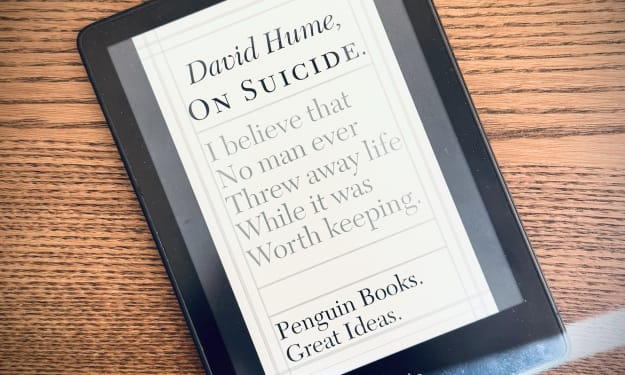
Book Review: "On Suicide" by David Hume
The Penguin 'Great Ideas' books have never really come up on my radar because they are so short. And to be honest, if I bought a book on David Hume's essays then I could consider them. However, some of the books are going relatively cheap on Amazon for the Kindle and so, I thought I would swoop in when a sale was on. I've been meaning to read this particular essay for a while. Currently, it is the end of May 2025 and I'm trying to read more essays, essay anthologies and nonfiction works - which is my reading goal for the whole year. So, let's take a look at what we can find inside David Hume's On Suicide...
By Annie Kapurabout a year ago in Geeks