literature
Geek literature from the New York Times or the recesses of online. Our favorite stories showcase geeks.
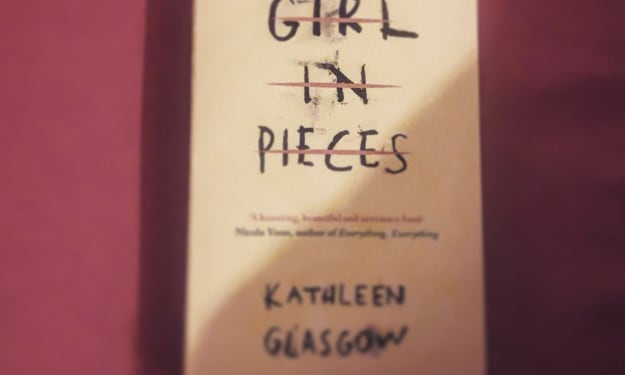
Book Review: "Girl in Pieces" by Kathleen Glasgow
There are not many books in the world that I would call ‘boring’ necessarily. But that does not mean the book is badly written and neither does it mean that you should not read it. The term ‘boring’ simply means that it did not appeal to me and it did not conjure any emotions or thoughts afterwards within myself. Apart from that, it does not mean anything about how well-written or how badly written the book is. I will give you an example or two. The first example is James Joyce’s “Finnegan’s Wake” which is obviously, brilliantly written but, I have to say that I find it intensely boring. However, the book “Men Who Hate Women” by Laura Bates is the opposite; I found the concepts interesting and the arguments well thought out. But, I found the writing itself a bit all over the place and reductive for a nonfiction book on its particular topic of misogyny. So the term ‘boring’ does not apply to either of these situations but instead is purely my own opinion. I would actually encourage you, reader of this review, to read the book for yourself and offer your own view. I would love to read about what you think of this book.
By Annie Kapur5 years ago in Geeks
Book Review: "Imaginary Friend" by Stephen Chbosky
Stephen Chbosky is the writer of the great YA novel that served my generation with amazing quotations, brilliantly diverse characters and a film which we have all seen thousands of times - "The Perks of Being a Wallflower" was one of the most incredible books of my teen years. "Imaginary Friend" could not be further from that previous endeavour of his. An experiment in the nature of psychodrama, "Imaginary Friend" is one of the best bildungsroman I have ever read in terms of how a child gains and loses his imagination and what happens when children go missing.
By Annie Kapur5 years ago in Geeks
Review of 'The Bane Chronicles'
Fans of The Mortal Instruments and The Infernal Devices can get to know warlock Magnus Bane like never before in this paperback collection of New York Times bestselling tales, each with comic-style art. This collection of eleven short stories illuminates the life of the enigmatic Magnus Bane, whose alluring personality, flamboyant style, and sharp wit populate the pages of the #1 New York Times bestselling series, The Mortal Instruments and The Infernal Devices. Originally released one-by-one as e-only short stories by Cassandra Clare, Maureen Johnson, and Sarah Rees Brennan, this compilation presents all ten together in print and includes a special eleventh tale, as well as eleven comic illustrations.Stories Included:1. What Really Happened in Peru2. The Runaway Queen3. Vampires, Scones, and Edmund Herondale4. The Midnight Heir5. The Rise of the Hotel Dumort6. Saving Raphael Santiago7. The Fall of the Hotel Dumort8. What to Buy the Shadowhunter Who Has Everything9. The Last Stand of the New York Institute10. The Course of True Love [and First Dates]11. The Voicemail of Magnus Bane
By Cyn's Workshop5 years ago in Geeks
Book Review: "Terminal Boredom" by Izumi Suzuki
When it comes to the Japanese short story, there are many authors that you could mention with books that are clearly some of the best of all time because of their efforts to twist the old traditions on to their heads to create something entirely new and original. One of these is Yoko Ogawa’s “Revenge” in which several stories are linked together by simple symbols, characters or minor events. Then there is “People From My Neighbourhood” by Hiromi Kawakami who has a similar concept in which the character goes through various people who live in their neighbourhood of interest. Each character is connected to another but not necessarily in order of how they are placed in the book. I think though, that this one entitled “Terminal Boredom” by Izumi Suzuki is slightly different yet again in that it plays on the concept of sci-fi to the point that it is a strange, twisted and darkly comic piece of satire in which we internationally recognise. There are so many genres going on at the same time that it is very difficult to pin-point one that is explored completely.
By Annie Kapur5 years ago in Geeks
Charles Dickens and the Cleveland Street workhouse
Charles Dickens’s second novel, “Oliver Twist”, is well known for the scenes in which young Oliver is born and brought up in a workhouse. Anyone who has seen the stage or screen version of Lionel Bart’s “Oliver” will recall the moment when Oliver is ejected after he is goaded by the other boys to “ask for more”. We see the boys spending hours “picking oakum” under the oversight of Mr Bumble, the pompous and corrupt beadle, and the cruel and degrading treatment meted out to children whose only crime was to have been born poor.
By John Welford5 years ago in Geeks
Oliver Goldsmith
Oliver Goldsmith was an 18th-century writer who is best known for one novel, one poem and one play. Had he had a longer life, and/or been more energetic as a writer, he would probably have become one of English Literature’s greatest figures instead of merely a middle-ranking one.
By John Welford5 years ago in Geeks
Book Review: "Everything Under" by Daisy Johnson
I feel like I should have read this book upon its release because I cannot understand why in the world I had not heard of it before. I had not heard of Daisy Johnson or the fact that “Everything Under” was on the shortlist for the Man Booker Prize in the year 2018. I do not understand how I have overlooked this novel and now, I would like to offer my apology for overlooking it to Daisy Johnson. As her debut, Daisy Johnson penned this stunning work and honestly, when I say stunning I am not using the word lightly. It is an incredible novel which resonates an almost Virginia Woolf-esque atmosphere with all of its madness, emotion and realism. Within all of this though, is the spectacle of fantasy which is peeled directly off the back of a Mary Shelley-like style - monstrous and raw, filled with passion, hatred and many layers down to its very depths (pun intended if you read the book as well). Honestly, I cannot say that there is a better book from the 2018 Man Booker Shortlist that did not win than this one. It is incredibly passionate and the atmosphere is absolutely stifling. I really do have to say it but seriously, I give it about ten to fifteen years and this book will be a modern classic of our generation. Thank you Daisy Johnson, for supplying us with your amazing talent for literature.
By Annie Kapur5 years ago in Geeks
Book Review: "Before the Coffee Gets Cold" by Toshikazu Kawaguchi
Books that are set in public places never fail to amaze me at how private and closed they can actually feel with all of these people, most of which do not know each other, locked in this space together. Some getting up to leave, some refusing to leave without an answer, some connected to others by chance and others in love with the other one. This book, if I can say this logically, reminded me a little bit of the atmosphere in Carson McCullers’ “The Ballad of the Sad Café” as it too has this almost private feel of a public place. The mood shifts between the situations of the characters but never changes massively. It is always a product of the environment being somewhat too quiet and undisturbed. Everything is just the way you need it to be, but then again that is the danger of the unexpected. It never arrives in moments of sheer panic and disillusion. Always when one least expects it.
By Annie Kapur5 years ago in Geeks
Book Review: "The Hair Carpet Weavers" by Andreas Eschbach
I have read many Sci-Fi novels in my time. From my favourite Sci-Fi novel (if you would call it of that particular genre) “The Island of Dr. Moreau” by H.G Wells to the more modern ideas portrayed in Ernest Cline’s “Ready Player One”. I have encountered everything from “Fahrenheit 451” all the back to the original genius of language and narrative depth in Mary Shelley’s “Frankenstein”. If we count novels such as “Brave New World” by Aldous Huxley, Margaret Atwood’s “Handmaid’s Tale” and the modern classic “The Hitchhiker’s Guide to the Galaxy” - yes, I can honestly say that I have read and enjoyed those two. But I will only ever admit here that I have never read the other modern Sci-Fi classic, “Dune”. Instead, I decided to give a different Sci-Fi novel on my TBR a go. “The Hair Carpet Weavers” by Andreas Eschbach is something I thought at first sounded pretty tame but, it turned out to be one of the most engrossing and exciting Sci-Fi novels I have ever read.
By Annie Kapur5 years ago in Geeks
Five Highly Anticipated Beach Reads for Summer
With summer vacation just around the corner, now is the time to starting planning your reading list. There's nothing better than spending the afternoon lounging on the beach with a good book, but it can sometimes be difficult to find the a book with the right summer vibe. With so many new novels being released this time of year, how are you to know which ones to read and which to skip?
By Word Rabbit5 years ago in Geeks
Margaret Mitchell: author of Gone With the Wind
Margaret Mitchell only wrote one novel that anyone has ever heard about, but that one (“Gone With The Wind”) was enough to make her name universally known, not least because of the blockbuster motion picture that was made from the story.
By John Welford5 years ago in Geeks