
Rachel Reviews: Saltburn (2023)
Prepare to be challenged with a film that presents privilege, desire and manipulation to great and disturbing effect


I have had a curious afternoon.
My ironing pile is huge and needed confronting. In order to diminish it effectively, I need distraction. I cannot stand and just iron. I need amusement in the form of something visual like a film or bingeable naffness like Married at First Sight.
Today, knowing that I would not be interrupted, I opted for a film. I had nothing in mind and so chose Prime as my provider and looked at what others had viewed.
Saltburn.
I like the title. I liked the font and with a brief read of its synopsis - university, Oxford, friends - I thought that this was just the escapism I needed. I'm not sure what I was expecting really. Something about the largesse of students and awkward friendships which endure the pressure of differing backgrounds and the striving to find common ground, the stresses of study, maybe some love interest. I don't know.
But it was some of these things and a whole lot of others. In that, I mean, it was a bit of a surprise and not an overly pleasant one.
I will give a brief summary of its premise before I delve more deeply.
The film deals with a student called Oliver Quick from Prescot near Liverpool who meets and become obsessed with Felix Catton when they are both students at Oxford.
Felix is incredibly popular whilst Oliver is finding it more difficult to fit in. But they become friends over time and then Felix invites him to spend the summer at his family home, Saltburn.
What appears to be a gesture of benevolence and generosity to someone from a less than privileged background soon becomes something else.
It's going to be difficult for me to talk about this without giving away spoilers but I am going to try as I think that this is a film that needs to be seen.
Barry Keoghan as Oliver Quick
First of all, Barry Keoghan.
There are few films I can think of where something I've watched has given me chills beyond the watching of it. The first instance and the keenest I can recall would be The Child-Catcher in Chitty-Chitty Bang Bang. Creepy, black-clad, big-nosed predator, sniffing out kids. Creepy as. I was a kid though, so my impression of this has been affected by life context, for sure. But I remember being genuinely scared and more than that, repulsed.
Barry Keoghan, or rather, Oliver Quick is my adult equivalent.
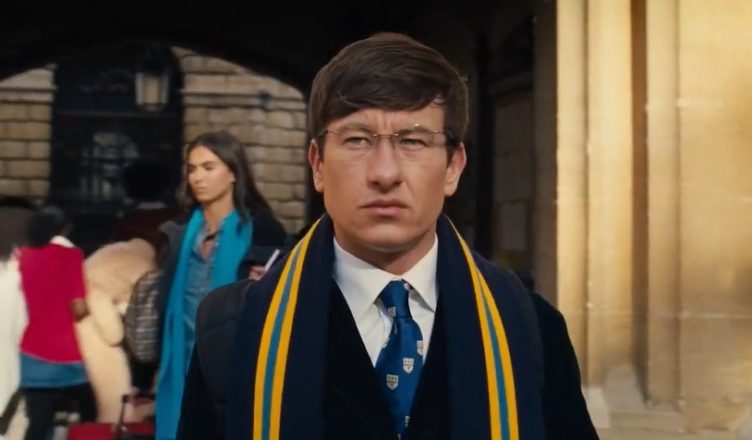
The film starts with us seeing Oliver arrive at Oxford and he seems to be a fish out of water. He tries to fit in but he has none of the key attributes needed to attract people to him: charisma, charm, money, privilege. Felix, the object of his adoration, however, has it in spades and through some luck, their worlds collide and Felix takes Oliver under his wing, like a stray dog. Oliver is also like Felix's project, as he guides him and acts as a buffer in certain situations, to help Oliver navigate a world which is not his own but one with which Felix is very au fait.
They are an unlikely pairing. Felix is tall, dark, rich, charming, approachable, sexy, desirable. Oliver seems stumpy, parochial, stifled, guarded, and I may as well just say it, weird.
But at the start of the film and with the depiction of their developing friendship, it is difficult to know what Oliver is: is he a creep or is he just a young man, trying to find his way through the difficult days of starting university? Does he have ulterior motives for trying to be noticed by Felix or is he just lonely?

Emerald Fennell, the writer and director of the film, does an excellent job of keeping you guessing about Oliver throughout. In her depiction of him, we see him as someone who induces sympathy with his social awkwardness. He seems watchful and assessing but it is difficult to know if this is because he wants to gauge his peers and try and fit in or if it's scheming and calculating. He seems innocent and inexperienced and doesn't have a lot of charisma. He's not sinister but there seems to be something considered about him and the way he acts.
Felix, in contrast, seems more open and engaging as well as friendly and is the archetypal popular kid, the person who everyone wants to know and with whom everyone wants to associate.
The story builds, showing where Felix eases things for Oliver; how Oliver is a curiosity to Felix, coming as he does from a working class background with a scholarship and seemingly poor and underprivileged. The relationship that Felix cultivates seems to be one of tolerant indulgence as his other friends do not like Oliver and let Felix know but Oliver manages, for whatever reason, to keep Felix's attention. Indeed, Felix confides in Oliver, maybe finding in him someone so different that he is a safe prospect, one which he can control, one who will feel indebted to him and therefore, be loyal and dependable.
Privilege
There are lots of ideas about privilege in this film. Felix's house is enormous, palatial even and his family are rich. They think nothing of throwing parties for hundreds of people - they have staff to help them and they loaf and relax and live a life of leisure. Hardship, therefore is a curiosity to them and there is a sense of the Cattons feeling like benign providers. However, they are also shown to be callous in the film, talking superficially about someone's death for who they seemed to care. In fact, at times, they seem devoid of emotional depth and are concerned for only how things might appear, rather than how they actually are.
Also, we find out that Oliver is not the first such "real" person who Felix has invited to stay for the summer and so, as a viewer, you are made to question what his motive may be for acquiring these friends and bringing them home. Is it just friendliness or is there something more subversive of which we will be made aware?
Fennell is expert at treading this line throughout as mentioned, revealing elements of the story and Oliver's personality by degree.
Uncomfortable moments
One thing that I think that this film will become renowned for and for which I think that my discomfort from watching it comes from is the amount of uncomfortable moments, of which there are a few! Oliver's influence is like an ink stain; barely discernible at first but gradually spreading into every fibre. This, in itself, is not disturbing but Fennell, in her direction, does not retreat from scenes where Oliver is shown in a light that, at times, is almost feral in its impulsiveness, its repulsiveness and its execution. There are four crucial scenes in the film where I can think of times where I wanted to look away and not because it is graphically confronting in nature and neither is it from what is implied, but from the presentation of desires and urges that, really, no decent person would want to see or imagine.
Actually, the fourth is not as bad and has elements of the satyr and revelry about it more than being gruesome but it is still vivid and unsettling.
And so, Saltburn is a very distinctive film, which has to have been getting people talking. I tend to shy away a little from popular media nowadays and so, have probably missed out on discussion in relation to this. I might not have watched it, had I been exposed to its analysis.
The upshot of my film watching afternoon is that I was transported as requested but it was to a place of darkness which I was not expecting.
And in conclusion, I'm wishing now that I had opted for something by Pixar.
About the Creator
Enjoyed the story? Support the Creator.
Subscribe for free to receive all their stories in your feed. You could also become a paid subscriber, letting them know you appreciate their work.
Comments
There are no comments for this story
Be the first to respond and start the conversation.