
Notes From Underground by Fyodor Dostoevsky
Why It's a Masterpiece (Week 123)

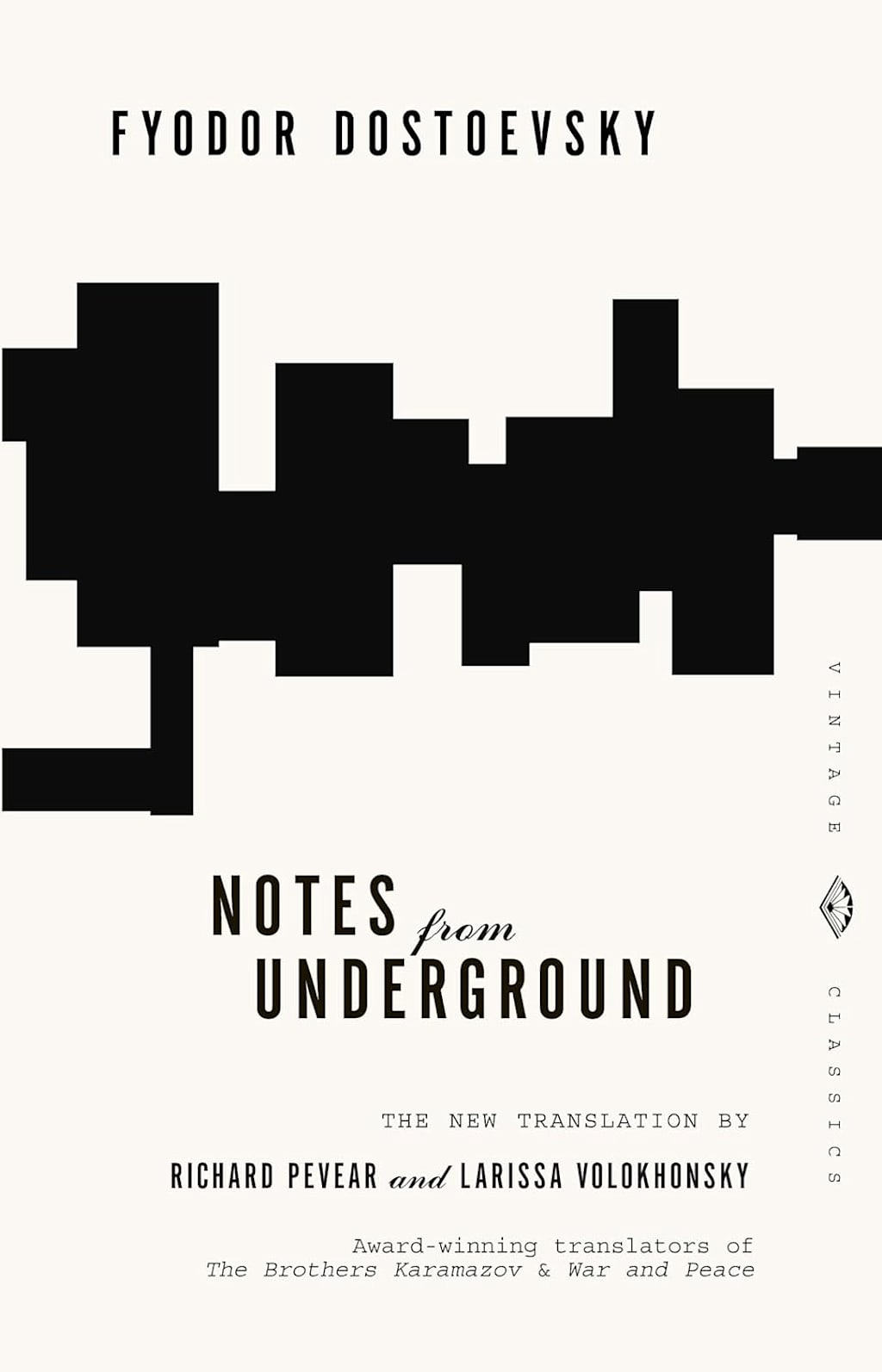
Background and Context:
You guys know how much I love "The Brothers Karamazov" (if you've been around for a number of years, you'll really know). Well, here's another great Dostoevsky classic: Notes from Underground. I've read this book twice in my life but I really feel like I should give it another go. It just seems like I haven't gone deep enough.
Notes From Underground by Fyodor Dostoevsky

Published in 1864, this novel was first released in the Russian Literature magazine Epoch - edited by Fyodor Dostoevsky and his brother, Mikhail. Marking a turning point in his literature to when his books definitely became darker and more psychological, Dostoevsky would definitely become less about marking his works with romantic styles of writing and more about dealing with socially charged, philosophical lessons.
It was written at an important time too. Dostoevsky had already spent four years in a Siberian prison and five years in compulsory military service - it is no wonder as to why his novels took the turn that they did. A response to what would be called 'Russian rationalism' this new era would target the ideas of the book What is to Be Done? by Nikolai Chernyshevsky.
A precursor to existentialist literature that became popular towards the end of the century, this book is divided into two parts: 'Underground' and 'Apropos of the Wet Snow'. One is a philosophical monologue and the other is a narrative recounting episodes from the unnamed narrator's life.
Plot

In Part 1, the unnamed narrator (known as the "Underground Man") is a retired civil servant living in isolation in St. Petersburg. He is a sick, spiteful, overly self-aware man who withdraws from society and critiques the ideas of rationalism. He mocks the belief that human beings are logical and driven by self-interest, often using Dostoevsky's linguistic power to present the reader with paradoxes. He argues that humans often act against their own interest simply to assert their own free will, stating that therefore humans are unpredictable and thus utopias are impossible. He alienates himself through overthinking and bitterness towards others, often succumbing to his own 'analysis paralysis'.
In Part 2, the narrator recalls a dinner with former schoolmates who think he's quite annoying and ultimately, he ends up humiliating himself over deliberate provocations. He tries to assert his dominance in the conversation but ends up being insulted, ignored and becomes rather an inferior part of his own conversation. He then meets Liza, a young prostitute and gives a monologue to her about life - it seems that she is listening more than the friends at dinner. Liza ends up visiting him at his home, hoping for some sort of compassionate connection but all she finds is a man who is bitter and resentful. The narrator is cruel and unkind, Liza leaves and he ends up retreating further into his isolation from society.
Into the Book

Freedom as the Rejection of Rationalism:
One of the central themes in Notes from Underground is the tension between human freedom and rationalist determinism. The "Underground Man" is deeply suspicious of the idea that human behaviour can be reduced to logic or mathematical certainty, as proposed by Enlightenment thinkers and Russian radicals of his time. He scorns the notion that human beings, if given the right conditions (like a utopian society), would always act in their own best interests. To him, this is a dehumanising concept, stripping people of their most essential quality: free will.
In his view, people deliberately act irrationally to assert their autonomy. He even argues that suffering and destruction may be more desirable than perfection if they are chosen freely. This becomes a paradox: the more society tries to organise and rationalise human life, the more individuals will rebel against that very structure, even to their own detriment. For the "Underground Man", irrationality becomes proof of freedom.
“What man wants is simply independent choice, whatever that independence may cost and wherever it may lead.”
- Notes From Underground by Fyodor Dostoevsky
Alienation, Isolation, Resentment:
The "Underground Man" is a figure of profound alienation: from society, from others, and even from himself. He is hyper-aware of his own weaknesses and perceived humiliations, and this self-awareness only intensifies his estrangement. Living in a “corner” both physically and metaphorically, he is disconnected from social bonds and filled with resentment toward a society he simultaneously longs to be part of.
This isolation is not merely circumstantial but deeply psychological. He cannot participate in relationships without sabotaging them, often out of pride or insecurity. His interactions with his schoolmates and with Liza are marked by clumsy attempts to assert control or superiority, which collapse into shame and cruelty. He desires love and recognition, yet his pride and hatred prevent any meaningful connection. Thus, he exists in a state of paralysis, too self-conscious to act but too desperate to ignore his desire for significance.
“I am a sick man... I am a spiteful man. I am an unattractive man. I believe my liver is diseased.”
- Notes From Underground by Fyodor Dostoevsky
Self-Destruction and Masochism:
Another key theme in Notes from Underground is the narrator’s inclination toward self-destruction and masochism. Unlike a character who seeks redemption or growth, the "Underground Man" relishes his degradation. He overanalyses his flaws to the point of paralysis, then punishes himself emotionally for his inaction. This cyclical pattern suggests he derives a perverse pleasure from suffering: it gives his life meaning, or at least intensity, in an otherwise empty existence.
The "Underground Man's" masochism is psychological rather than physical. He takes offense easily, exaggerates slights, and rehearses humiliations in his mind repeatedly. His interactions, particularly with Liza, reflect this pattern. When she shows him tenderness, which could redeem or soften him, he lashes out and cannot tolerate the possibility of vulnerability or being forgiven. To dominate her emotionally, he must degrade both her and himself.
“I swear to you, gentlemen, that to be overly conscious is a sickness, a real, thorough sickness.”
- Notes From Underground by Fyodor Dostoevsky
Why It's a Masterpiece

At the time it was published, some contemporary readers and critics admired its intellectual ambition and the boldness of its philosophical critique. They recognised the work as a significant intervention in the ideological debates of the time; particularly Dostoevsky’s scathing response to the growing popularity of utilitarianism, rational egoism, and socialist-utopian ideals. Supporters praised Dostoevsky’s ability to penetrate the contradictions of modern man and the psychological realism of the "Underground Man’s" inner turmoil.
However, many others found the novella unsettling or even impenetrable. The narrator’s bitterness, misanthropy, and self-contradiction challenged readers’ expectations of a coherent, sympathetic protagonist. Some critics were alienated by the deliberately erratic structure and the absence of traditional plot resolution. "The Underground Man’s" endless self-scrutiny, unpredictable reasoning, and emotional instability made it difficult for readers to know whether to take his claims as confessions, critiques, or ironic parodies.
For many, the novella was less a story than a philosophical outburst: fragmented, disjointed, and cynical. It did not fit neatly into literary trends of the time, and its bleak, introspective tone clashed with the more optimistic vision of human progress dominating intellectual circles in Russia. But over time, Notes from Underground came to be seen as a groundbreaking work, anticipating existentialism and modernism, and is now regarded as one of Dostoevsky’s most important philosophical texts.
Conclusion

I cannot describe to you how important it is to read this book. I will however state this: if you have not yet started reading anything by Dostoevsky then I would say start with this one, move on to (one of my favourite novels of all-time) The Brothers Karamazov, then - you can pretty much go anywhere from there. But these two books will cement your knowledge of Dostoevsky's main ideas, all of them get expanded on, branched off and even deepened in other ways, in the rest of his bibliography.
Next Week: We Think the World of You by JR Ackerley
About the Creator
Annie Kapur
"Et in Arcadia Ego"
***
I am:
🙋🏽♀️ Annie
📚 Avid Reader
📝 Reviewer and Commentator
🎓 Post-Grad Millennial (M.A)
***
I have:
📖 300K+ reads on Vocal
🦋/X @AnnieWithBooks
📸 ThePrancingPonyBakery
🔗 PrancingPonyBakery.com
***
🏡 UK
Enjoyed the story? Support the Creator.
Subscribe for free to receive all their stories in your feed. You could also become a paid subscriber, letting them know you appreciate their work.
Comments
There are no comments for this story
Be the first to respond and start the conversation.