
Moby-Dick by Herman Melville
Why It's a Masterpiece (Week 117)

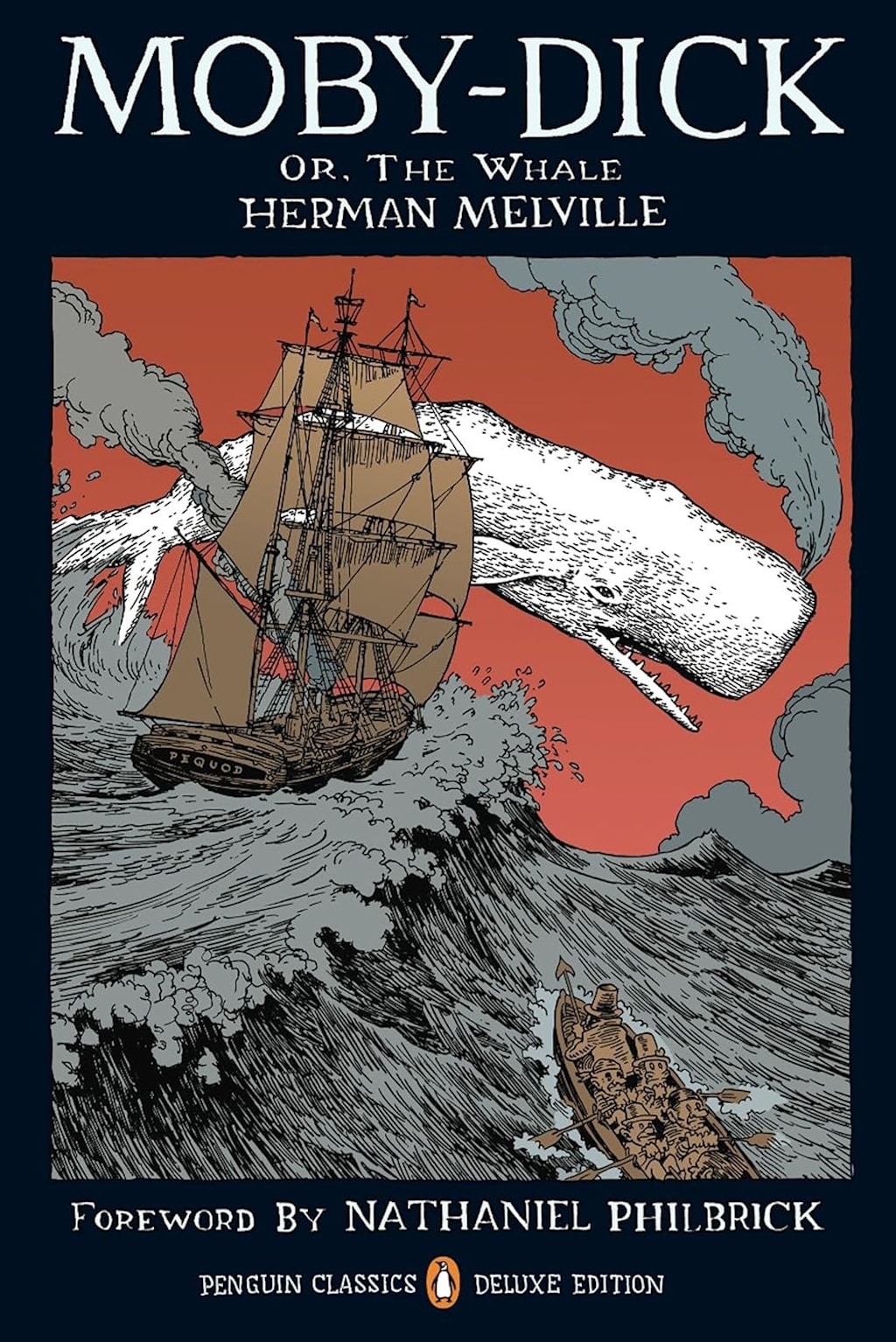
Background and Context:
I remember the first time I read this book. I'm not going to lie, I was a teenager and it was really difficult. I needed a dictionary and a relatively less impressive version of the internet to look up whaling practices. It took a while and yet, when I broke through the top of the water and I could finally breathe afterwards, I felt something wash over me. It was on the whole, a beautiful story, with wonderful themes and ultimately, I cried. I have read it twice since and each time, I always take that same amount of time with it. I read it slowly, I savour the words and phrases and I learn something new about humanity. This is a lesson in: when someone tells you that Moby-Dick basically invented the concept of the Great American Novel - believe them.
Moby-Dick by Herman Melville
Background and Publication

Moby-Dick was first published in London by Richard Bentley in October 1851 under the title The Whale, and then in New York by Harper & Brothers in November 1851 with the now-famous title Moby-Dick; or, The Whale. Whilst the British edition was heavily edited, omitting some passages and altering language; the American edition was more complete and closer to Melville’s original manuscript. Upon release, the novel received mixed to negative reviews and was not commercially successful during Melville’s lifetime. The novel was largely forgotten for decades, but it was rediscovered and gained recognition as a literary masterpiece in the early 20th century, especially during the 1920s "Melville Revival."
Plot

The narrator introduces himself with that iconic opening line: Call me Ishmael - and all of a sudden, one of the world's greatest stories is underway. Ishmael tells the reader about his want to join a whaling ship and so, he sets off for New Bedford in order to take to the seas. But when in New Bedford, he meets a tatooed South Sea Islander by the name of Queequeg. Queequeg is a harpooner and though Ishmael is initially afraid of him, the two end up becoming close and sign up to board the Pequod together.
The Pequod is headed by the weird and unseen Captain Ahab who is both mysterious and strangely aloof. The ship itself is owned by two Quaker businessmen who give them warnings about Ahab's erratic and often unpredictable behaviour as both a captain and a tyrant. And, on top of this, as the ship sets sail, a prophetic stranger by the name of Elijah warns Ishmael of the dark and foreboding nature of Queequeg and how he may symbolise in his nature, the horrid things that may come about when on the Pequod. If this wasn't enough, there's also a group of strangers aboard the ship, they are shadowy figures and are revealed to be Ahab's personal whalemen. All of this is very strange and worrying to Ishmael.
When Captain Ahab finally appears, they have been at sea for days. He is a grim and gloomy man, disabled on one leg and obsessed with vengeance against a whale named Moby-Dick - who took his other leg. Moby-Dick is a great, white whale whom Ahab wishes to kill and assert dominance over in order not only to win the war against the creature but also to win back his dignity. He then states that a gold doubloon will be given to the first man who spots Moby-Dick and nails the gold to the mast. He reveals through this that the trip isn't about whaling but about hunting this one, very particular white whale.
The Pequod often meets other ships during the voyage and they exchange news of any sightings of whales. Some of these reveal the true and disturbing nature of the seas, especially those concerning the true nature of the great white whale Ahab is so obsessed with. Other stories concern the sea's dangers and with each step of the way, there is a strange foreboding that follows the Pequod everywhere. Starbuck is the first mate, and thus questions Ahab's obsession even though he is a rational and often devout man. He once suggests killing Ahab to save the crew but cannot bring himself to commit an act of murder.
The ship hears from another ship called The Rachel whose captain please for help finding his lost son after an encounter with Moby-Dick but Ahab refuses. He only wants the whale. When Moby-Dick is finally sighted, a three-day chase ensues and the crew launch repeated attacks on the whale, but it resists with all of its horrifying power. On the third day however, the great whale destroys the Pequod, killing Ahab and most of the crew. Ahab is dragged under the whale - entangled in harpoon lines.
Ishmael survives. He clings to the coffin of his friend as he drifts by the Rachel, who are still searching for the captain's son. He is picked up and the story ends as a Shakespearean tragedy does - everything is reset after the tragedy, but some things are left purposefully open.
Into the Book

Obsession and Monomania:
Captain Ahab's quest for revenge overrides and consumes his entire life. It leaves him often illogical and immoral, sacrificing the safety of his own crew. His single-minded focus isolates him from others and turns him from leader to tyrant as he is increasingly feared for his obsessive nature. Ahab's obsession is present as self-destructive and unnatural, warping his humanity and purpose as a whaler. Instead, he is a man on a spiritual crussade of revenge. The crew therefore becomes complicit in this, swept up in the passion of Ahab, they highlight how obsessions of those at the top can infect those at the bottom with its warped and controlling nature. Melville ultimately presents Ahab's obsession as a wrestle between man and forces he cannot control.
“All visible objects, man, are but as pasteboard masks... if man will strike, strike through the mask!”
- Moby-Dick by Herman Melville
Fate and Free Will:
The novel explores the tension between fate and predestination, questioning how much control people actually have over their own lives. Ahab believes he is destined to confront Moby-Dick and interprets signs along his path as confirmation of this destiny. Starbuck and others wrestle with existential questions, often unsure about fate and choice and what guided them here. On top of this, the sea is a metaphor for the unfathomable mysteries of existence where reason can only take you so far. It is a cold teaching about the way in which the universe is indifferent to any plights of humanity. Through all of this, Melville suggests to us that perhaps there are some truths within the world that are unreachable. In fact, trying to reach these unreachable truths will leave us worse off than if we just accepted them.
“There is a wisdom that is woe; but there is a woe that is madness.”
- Moby-Dick by Herman Melville
Man Vs. Nature:
Again, we have the representation of the ocean and the whale as being the great indifference that the universe has for humans and human concern. Moby-Dick, through this, becomes more than just a whale, he becomes the truest personification of nature in which he is the truth that cannot be understood. He is the aspect of life the characters cannot control and thus, the whalers' attempt to dominate it reflects these industrial ambitions which litter every era since the 1700s. We would have liked to assert dominance over nature and every time we do, we destroy ourselves in the process. It is a great metaphor for our own times of AI.
“Consider the subtleness of the sea; how its most dreaded creatures glide under water, unapparent for the most part...”
- Moby-Dick by Herman Melville
Why It's a Masterpiece

Often regarded as a masterpiece for its philosophical depth, the book explores themes of obsession and the limits of human understanding whilst elevating itself beyond a simple sea adventure. Melville succeeds in this depth by fragmenting the book beyond a simple story; instead he uses everything from essays to sermons to soliloquys and entries on whales. It is both intellectually ambitious and attempts to legitimise the book. The timeless relevance of one man attempting to overcome true nature in order to become someone more is a story that has been told time and time again and I personally believe that one of the best tellings of that is in this book here.
Conclusion

It is probably one of my favourite American novels because of its mind-blowing ability to convince us that maybe, hyperfixation and turning into a tyrants is a bad idea. I'm joking, I love it because it reads like if Shakespeare were to write a novel about the sea. It is the perfect tragedy and is so different to the other books of the same time period. I hope you return next week for more Why It's a Masterpiece...
Next Week: Käsebier Takes Berlin by Gabriele Tergit
About the Creator
Annie Kapur
"Et in Arcadia Ego"
***
I am:
🙋🏽♀️ Annie
📚 Avid Reader
📝 Reviewer and Commentator
🎓 Post-Grad Millennial (M.A)
***
I have:
📖 300K+ reads on Vocal
🦋/X @AnnieWithBooks
📸 ThePrancingPonyBakery
🔗 PrancingPonyBakery.com
***
🏡 UK
Enjoyed the story? Support the Creator.
Subscribe for free to receive all their stories in your feed. You could also become a paid subscriber, letting them know you appreciate their work.
Comments
There are no comments for this story
Be the first to respond and start the conversation.