
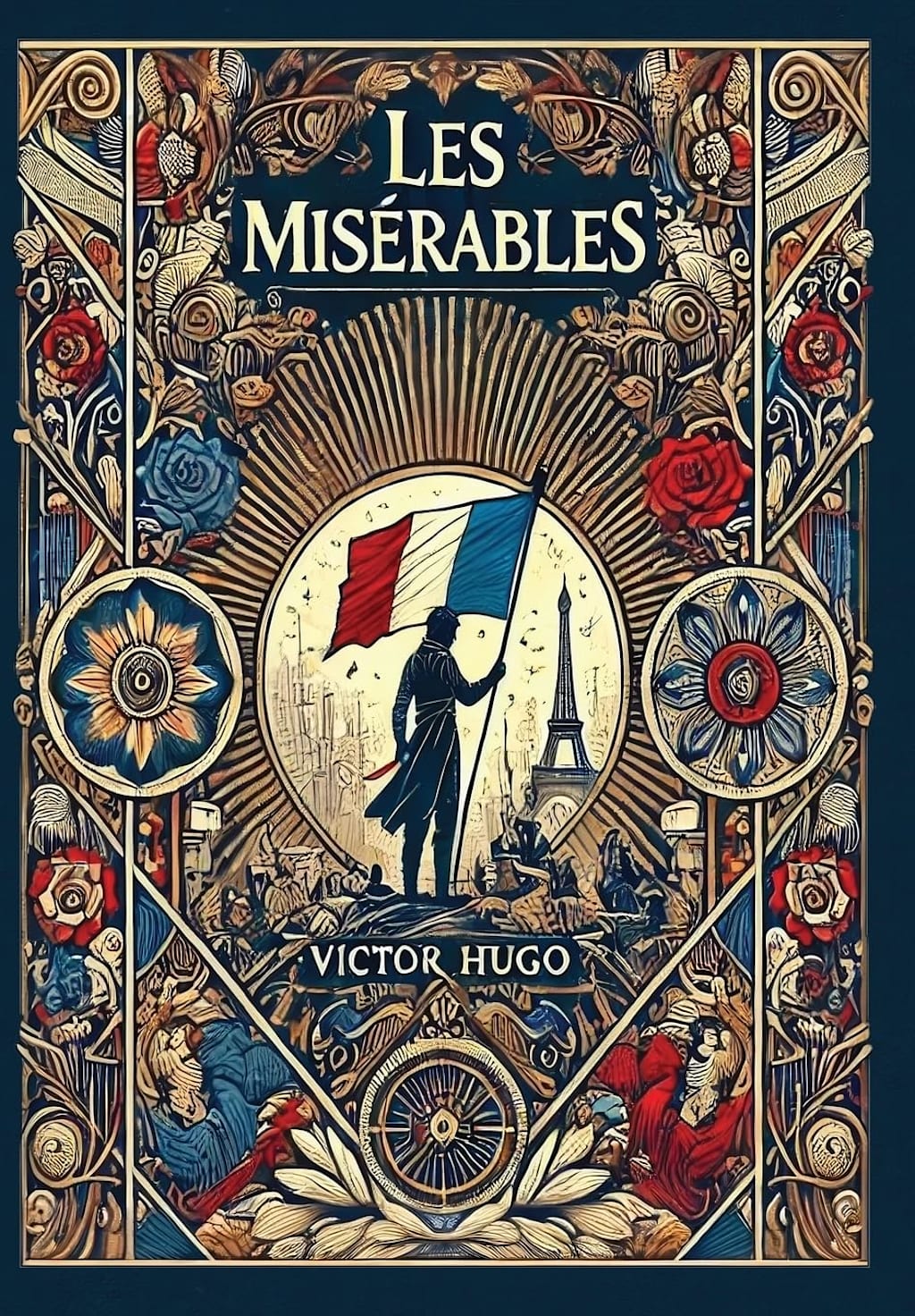
Les Misérables by Victor Hugo
Why It's a Masterpiece (Week 121)

Background and Context:
I read "Les Miserables" for the first time when I was in my teens and I am not ashamed to say that it took young teen me a whole month to read. Not only was the language a bit difficult but there were so many characters to remember and then you had the fact that there were a lot of outdated and rather archaic sayings etc. that were littered about. All of this and then, you have all that history of the French Revolution to contend with. When I exited the book though, I was pretty much a teen expert on the political landscape of the French Revolution. I have to say that if you come out of "Les Miserables" (the book, not the musical or the movie) and you aren't an amateur expert on the French Revolution then you haven't really been reading it properly.
I'll leave a bit of a reading list after the article so that, if you're interested, you can do some secondary reading around the book.
Before all of this though, here's some stuff that I've written on "Les Misérables" in the past...
Top Ten Most Dramatic Novels of All Time
Les Misérables by Victor Hugo

Victor Hugo began thinking upon Les Misérables in the 1840s, inspired by France’s social injustices and the suffering of the poor. He believed literature had a moral duty to shine a light on society’s failings and so, got to work on his magnum opus. As a staunch opponent of the death penalty and supporter of republican ideals, Hugo sought to reveal the humanity of criminals, prostitutes, and the downtrodden. The character of Jean Valjean was partly inspired by real-life ex-convict Eugène François Vidocq.
The novel was written during a period of intense political upheaval in France, following the fall of Napoleon and leading into the revolutions of 1830 and 1848. Hugo began writing in 1845, paused due to political events, and resumed during his exile from France (1851–1870) under Napoleon III. His experiences in exile (particularly witnessing poverty in Brussels and London) informed his depictions of the suffering poor. The novel is seen to reflect Hugo’s passionate support for republicanism and his critique of institutional cruelty, especially in law, religion, and governance.
He wrote much of Les Misérables while exiled on the island of Guernsey after Napoleon III’s 1851 coup. He used the isolation to focus deeply on the novel, eventually completing it in 1861 after nearly 17 years. The manuscript spanned over 1,400 pages. He reportedly said he “closed the book of war and opened the book of peace.” His remote setting allowed him freedom to critique France’s government without censorship, making Les Misérables not just a novel but a revolutionary act - showing the entire public what was really happening in their countries.
Les Misérables was published in 1862 by A. Lacroix, Verboeckhoven & Cie in Brussels, simultaneously released in major cities across Europe. It was an instant bestseller that divided the critics entirely...
Plot

Note: I know this is a long book. I will try to make this as concise as I can without leaving anything out.
Jean Valjean is released from prison after 19 years; five for stealing bread and fourteen for trying to escape. Branded as a dangerous ex-convict, he is rejected by society until Bishop Myriel offers him shelter and mercy. When Valjean steals the bishop’s silver and is caught, the bishop lies to the police, claiming he gave it as a gift. This act of grace transforms Valjean, who vows to live an honest life. He breaks parole and disappears, setting off a lifelong pursuit by Inspector Javert. Valjean assumes a new identity and begins a journey of redemption and compassion.
Valjean re-emerges years later as Monsieur Madeleine, a wealthy factory owner and the beloved mayor of Montreuil-sur-Mer. He helps the poor and earns widespread respect. One of his factory workers, Fantine, is dismissed and falls into destitution while trying to support her illegitimate daughter, Cosette. After Fantine is arrested, Valjean intervenes, taking responsibility for her care and promising to retrieve her child. Meanwhile, Javert suspects Madeleine is actually Valjean. When another man is mistakenly identified as Valjean and arrested, the real Valjean confesses to save the innocent man, thus risking his freedom to uphold justice.
Fantine dies in the hospital, never learning that her daughter will be saved. Valjean, now revealed, narrowly escapes arrest by Javert and travels to Montfermeil, where Cosette is being abused by the Thénardiers, her cruel caretakers. He pays them off and takes Cosette with him. This act marks the beginning of a deep and tender father-daughter bond. Valjean raises Cosette in hiding, moving frequently to avoid Javert. Despite his fugitive status, Valjean finds purpose and redemption in caring for Cosette, dedicating his life to shielding her from suffering and giving her a chance at happiness and stability.
To escape Javert, Valjean seeks refuge with Cosette at the Petit-Picpus convent in Paris, where they live in secrecy for several years. Valjean works as a gardener, and Cosette is educated by the nuns. Their life is peaceful and hidden, allowing Valjean to live in grace while preparing Cosette for the world. As Cosette grows into a young woman, she begins to question her secluded life. Valjean, fearing that her future will eventually be beyond his control, becomes increasingly protective. Their quiet existence begins to unravel when Cosette attracts the attention of a young revolutionary named Marius Pontmercy.
Marius Pontmercy, a politically idealistic student estranged from his royalist grandfather, falls in love with Cosette after glimpsing her in a public park. He becomes obsessed, and eventually they begin exchanging secret glances and notes. Valjean notices Cosette's distraction and becomes fearful of losing her. Meanwhile, Marius lodges next door to the Thénardiers, who have descended into criminality in Paris. Marius unwittingly learns of Valjean’s true identity and criminal past, leading to a moral dilemma. Torn between his love for Cosette and his loyalty to justice, Marius is swept up in both romantic passion and revolutionary fervour.
Marius joins the June Rebellion of 1832, a student-led uprising sparked by poverty and the death of General Lamarque. At the barricade in the streets of Paris, Marius displays great courage, believing he has nothing to live for without Cosette. Valjean discovers Marius’s involvement and, despite his fear of Javert, goes to the barricade to protect him. There, Valjean is given the chance to kill Javert, who has been captured by the rebels. Instead, Valjean secretly releases him, demonstrating mercy once again. As the barricade falls and most of the rebels die, Valjean carries the wounded Marius to safety.
After the barricade is destroyed, Valjean carries the unconscious Marius through the dark, filthy sewers of Paris. The journey is harrowing, filled with physical danger and moral symbolism, as Valjean literally carries the future of a new generation on his shoulders. Along the way, he encounters Thénardier, who tries to extort money and falsely accuses Valjean of wrongdoing. When Valjean finally emerges, he is arrested by Javert. However, having witnessed Valjean’s courage and mercy firsthand, Javert is shaken. Unable to reconcile his black-and-white view of justice with Valjean’s moral complexity, Javert later commits suicide in despair.
Valjean brings Marius home, and he eventually recovers, unaware of who saved him. Cosette and Marius reunite and marry with great joy. Valjean, however, confesses his criminal past to Marius, who (though grateful) grows cold and distant, thinking Cosette’s reputation must be protected. Valjean chooses to withdraw from Cosette’s life for her own happiness, falling into despair. He leaves behind his role as her protector, believing he is unworthy of her love. Meanwhile, the Thénardiers attempt to blackmail Marius with lies about Valjean, but instead reveal the truth about how Valjean saved him, leading to a moment of revelation.
Marius learns from the Thénardiers that Valjean saved his life at the barricade and did not commit murder. Overcome with guilt and gratitude, he and Cosette rush to find Valjean. They discover him in a weakened, dying state. The long years of sacrifice, suffering, and hiding have taken a toll on Valjean, but he is comforted by their presence. Cosette finally learns the full truth about her adopted father and expresses deep love and gratitude. Valjean’s spiritual journey, driven by compassion and selflessness, reaches its emotional climax as he finds peace in being loved and understood at last.
Jean Valjean dies peacefully, surrounded by Cosette and Marius, having at last found moral redemption and emotional reconciliation. His soul is uplifted by the knowledge that Cosette is loved and safe. As he dies, he sees a vision of Bishop Myriel. The cycle of compassion is complete.
Into the Book

Redemption:
Redemption lies at the heart of Les Misérables, shaping Jean Valjean’s transformation and driving the narrative forward. Victor Hugo presents redemption not as an instantaneous event but as a lifelong commitment to goodness and compassion, often made difficult by society’s judgment and legal structures. Valjean begins his journey hardened by prison and rejection, but an act of mercy from Bishop Myriel awakens his conscience and sets him on a path of self-reinvention. This moral rebirth, however, is tested constantly by his desire to avoid recapture, by his fear of being unworthy, and by the temptation to protect himself at others’ expense.
The depiction of redemption extends beyond the personal. It challenges institutional thinking (embodied by Inspector Javert’s rigid adherence to the law) and suggests that true justice is achieved through love, sacrifice, and grace. Fantine, too, is a figure of attempted redemption, though her fall is tragically unrecoverable in her lifetime. Valjean’s repeated efforts to do right by her: caring for Cosette, revealing his identity to save an innocent man, and sparing Javert. These showcase that redemption is not a single act, but a sustained effort to live rightly in the face of a harsh world.
By the novel’s end, Valjean dies in peace, not because he has erased his past, but because he has risen above it through love. Redemption in Les Misérables is not a reward granted by others but a condition of the soul earned through humility, forgiveness, and the courage to change. Hugo’s belief in humanity’s capacity to transcend its worst acts permeates every page, insisting that even the most broken can become beacons of hope.
“Jean Valjean was no longer Jean Valjean, but something new: a soul made anew by love.”
- Les Misérables by Victor Hugo
Justice and the Law:
Les Misérables offers a powerful critique of legal justice versus moral justice. Throughout the novel, Hugo explores how the law, when stripped of compassion, can become oppressive rather than protective. Inspector Javert embodies this conflict; he is a man of unwavering duty, incapable of nuance or mercy. He pursues Jean Valjean relentlessly, believing that a man who breaks the law, even once, must remain criminal forever. Hugo juxtaposes Javert’s cold legality with Valjean’s evolving moral conscience to highlight the failure of a system that values punishment over rehabilitation.
Valjean’s original crime is portrayed not as a criminal act but a desperate one born of injustice. Yet, the punishment he receives is severe and life-altering. The system marks him for life, branding him an outcast. Even after turning his life around, Valjean cannot escape the shadow of his record. Society and law refuse to recognise his transformation, trapping him in a cycle of concealment and fear.
Alternatively, characters like the Bishop and even Valjean himself offer glimpses of a higher justice: one based on mercy, understanding, and human dignity. The Bishop’s refusal to condemn Valjean begins a chain of redemptive acts that stand in stark contrast to the rigid structures of the state. Ultimately, Javert’s suicide is a tragic recognition that strict legalism cannot contain the full complexity of human morality.
“There is a point at which the unfortunate and the infamous are associated and confounded in a single word, a fatal word, Les Misérables.”
- Les Misérables by Victor Hugo
Love and Compassion:
Love and compassion are the moral and emotional foundations of Les Misérables, offering salvation where the law and social systems fail. For Victor Hugo, love is not a romantic indulgence but an ethical force capable of transforming individuals and society. Jean Valjean’s journey is shaped by his deepening capacity to love - first inspired by the Bishop’s compassion, then reinforced through his paternal love for Cosette. Love motivates Valjean to risk everything, time and again, not for recognition but because it is the highest expression of his humanity.
The novel presents many forms of love: the pure and selfless bond between Valjean and Cosette; the tragic maternal love Fantine has for her child; Marius and Cosette’s young romance; and even the corrupt, possessive "love" the Thénardiers have for their own survival. The author demonstrates that true compassion transcends blood or legal obligation; it is rooted in sacrifice, patience, and the will to ease another's suffering.
Valjean’s greatest acts don't steam from duty but from love. Even Javert is ultimately undone not by hatred, but by his inability to reconcile his concept of justice with the compassion shown him. The novel insists that love is revolutionary and it resists systems that dehumanise and stands as the most redemptive and radical force available to humankind.
“To love or have loved, that is enough. Ask nothing further.”
- Les Misérables by Victor Hugo
Why It's a Masterpiece

When the book was released across Europe, critics were initially divided - some hailed it as a moral vision and yet, there were others who dismissed it as sentimental drivel. Ordinary readers ate it up, hailing it as one of the greatest books ever written and even today, that is also the case. The novel’s reach was enormous, influencing both literary and political spheres. Despite controversy, Les Misérables cemented Hugo’s status as a literary giant and became one of the most widely read novels of the 19th century.
Conclusion

I hope you enjoyed reading about this book. I mean, if you have not read it already I hope it gives you a reason to start. I'll be back next week with another book. Thanks for reading.
Next Week: Grand Hotel by Vicki Baum
About the Creator
Annie Kapur
"Et in Arcadia Ego"
***
I am:
🙋🏽♀️ Annie
📚 Avid Reader
📝 Reviewer and Commentator
🎓 Post-Grad Millennial (M.A)
***
I have:
📖 300K+ reads on Vocal
🦋/X @AnnieWithBooks
📸 ThePrancingPonyBakery
🔗 PrancingPonyBakery.com
***
🏡 UK
Enjoyed the story? Support the Creator.
Subscribe for free to receive all their stories in your feed. You could also become a paid subscriber, letting them know you appreciate their work.
Comments
There are no comments for this story
Be the first to respond and start the conversation.