
Feared and Admired: Aegir the Ocean God of the Norse
The Norse had their own Sea God and he was was just as fickle as Poseidon and the realm he ruled. This the rocky and contentious story of one of the most feared Gods in Nordic mythologies and how he endured over the centuries.


An Inhospitable or Accommodating God?
Aegir made for an inhospitable god. His realm was the cold, dark sea; his palace dominated its murky bottom. And, forget about visiting the Nordic/Germanic God of Ocean. The only way you were getting there was by being onboard a sinking vessel that he managed to pull under the waves.
The Norse sailors feared this God and for a good reason; he controlled the most powerful force in the Norse world: the ocean. Arrival at the palace for mortals was most likely a result of the god's anger. And his anger manifested itself as the squalls and storms that pounded to coasts and swallowed the ships, men and cargo alike.
However, if you were a Norse god, his palace was the place to go. Aegir was more than happy to accommodate and entertain. After all, as well as being the ocean god, he was also the god of brewing ale. Here, in his hall lit by the gleam of gold, a god can unwind and party in the presence of Aegir, his wife and nine daughters.
Who Was Aegir?
Aegir was an old god who was the personification of the ocean. He demanded the upmost respect from the Norse people. So much so that sacrifices of prisoners were often done before sailors set out on a voyage (Lindeman, 1997).
Sailors feared the ocean for its unpredictable nature. A calm ocean meant the sailors could get their cargo from one place to another without any difficulties, or the fishermen could hoist up a bountiful array of fish. But, storms, tidal waves, and generally rough seas could easily take life away. It was believed by the Norse sailors that if Aegir had been enraged, he would appear on the surface of the water, manifest himself as a storm and suck the unlucky ship and crew to the depths through the "jaws of Aegir".
His origin is a bit of a mystery. Some Scandinavian and Icelandic poems and other accounts do not offer much. Most accounts, such as the Icelandic historian Snorri Sturluson's "Skaldskaparnel" ("Language of Poetry" 1220) and the 50,000 word poem "Lokasenna" mentioned that Aegir belonged to an ancient race of god-giants known as jötnar or jötunn, which is the singular version. He was around before the arrival of the main Norse gods known as the Aesirs and Vanir. It is written that he would outlive the two god-races, after the cosmic end time battle of Ragnarök.
In most accounts, Aegir was depicted as an old man that was very thin with long white hair and claws instead of fingers. In many respects, Aegir's own appearance was a contradiction. He appeared wise, yet frail. But, the claws indicated a wild and powerful side to him.
His Bizarre Family
Aegir had a family, as well. He was the son of the God Fornjotr ("Mist-Blind"). His brother was Logi ("fire") and Kari ("Air" or "Wind"). Some accounts name Loki, instead of Logi as the brother. Either way, Loki would play a pivotal role in a story that has Aegir in it. The ocean god also had his goddess wife (who also happened to be his sister) named Ran. Aegir and Ran would produce nine daughters who came to be known as the Billow Maidens. These daughters were actually the names of the types of waves of the sea; they wore white robes and veil - giving a similar impression of the white caps of a wave.
Two servants were often mentioned. Fimafeng ("Handy") and Eldir ("Fire-Kindler") joined the god and his family in the palace which was at the bottom of the sea near the island of Hlesey. Eldir's main job was to be the cook; he helped the ocean god to prepare for the parties. As his name suggests, Fimafeng was a handyman of sorts.
However, Fimafeng was known for something else. He was killed in the palace by Loki after a dispute. This account was told in "Lokasenna." In many respects, this particular murder would start a feud between the two races of gods, the Aesirs and the Vanir.
The Party God
Another famous Nordic God to be associated with Aegir was Thor. According to "Lokasenna", Thor was the one who gave the boiling pot Aegir needed to make his beer. The giant pot served Aegir well, for it was the ale that the gods so desperately wanted.
As mentioned, Aegir was a personification of the ocean. Smooth and bountiful at times, he was moody, rough and dangerous the next. He also represented a very powerful force on Earth.
For the Vikings - whose existence and modes of survival was based on the ocean - Aegir was a venerable god who couldn't be taken for granted. The gods may have loved their beer, but the mortal sailors had no desire to join that party at the bottom of the sea.
Nearly Forgotten
Aegir suffered a monumental fate. As Christianity spread through Scandinavian and the Germanic speaking lands, his prominence fell. The new religion turned the old Nordic gods and goddesses into pagans and mere footnotes in European religion.
But, not all was lost. Eventually, Aegir and the rest of these gods were reborn thanks to the influential 13th century Icelandic writer and archivist, Snorri Sturluson. Aside from collecting various epic poems (but didn't write) that would make up the Poetic Edda, he recorded the Nordic gods in his pivotal Prose Edda. Sturluson's collection attempted to give these gods a role in Christianity.
Surprisingly, he pops up in several form of modern media and has managed to be used for the name of a celestial body
Still, his work would finally record the mythology behind these gods from the oral tradition they originally came from It is here that Aegir found new life.
And as time marched on, Aegir and the rest of the Nordic gods would become influences on classic and modern literature as well as entering the lexicon in the Germanic languages.
Aegir in Modern Times
In modern times, Aegir hasn’t received the same recognition as his Greek counterpart, Poseidon. Still, that doesn’t mean he has been forgotten. Surprisingly, he pops up in several form of modern media and has managed to be used for the name of a celestial body.
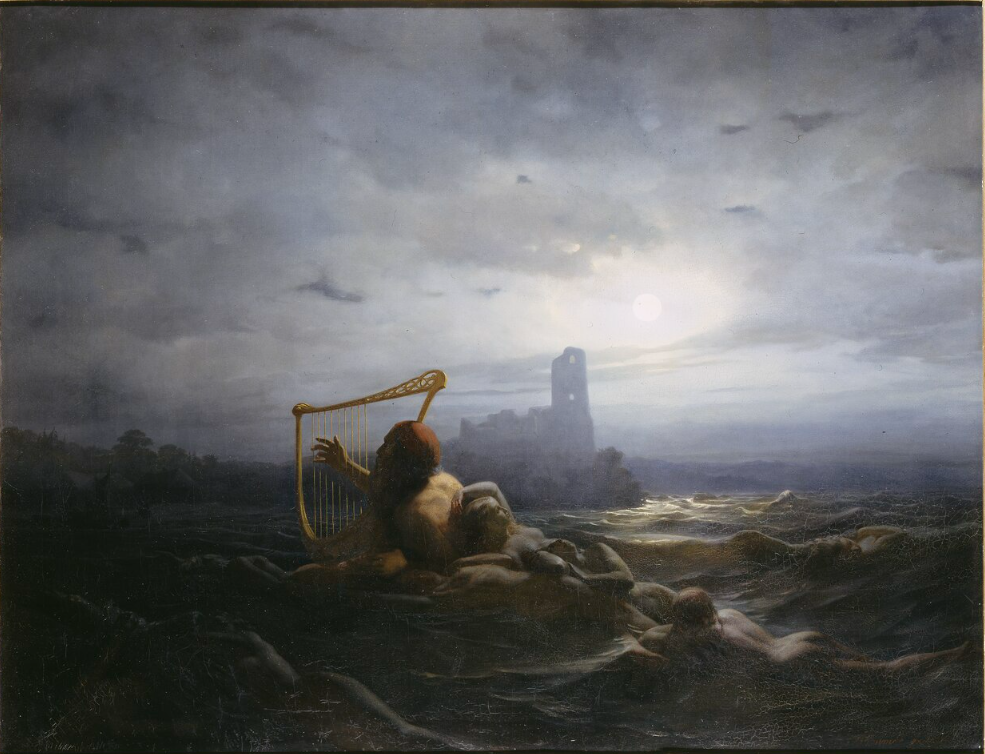
Over the years, he has been the inspiration for paintings, sculptures, and comic books, and music. One of the earliest example came from Nils Blommér 1850 painting entitled, Näcken och Ägirs döttrar (The Neck and Aegir's Daughters). This was was based on a poem about the ocean god and his family from Swiss writer, Arvid August Afzelius.
Another noted work of art came from Swedish artist, J.P Molin, who sculpted a fountain relief depicting the ocean god and his nine daughters.
By the 20th century, Aegir eventually went where nearly every ancient gods had gone; he graced the pages of comic books. In his case, he was referenced in the manga and anime series, My Hero Academia.
Another honor bestowed on Aegir comes from the world of science
Also, he became a reoccurring character in the Marvel Comics universe. He first appeared in Thor #307 in February 1981 and had the title of “God of the Trackless Sea”. He’d reappeared in future Thor comics and throughout the Marvel Universe in several publications. As far as it goes, however, he was and still is a minor character.
Comics and poems aren’t the only time Aegir showed up in modern media. He appeared (or mentioned, to be precise) in the God of War series through collectible coins in the Lake of Nine in God of War 2018, and God of War Ragnarök.
Scientists and NaviesTake Notice
Another honor bestowed on Aegir comes from the world of science. From geology to astronomy his name has been given to several discoveries. They include the following:
The mineral Aegirine, discovered in Kongsberg, Norway in 1821.
An exoplanet originally named for Aegir (now known as Epsilon Eridani b), which was discovered in 2000.
Name of a tidal bore in the River Trent (Trent Aegir).
In addition to scientists, the Norwegian and German navies have named several ships after him. This includes:
a Norwegian corvette built in 1967;
a coastal defense ship in the Imperial Germany Navy during World War I.
Aegir could’ve been swept away by the waves of history. Instead, he rode them and managed to become a part of the modern world.

Work Cited
Lindeman, Micha F. "Aegir" Encyclopedia Mythica/Pantheon.org (March 1997)
"Ocean God and Goddess: "Aegir"Pagonnews.com (defunct) (Retrieved 2009).
"Aegir" https://lofnbard.wordpress.com/2014/03/19/nafnathulur-english/ (Retrieved 2009).
Daniel McCoy: "Aegir and Ran": Norse Mythology for Smart People (2009)
Wikipedia Editor: "Aegir": Wikipedia.org (retrieved 2026)
Fandom Editor: "Aegir (Earth-616): Marvel Data Base (Fandom. wiki): (Retrieved 2026)
Norse Spirit Editor: "Aegir": Norse Spirit (retrieved 2026)
About the Creator
Dean Traylor
* Masters in special education and degree in journalism.
*Seasoned writer for the last 30+ years (Newspapers, Magazines, Internet sites)
* Former writer at Hubpages, Helium, and Wikinut.
* Current: Medium (https://medium.com/@ds_traylor)
Enjoyed the story? Support the Creator.
Subscribe for free to receive all their stories in your feed.
Comments
There are no comments for this story
Be the first to respond and start the conversation.