
Brynhild: This Fat Lady Hasn't Stopped Singing
When Brynhild the “Fat Lady” sang, it became an idiom in our language denoting that something was about to end or wasn’t about to end, yet. Ironically, the idiom as well as the myth and opera has only heightened the exposure of this iconic Nordic deity.


The Opera Revives a Deity
The following scene has come to symbolize a musical art form. A heavy-set woman dressed in Viking armor and horned helmet enters the stage and immediately hits high notes as she stretches her arms to seemingly embrace the crowd. She is known as the “fat lady that sings” and the term itself has become a part of our daily language.
Brynhild is possibly the most iconic character in opera. Her chain mail dress, horned helmet, blonde ponytail, sword, shield, and a high octave voice have come to personify this musical art form. One doesn’t even have to be a fan to know exactly what this iconic figure looks like or what she represents.
What is not known about Brynhild, however, is that she has had a pivotal role in Germanic literature for many years. Richard Wagner merely reintroduced her to the modern world in the 19th century. Yet, her lineage stretches as far back as the age of the Vikings.
In addition, Brynhild has found new life in other form of mediums, as well. And that includes the ever popular myhos of comic book literature.
Wagner Discovers Prose Edda
Germanic mythology often refers to Norse, German or Scandinavian folklore and stories. In the various societies that made up this language group, Brynhild’s role was pretty much the same.
She has been known by several names:
Brunhild
Brunhilda
Brynhildr
Brunhilt
Brynhld
She was either a shield-maiden or a Valkyrie. Shield-maidens were women warriors. Valkyries, on the other hand, were goddess-like deities who decided who will die in battle. In addition, they guided these chosen warriors to Valhalla, the majestic palace hall located in Asgard and ruled by the prime Norse god, Odin.
There are three ancient manuscripts Wagner drew inspiration from. The Old Norse collection called the Prose Edda established Brynhild as a Valkyrie, as well as her relations with the other gods.
The Poetic Edda, a collection of poems about Nordic mythology, contained the poem, “Helreið Brynhildar (Bryndhildr's ride to Hel)”. In it, she was confronted by a giantess who passed judgment on her for living an immoral life.
The Crime and the Search for the Right Man
The most of influential and where Wagner got most of his the plot for his four operas from – was the 13th century manuscript “Volsunga” saga. The poem was another included in the Poetic Edda. In this poetic saga, Brynhild was a beautiful Valkyrie who had been punished by Odin for disobedience.
Her crime was that she killed Hjalmgunnar, the king Odin had promised victory. He sentenced her to be imprisoned in a ring of fire and guarded by the dragon Fafnir. Her only way out of this ring of fire was to find and marry a man who knew no fear.
Eventually, that man, Sigurd, arrived and rode through the flames that enveloped her. He rode through it, slew the dragon, and took its treasure.
Sigurd fell in love with Brynhild when they met. He didn’t free her; instead, he left to take care of other tasks. Still, he promised to return for her once those tasks were completed. As a token of his promise, he gave her his magic ring (called Andvaranaut).
He returned; however, Sigurd was in disguise as Gunnar, the King of Burgundy. Gunnar was Sigurd’s ally and best friend (and brother-in-law). For some reason, Gunnar wanted to marry Brynhild. However, Gunnar was not brave enough to ride through the flames.
Thus, through magic, Gunnar and Sigurd changed identities. And, disguised as Gunnar, Sigurd rode through the flames to meet Brynhild (and to complicate this story, Sigurd forgot his pledge to Brynhild and gave it to Gunnar’s sister Gundrun, thanks to a magic potion given to him by Gunnar’s mother, Grimhild).
Afterward, a soap opera-like tale ensued: Brynhild married Gunnar; Sigurd married Gundrun; the couples had children; and went about their own business until the deception was revealed.
As a result of the revelation of the deception, Brynhild sought revenge against Sigurd, and, eventually, so did Gunnar. And through a third party (Gunnar’s brother Guttorm), Sigurd was killed. But, at the funeral, Brynhild was so overcome with grief that she killed herself.
In the final act, Brynhild (as a spirit) revealed to Gunnar that she had always loved Sigurd. Thus, he granted her wish to be burned together with Sigurd in a single pyre. Also, by her order, she had Sigmund, the three-year-old son of Sigurd and Gudrun, killed and burned on the pyre with her and Sigurd.
Another Version Brynhild’s Tale
Another version of this story was told in the 13th century German epic poem, “Nibelungenlied.” In this version, Brynhild is a queen of Isenland (Iceland). Also, Gunnar (now known as Gunther) wanted to make her his wife. Like the other versions, Gunner devised a plan with Sigurd (whose name changed to Siegfried in this version) to win her.
In order to win her, however, Gunther had to defeat her in three warlike games. And, being the crafty king he was, Gunther employed Siegfried to help him by using a cloak of invisibility.
That was until near the end. Brynhild failed to kill herself at Siegfried’s funeral. Instead, she survived and moved onto another adventure.
The first task involved a spear that only three people could barely hold. Brynhild threw it at Gunther, but at the last second it was diverted by an invisible Siegfried.
In the second task, Brynhild picked up a massive boulder and threw it at the king. Again, Siegfried saved the day.
And finally, as a show of agility, Brynhild challenged Gunther to jump over the same rock. Siegfried ensured that Gunther won. After this defeat, Gunther married Brynhild.
But, in a twist, Brynhild fell in love with Siegfried. The tale followed the Volsunga saga. That was until near the end. Brynhild failed to kill herself at Siegfried’s funeral. Instead, she survived and moved onto another adventure.
How Brynhild Became the “Fat Lady”
Throughout the early stories, Brynhild was not represented as a heavy-set woman. In many respects, she was depicted as a beautiful maiden that many men wanted to be with. The image of her as the “Fat Lady” didn’t happen until 19th century when Richard Wagner wrote his epic opera cycle Der Ring des Nebelungen (The Ring of the Nibelung). Even then, it was not a necessary character trait as it was a necessity for opera. Of these sagas, “Götterdämmerung”, led to the creation of the modern image of Brynhild.
Portions of Götterdämmerung
As pointed out on the website TV Trope, the women that played her in the operas were often big women “they’re usually the ones with vocal vigor”, especially in a Wagnerian opera (Trope, 2026). Simply put, bigger or heavy-set women were capable of hitting the type of high notes needed for the opera that women of lesser size were incapable of hitting.
Brynhild’s story in the opera saga is complicated in many ways. Along with its performance demands on the main character/opera singer, the story, itself, was unusually long (some performances lasted nine to twelve hours). And through all of it, Brynhild appeared in three of the four-part opera saga.
She Becomes a Popular Expression
Still, in the most ironic way, Brynhild would find immortality outside the stage and literature. Often, Brynhild would be the last person to perform in the long Wagnerian opera saga and it was usually the most demanding high pitch performance of the play.
During the mid-20th century, the sports announcer Dan Cook often evoked Brynhild by stating “It ain't over ‘til the Fat Lady Sings” while covering basketball games.
In its current use, it often means that something isn’t over until it is over. And that finality is represented by Brynhild going out on stage for the last time.
Not only did this become a popular idiom in today’s language, the image of Brynhild as a fat lady in her Viking gear hitting a high note has become a trope commonly used throughout various forms of media. Interestingly, she also took on a new identification as “Brawn Hilda” as a way to describe her new girth image (TV Trope, 2026).
Brynhild Lives On!
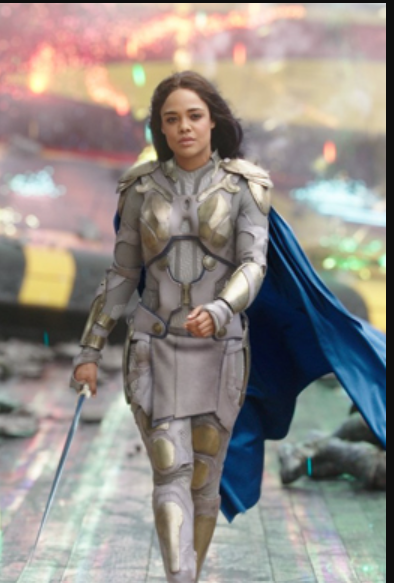
Other forms of media incorporated the deity. Marvel comics (which has had a history of using Norse gods such as Thor) had her as a character in a few illustrated series. In the comic and cinematic universe, Brynhild (spelled Brunnhilde) is also named Valkyrie.
Also, the TV show, “Xena: Warrior Princess” had a character based on her. In addition, Manga and Anime shows from Japan focused on her and other Valkyries.
Brynhild may have had a tragic end in the original stories, including the Wagner operas. However, the “fat lady” hasn’t sung yet, after all. Brynhild seems to remain an icon for opera, and a worthy subject for other forms of story-telling.
Work Cited
Wikipedia Editor: “Brynhild”: Wikipedia. org (retrieved 2010):
Jimmy Joe: “Brynhild ”: Timeless Myths.com (Aug. 16, 2003)
Fandom Editor: "Brunhild": fandom.com (retrieved 2026)
TV Tropes Editor: "Brawn Hilda" :TV Trope.org (retrieved 2026
Victoria Pena: "Fat Lady": Stereotypes of Women in the Arts (April 28, 2011)
Sacred-Texts editor: "Helreith Brynhildar (from Poetic Edda)": Sacred-Texts.com (Retrieved 2026)
by Snorri Sturluson (Author), Jesse L. Byock (Editor, Translator): The Prose Edda: Norse Mythology: Penguin Classic (January 31, 2006)
Fandom Editor: "Brunnhilde (Earth-616)": Marvel Fandom.com (retrieved 2026)
Anonymous (13th century), William Morris and Eirikr Magnusson (translator): The Story of the Volsungs: Walter Scott Press, London (1888)
Anonymous, Margaret Armour: The Nibelungenlied : York University Press (1999)
About the Creator
Dean Traylor
* Masters in special education and degree in journalism.
*Seasoned writer for the last 30+ years (Newspapers, Magazines, Internet sites)
* Former writer at Hubpages, Helium, and Wikinut.
* Current: Medium (https://medium.com/@ds_traylor)
Enjoyed the story? Support the Creator.
Subscribe for free to receive all their stories in your feed.
Comments
There are no comments for this story
Be the first to respond and start the conversation.