
Book Review: "The Way Home" by Mark Boyle
4/5 - a surprisingly interesting book about living in nature...

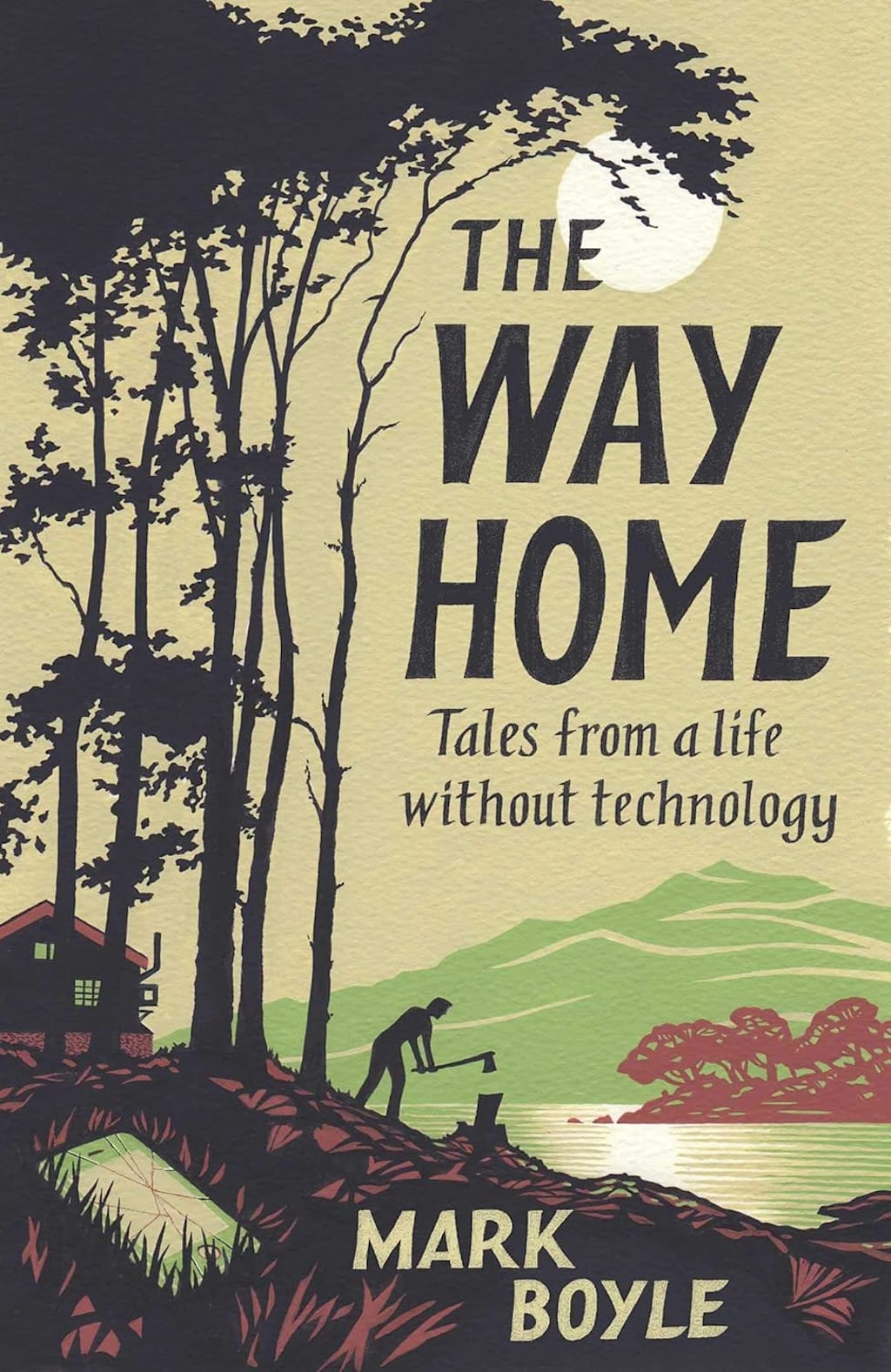
Perhaps I thought this book was going to be so boring that I didn't actually bother spending money on it. Yes, I got it for free. But as an interim book, this wasn't actually that boring at all. In fact, the further I got into the book, the more fascinating it became (keep going past the stuff about composting manure, I promise it gets more interesting). The author's want to live away from modern technology and all its infrastructures initially seems like an experiment doomed to fail, but as we get more into the text we see that he is pretty determined to live like this. Complete with little side stories and supporting literature such as books by Robert Macfarlane - this book was surprisingly enjoyable.
The author moves into a smallholding in rural Ireland and attempts to build a home and grow his own food, meeting his needs without the requirement of modern technology (or indoor plumbing for that matter). Using only locally sourced resources and natural methods, he 'lives off the land' in a way we would think that a John Steinbeck character would. We get an insight into the skills he picks up along the way and how he gains more knowledge of them. For example we see: woodworking, foraging and water collection. Yes, it might be done through trial and error, but let's admit it - we're sitting behind a computer screen so he's a bit better than us.

He seeks to reconnect with nature. But not just in a Tables Turned by William Wordsworth kind of way, but he wants to connect with the land and seasons, the very rhythm of nature itself. His argument? People have become more distanced from the natural world and thus, have moved away from what essentially makes us human. The reconnection isn't only essential for wellbeing, but is also good for environmental sustainability as people are learning skills from the land rather than from their phones. They are creating better energy rather than consuming energy that is eventually going to run out. I found this quite interesting to see because when I've read about nature the main argument seems to be 'do this for your wellbeing'. My response is often: great, now I'm depressed but now I'm also outside. If there is something to do outside rather than just walking around my knife-ridden city, then I'd perhaps consider it.
Don't get the author wrong, there's nothing romantic about the experience. Things go wrong, there's lots of manure (I promise I will move on from this eventually), the weather is harsh and often horrid, there is a huge difficulty associated with self-sufficiency and plus, the author admits early on in the book that he uses technology for everything. There is a certain amount (a big amount) of self-sacrifide required to commit to this lifestyle. This is a way to create what the author understands as 'home' - which is more complicated than simply a building where we eat and sleep. There is something about that cultivated environment that we inhabit. It is not just a purchased piece of land. There is so much more. I found that beautiful.
The author also engages with the idea of community. What we often see as community, which would be online worlds where we now spend a lot of our time, may also foster a great amount of emotional isolation. But, there might be a physical isolation of the lifestyle our writer has chosen for himself, there are a bunch of small connections that prove to be very close. There's not much emotional isolation. There's a true sustainability that seems to rely on mutual support and small networks. These friendships are deeper, more meaningful and make people responsible for various things rather than the friendship being weighted towards certain individuals. I have often found that in my friendships that I do the work to maintain them and thus, I have all the responsibility. It is books like this which have convinced me to stop doing that and to let these people walk out of my life. Thus, I thank Mark Boyle for letting me know that there is more out there and that selfishness isn't friendship.
As you can see, I was surprised at how engaged with this book I was and so, I'd recommend it to anyone who is planning on simply putting down their phone more. If you're feeling a bit more wild however, you could take a leaf out of this book...
About the Creator
Annie Kapur
"Et in Arcadia Ego"
***
I am:
🙋🏽♀️ Annie
📚 Avid Reader
📝 Reviewer and Commentator
🎓 Post-Grad Millennial (M.A)
***
I have:
📖 300K+ reads on Vocal
🦋/X @AnnieWithBooks
📸 ThePrancingPonyBakery
🔗 PrancingPonyBakery.com
***
🏡 UK
Enjoyed the story? Support the Creator.
Subscribe for free to receive all their stories in your feed. You could also become a paid subscriber, letting them know you appreciate their work.
Comments
There are no comments for this story
Be the first to respond and start the conversation.