
Book Review: "The Scape-Goat" by Lucy Hughes-Hallett (Pt. 2)
"Sex" to "Apocalypse"

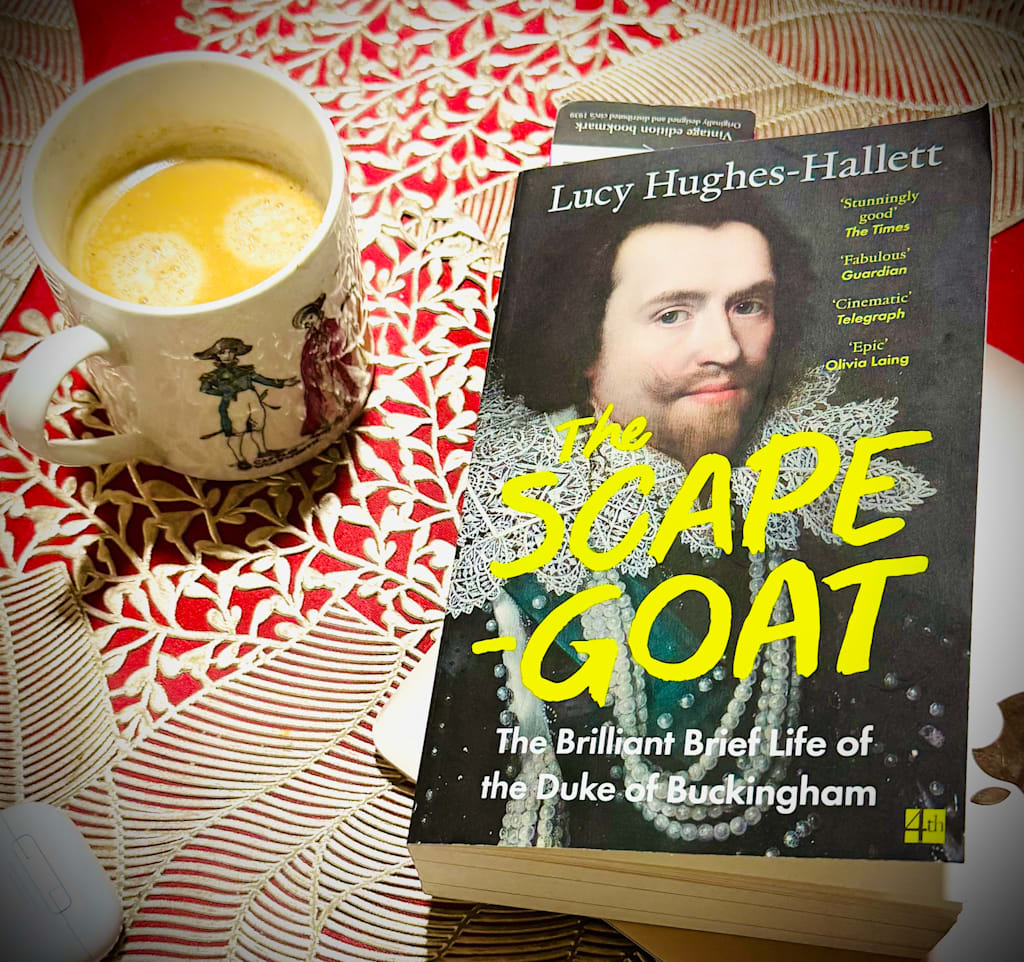
Sexual activity may have been commonplace in a court of intrigue, but if it was between two men it was considered against nature. James would condemn it himself in the same way McDonald's might condemn ultra-processed foods. The author makes a point of James defending himself and his relationship with Buckingham by comparing it to the relationship Jesus had with John. I personally do not think those two things are the same, but each to their own. If James perhaps lived today, his relationship with Buckingham wouldn't be a problem because it was homosexual, it would be a problem because James was married. I still feel sorry a bit for Anne, though she was well looked after.
James hated war. Henry, the eldest son, hated scholarship. This caused an obvious rift between father and son. Buckingham too was attracted to the King's want for peace but knew that this also meant that he wouldn't necessarily say 'no' to advancements in the Villiers family. Queen Anne noticed this and as the author puts it, saw that Buckingham was dropping his helpers like flies once he had secured whatever position he was looking for. Honestly, this picture of Villiers is much more contrived that the one we get in part 1 of my review. It represents a man who is far more confident in his position at court and the author does justice in making him seem as though even though he's not well liked, he's still exactly the same as everyone else: trying to advance his position in the King's favour.
The King would make Buckingham 'Master of the Horse', a title which focused on horse breeding of course, for hunting and war. This would send Buckingham to Europe and he would come back with deals for horses from Italy and Spain with an Arab one for the King. Hallett paints this again, as part of Buckingham's trial to impress the King and we are reminded that he wants positions for his family in the long run. Of course, this impresses the King. Actually, it impresses him so much that he gives in to approving of Buckingham's breeding program for the horses in order to create even stronger ones. This isn't machiavellian in the sense, but it is definitely something we must notice about the Duke.

Buckingham was an ample art collector and wanted to be considered along the same lines as a the scholars of England in art collecting though he wasn’t much of a reader. Peter Paul Rubens would visit Buckingham’s art collection after he died and notice works by artists like Titian. It was clear that art collection was a gentleman's pursuit and Buckingham definitely wanted to have his ahnds in the pot of being considered a rich gentleman so that the King would not throw him to one side. This again, was another play to keep his name in the King's mouth so that when the time came, he could get his own people into court.
Buckingham did most of James’ work for him even though others didn’t see it. He didn’t concern himself with court gossip anymore but instead he got involved in being prepared for war, creating and maintaining laws and making sure the royal household was in order. He was literally doing the King’s work for him. I'm not going to keep repeating the same thing but you get the idea. This is a man who desperately wanted to keep favour, he also wanted to have power over others. From the very fact that the author states earlier on in the book that people often forget that this man had his own motivations and ideas (and allegiances) means he was perhaps very good at hiding them. Almost too good.
Bacon and Cooke were both advisors and very smart men. Bacon’s education was in law and he seemed to do nothing but consider the law and legal system in everything. He was the advisor to Buckingham and when Buckingham was trying to get his brother married (his brother was insane), the wife was unhappy and ran away - her lover imprisoned. Buckingham had failed this time and his friendship with his advisor became shaky at best. The author paints this as somewhere where Buckingham really failed at something he was meant to do in the real world. Proving that he simply didn't have the same calm or smarts as the other men of the court. They were older and more experienced than he was.
But it wasn't all down and out for Buckingham, he had an affair with a married woman who would become a double agent. Her name was Lucy Percy. He also enjoyed hunting. The author takes us through every single bit of the hunt, looking at how Buckingham's horses would have been used by the gentlemen, again a way of keeping him in favour if his horses were doing well. But one thing we notice is that there is a stark difference between the upbringings of the King and Buckingham. Whilst the King was horrifically unhappy and was orphaned at a young age, Buckingham had many relatives. James therefore kept a lot of relationships as formalities, almost allowing himself to become fully in love with Buckinham as a result. This is a slightly more sympathetic picture of a misogynist and often unwise King.

Painted as Venus and Adonis from the Shakespeare poem and myth of the same name, Buckingham was in love with his wife, but was also very enamoured with the King. He employed a wizard, which was dangerous considering James' position on witchcraft and ultimately he would oppose the idea of the King going to war on Spain.
As we can see now, there are holes forming in the story. Buckingham is starting to have ideas, the King is starting a new plan and the advisors have drifted away from the Duke. What on earth will happen next?
About the Creator
Annie Kapur
"Et in Arcadia Ego"
***
I am:
🙋🏽♀️ Annie
📚 Avid Reader
📝 Reviewer and Commentator
🎓 Post-Grad Millennial (M.A)
***
I have:
📖 300K+ reads on Vocal
🦋/X @AnnieWithBooks
📸 ThePrancingPonyBakery
🔗 PrancingPonyBakery.com
***
🏡 UK
Enjoyed the story? Support the Creator.
Subscribe for free to receive all their stories in your feed. You could also become a paid subscriber, letting them know you appreciate their work.
Comments
There are no comments for this story
Be the first to respond and start the conversation.