
Book Review: "The Scape-Goat" by Lucy Hughes-Hallett (Pt.1)
"Introduction" to "Older Women"

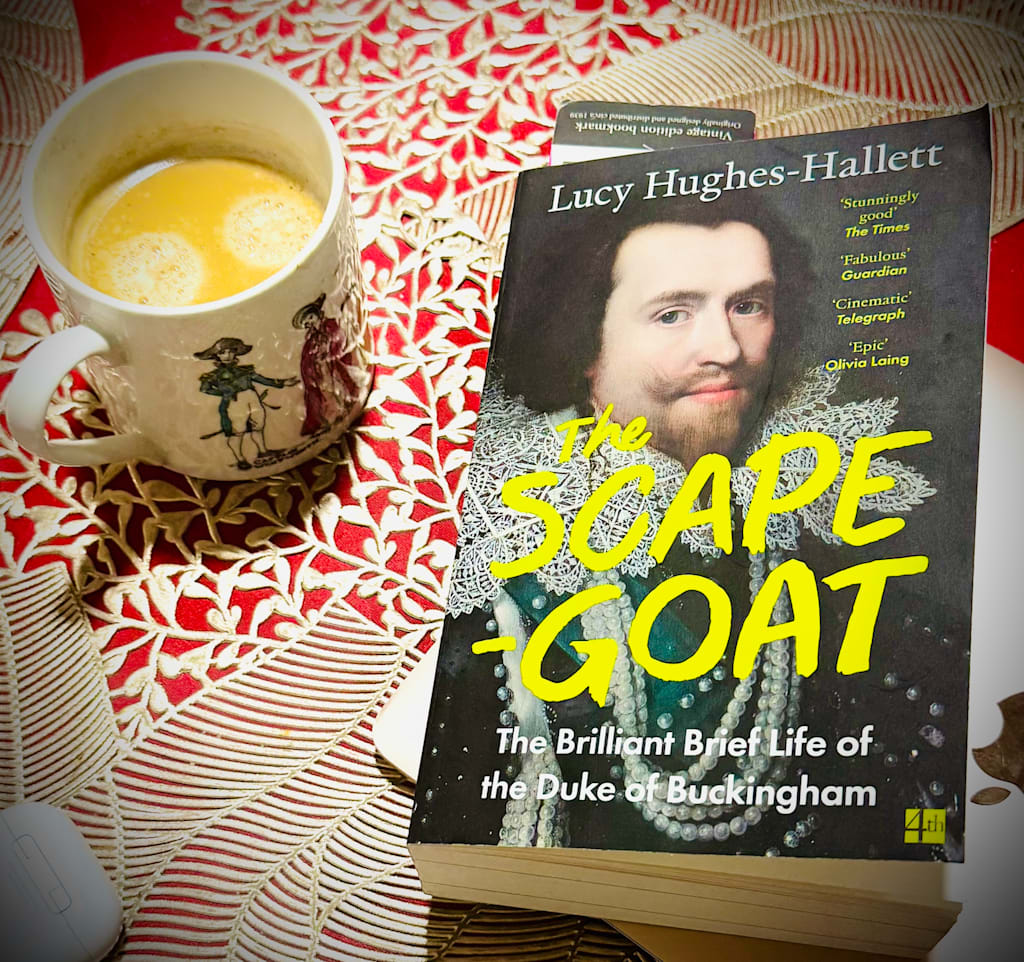
I have yet again turned my gaze towards large books about historical figures. So far, books such as Queen Victoria, Agatha Christie and Jane Austen at Home have caught my attention - all by Lucy Worsley. I have also been caught by The Palace by Gareth Russell - an almost 500 page book about Hampton Court. I have also a number of others to read yet. But as for now, we turn our attention to the book The Scape-Goat by Lucy Hughes-Hallett, a book that covers the life of George Villiers, Duke of Buckingham. At almost 700 pages, it is a brilliantly deep book which covers absolutely everything about this strange man from history. Let's investigate it therefore, in our classic new style: parts and sections.
Hallett first introduces to us the court politics of King James I. Needless to say, it is a court of intrigue and power struggles, it is where people who are too in favour are not very well-liked amongst their peers. But George Villiers, the Duke of Buckingham is said to be extremely handsome and so, he seems to get a bit of a free pass amongst the others, especially when it comes to Queen Anne (wife of James). James adored Buckingham and Anne understood that the King needed this man with him even if she were to take a back seat.
Hallett also takes us through the early life of Buckingham, noting that he was not book-smart, nor was he very good at languages. For example, he didn't really know much of the lingua franca of latin - the language of diplomacy and yet, he was still able to get into court. How was this done? Hallett explains his mother, Mary, was a woman who definitely believed her son was destined for great things and so, wanted to parade his beauty around the court. The King was enamoured. The fact that Buckingham wasn't very smart therefore, didn't matter too much.
The author's writing definitely reflects the fact that this man was to be in court for the reason of being handsome because almost as quickly we move on from Buckingham to the King himself. An awkward man with a lifelong limp, James had been through his own course of violence as a child. Multiple people in his family were either slaughtered, beheaded or murdered in front of him. By the time he was the King of England therefore, he had already been King of Scotland for long enough to not actually be able to relate to others very well and so, his minions are described as essential to his wellbeing.
It is strange that this man (Buckingham) was practically bred to be a minion to the king, but as the book starts off with him receiving commendations and being celebrated, there was definitely once a time where he was loved and respected by everyone. though, of course it did not last. It never really does in a court of intrigue and hedonism. Hallett makes it clear that there is about to be explosive movements happening behind those closed doors and we are drawn into a world of love, fear and politics.

Buckingham is also described as a great dancer and dancing was one of the most iconic things to do in the royal court. It was difficult and proved impossible for those who had not learned the exact movements, but it was best when it looked as if it were low effort. It had to look like you always knew exactly what you were doing and not putting too much into it. Many people talked about Buckingham having the best legs and feet for the job and its reported on in primary sources from the author's research.
Masques and dances are described as key parts of the entertainment at court. when I read ‘The Palace’ by Gareth Russell, I noted that he spoke of the women around Queen Anne (consort to James) performing masques featuring characters from mythology. Performance, hedonism and theatricals were part of the Baroque and so, was also part of royal life. Buckingham with his intricate steps in dancing and in social climbing, fit right in. I'm not going to lie, I love how noteworthy everything about Buckingham is. Everything is almost too deliberate and yet, he was not nearly as smart as the politicians and ambassadors in the room. He was nonetheless, triumphant at getting the attention of the King of England.
It seems sad to see that King James and his wife, Queen Anne, were living separately for some time though they still liked and respected each other, it's clear that love was not part of the relationship once Buckingham comes into the picture - though it is still presented as such. The author explains to us that the reason for Buckingham entering the picture was due to the deep seated loneliness of James I and the fact that he had to have someone with him to hold. Of course, Anne had the friends she kept, but James found it increasingly difficult to make new friends. We get to see these fallouts through the horrific back and forth in courts ending with the imprisonment of the Duke of Somerset (even though thankfully for him, he was not beheaded) and the misogyny which James seemed to take under his wing. Hallett puts both of these things together to create a rather unsympathetic and entitled portrait of the King, but I think that two things can be true at the same time. This is a man who is both a product of and a victim of his own circumstances and cannot seem to change them because of who he is.
As we move on to the next chapters of the book, we gain access to the changes that Villiers made in the king's life. We look at the different attitudes of the court and the way in which the Duke of Buckingham slowly made friends - but also made great enemies. If you were a favourite of the king's then chances are there were a lot of people who did not like you.
About the Creator
Annie Kapur
"Et in Arcadia Ego"
***
I am:
🙋🏽♀️ Annie
📚 Avid Reader
📝 Reviewer and Commentator
🎓 Post-Grad Millennial (M.A)
***
I have:
📖 300K+ reads on Vocal
🦋/X @AnnieWithBooks
📸 ThePrancingPonyBakery
🔗 PrancingPonyBakery.com
***
🏡 UK
Enjoyed the story? Support the Creator.
Subscribe for free to receive all their stories in your feed. You could also become a paid subscriber, letting them know you appreciate their work.
Comments
There are no comments for this story
Be the first to respond and start the conversation.