
Book Review: "The Meaning of Life: A Very Short Introduction" by Terry Eagleton
2/5 - probably one of my least favourite of the series so far...

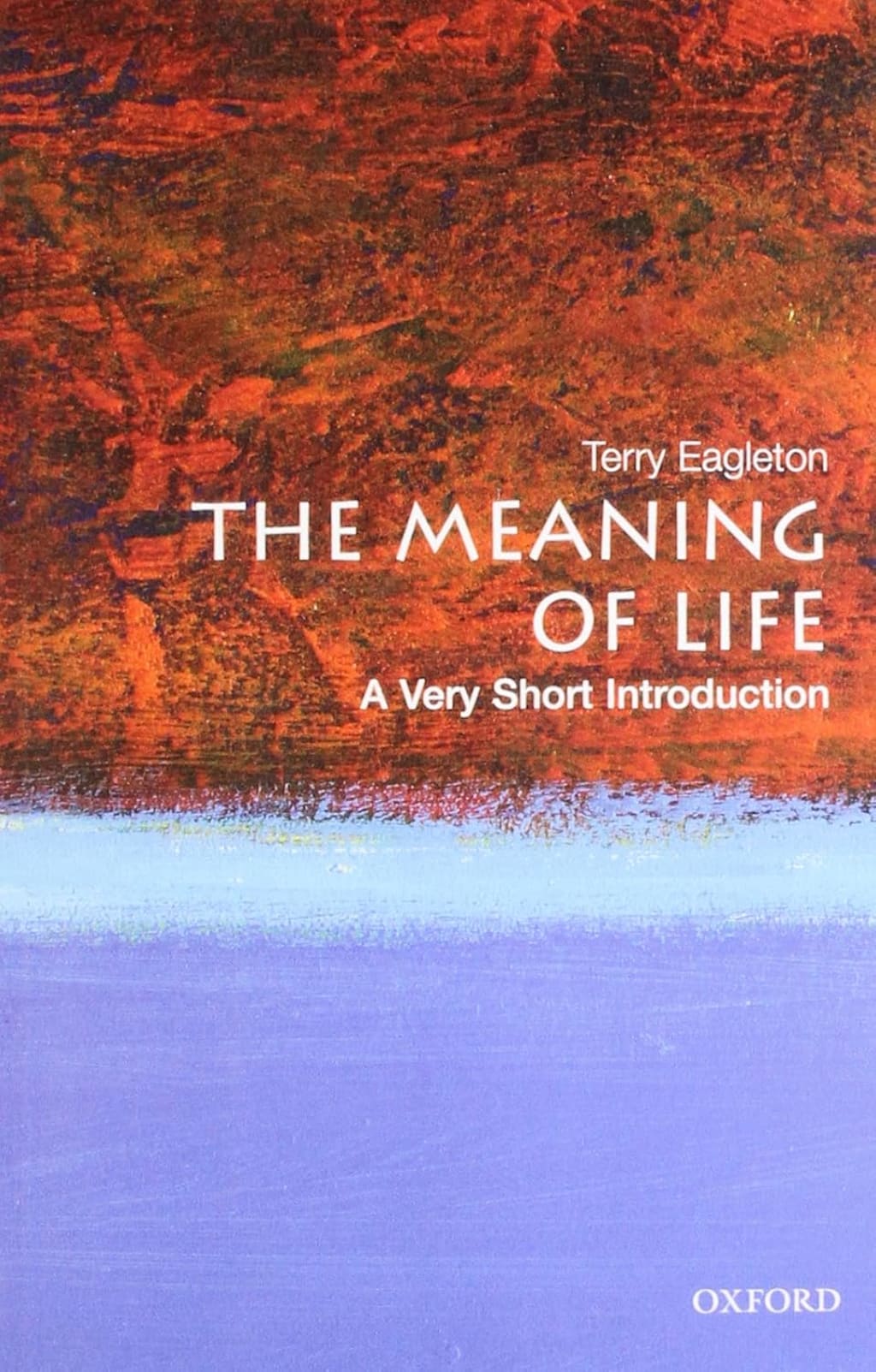
I've read plenty by Terry Eagleton as many a post-grad of literary subjects will have. I've been over some of his essays and have often regarded him as a master of literary and critical analysis. So you can imagine that I was probably wondering what went so horribly wrong here in which he talks in swings and roundabouts about The Meaning of Life. This book felt like a mixture of philosophy, religion and ethics - which I can understand. But it also felt disorganised and when it comes down to it, kind of here and there. It never really gives us an answer, but ironically it doesn't really leave us to think about a question or at least, a perspective to the question, for very long at all. It thrusts itself too quickly across points and these points aren't very well discussed. This has probably been one of my least favourite in the series. It just doesn't measure up.
The first thing we have is a very 'Jordan Peterson' look at the question of the meaning of life, as every word in the question seems to be problematic. I cannot stress enough that if you are going to start off a philosophical analysis this way at least try to go into some depth. I know it is called A Very Short Introduction but there is a chance to do something. This book is particularly shorter than the others, and yet we still get no real focus. He states that because of the problematic nature of each word in the question, the conversations of the meaning of life tend to misunderstand each other. The author states that in order to answer our question we must first understand from which angle we are going to approach it from. I felt like I was going to cry of boredom by the time this point was made but here we are. I didn't cry of boredom. But I was bored.
He argues that people in earlier societies often relied on religion, tradition, or shared cultural frameworks to provide answers. I mean, that's kind of obvious but at least we aren't dragged through each individual section. Modernity therefore has this question in a more urgent sense because these three things have broken down over time. This I agree with, but again it seemed like a fleeting idea that wasn't explored. I would have liked to seen this in more action - looking more at what our modern day did to make so many of us question the meaning of life. If the past answers were so easy, there must be some sort of easy answer for us too.
A common response to modern uncertainty is nihilism: the belief that life has no meaning at all. This then transforms into absurdism as you get older (which is basically just: ✨life has no meaning at all ✨, so it's sparkly and fun nihilism), but that's besides the point. Our author argues that this conclusion often results from a false dilemma. The choice is often framed as either God giving life meaning or life being entirely absurd. Eagleton rejects this binary. Even if the universe has no divine designer, meaningful human values and purposes can still emerge from our social and ethical lives. I don't know if I agree that it really is a binary, but I guess there is some sort of binary existent within the individual - though these probably wouldn't be the two choices I would say they are. I would instead say they are: "my life has intrinsic meaning because I do therefore, I exist" vs. "I do not do and so, I do not care". Or something like that.
He draws heavily on Aristotle’s concept of eudaemonia, often translated as flourishing or happiness. According to this view, the purpose of human life is the full development of our capacities which are: intellectual, emotional, and social. Meaningful life involves living in ways that allow these capacities to thrive. Happiness is not simple pleasure but a deep form of well-being that arises from fulfilling our human nature. Here we go guys: another way of saying being present without defining what being present actually is. If you're like me and you've gone out into nature and not been 'changed' by it, then you're not broken you just don't know what you're looking for. I dislike this notion that something like walking barefoot on grass can make you have an epiphany about your own meaning and spirituality. It seems like Eagleton is trying to answer a question he has already admitted has no answer.
He states that humans are social beings whose flourishing depends on communities and institutions. This means that societies marked by severe inequality or exploitation undermine meaning for everyone (I actually massively agree with this. If you'd like to learn how this was a achieved in our modern day read The Social Distance Between Us by Darren McGarvey - you won't regret it). A meaningful life therefore has political and ethical dimensions: it involves creating social conditions that allow people to develop their capacities together. This is a point I really agree with and I love reading about and exploring. The social engineering of inequality in order to depress the masses and control them through their feeling of a lack of inherent meaning. You don't give them meaningful work, you give them meaningless items - you sell things to them. All of this is by design. All of this is method.
Though I don't agree with the usual 'touch grass' and you'll have an epiphany about being social and being in nature and your depression and anxiety will be solved, I do agree with the fact that a lot of people might actually need it - it just doesn't work on me. Equality in society has been proven to help societies thrive and so, you can only imagine why society has been structured in order to draw people apart through money and meaning with those at the bottom hit the hardest. I think Terry Eagleton is being very smart here, but I think it is too much in too little of a space. There's just a lot in a small book and it's all balanced rather incorrectly. It makes the book seem very surface layer.
About the Creator
Annie Kapur
"Et in Arcadia Ego"
***
I am:
🙋🏽♀️ Annie
📚 Avid Reader
📝 Reviewer and Commentator
🎓 Post-Grad Millennial (M.A)
***
I have:
📖 300K+ reads on Vocal
🫶🏼 Love for reading & research
🦋/X @AnnieWithBooks
***
🏡 UK
Enjoyed the story? Support the Creator.
Subscribe for free to receive all their stories in your feed. You could also become a paid subscriber, letting them know you appreciate their work.
Comments
There are no comments for this story
Be the first to respond and start the conversation.