
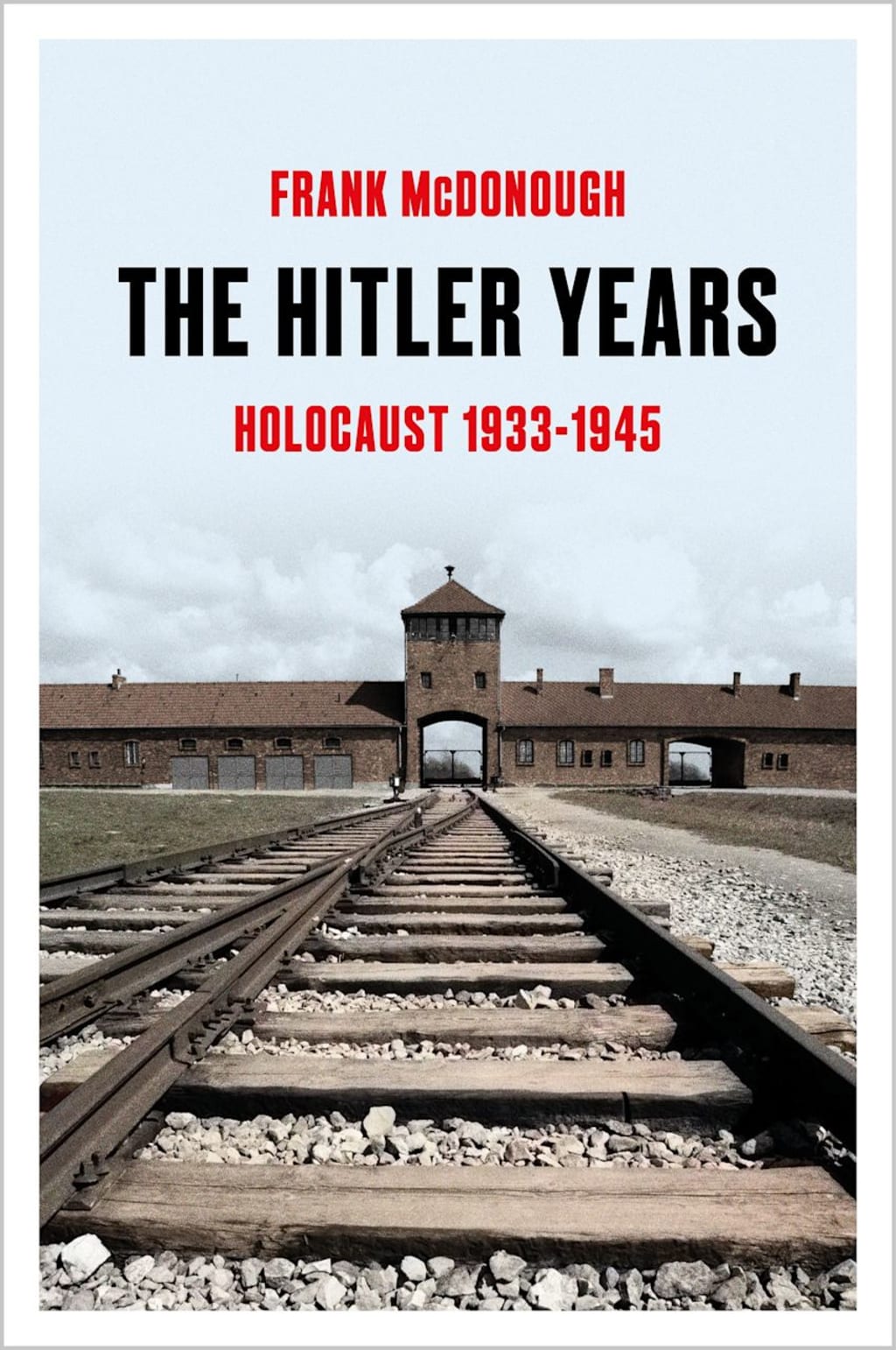
Book Review: "The Hitler Years" by Frank McDonough" (Pt. 6)
5/5 - ...shocking and upsetting...no matter how much you know about the holocaust, there's not much that can prepare you for learning more about it...

You can read the entire series of these reviews of three books by Frank McDonough in the links below:
The Weimar Years:
Triumph:
Disaster:
This review of Holocaust will therefore be Part 6 in the series (I know, the Weimar one doesn't count because at that point, I simply didn't know there were more books and you can probably see the difference in the timeline to when I read the first one to when I started Triumph. Sorry about the confusion).
Holocaust deals with what it states. The years are 1933 through to 1945 and we not only bear witness to the horrors, but we see the politics behind them, the key players and the inner circle. We get a feel for the precursors to the nightmare that followed and how it was all normalised beforehand in a gruesome and planned out political attack. It didn't start with the murders and the genocide, but that is where it ends up time and time again. If there is one thing that Frank McDonough teaches us it is that the holocaust we know about in the 20th century is not alone in its political playbook. This technique has been used time and time again throughout history to make sure that certain people were eradicated from a certain place and time via discrimination and victimisation. We also see how the Nazis implemented the techniques from older time periods in order to eliminate these people they called their enemies and the enemies of the German people and to what extent they took this too. And by god is it a horrific extent. They basically gaslit a whole nation.
One of the main points that this book deals with is that the holocaust itself was not an overnight thing but a planned and organised political attack on the Jewish people not only of Germany but of places that would later become German occupied. For example: there were mandates brought in to stop Jewish people joining the arts and education sectors, to stop them joining orchestras and clubs and to make sure that they were being discriminated against in every aspect of their lives - and this was long before any Night of the Long Knives or Night of Broken Glass took place. Then, people were encouraged to stop buying from Jewish businesses and (even though this started by not going very well and people continued buying from them) they were incentivised to turn away from Jewish produce. Honestly, to be Jewish in Germany during the lead up to the holocaust must have felt psychologically terrifying - the very government you lived under was actively trying to destroy your life from every angle. The holocaust became the 'final solution' only because all of the incentives to force the Jews out of Germany and Europe did not work and I even have my own feelings that the holocaust was the plan all along - everything else was just a distraction to make it look like a 'long road'. Honestly, it is disturbing and distressing either way.
Another main point this book deals with is the way in which the final solution impacted so many people across Europe. It would, as the author states, be the richer Jewish people who had the means to leave and were at most, left alone. It was the lower middle class and the working class who were subjected not only to the nightmares of the labour and death camps but also to the hands of the dreaded and evil Josef Mengele. As the book progresses, we learn that not a lot of the Jewish folk who were tortured and imprisoned were actually from Germany at all, but from the surrounding area, led to their demise via those nightmare-fuel trains that took them to places like Auschwitz and Treblinka. Reading about some of the practices within the camps makes you want to be sick especially when you know how many children were subjected to this treatment and what happened to them under men like Mengele. Yes, I will constantly complain about him - there are few people in the world with so much evil in their hearts.
Anyways, this book was distressing, disturbing but then again it is also very important. If we cannot learn from our past we are doomed to repeat it and one thing the author teaches us is that Germany's holocaust of the Jews wasn't the first of its kind in which one group of people try to eradicate another - and if we aren't careful it won't be the last either.
About the Creator
Annie Kapur
"Et in Arcadia Ego"
***
I am:
🙋🏽♀️ Annie
📚 Avid Reader
📝 Reviewer and Commentator
🎓 Post-Grad Millennial (M.A)
***
I have:
📖 300K+ reads on Vocal
🫶🏼 Love for reading & research
🦋/X @AnnieWithBooks
***
🏡 UK
Enjoyed the story? Support the Creator.
Subscribe for free to receive all their stories in your feed. You could also become a paid subscriber, letting them know you appreciate their work.
Comments
There are no comments for this story
Be the first to respond and start the conversation.