
Book Review: "The Hitler Years" by Frank McDonough (Pt. 5)
5/5 - the rushing decline of Nazi Germany is a tale of two things...

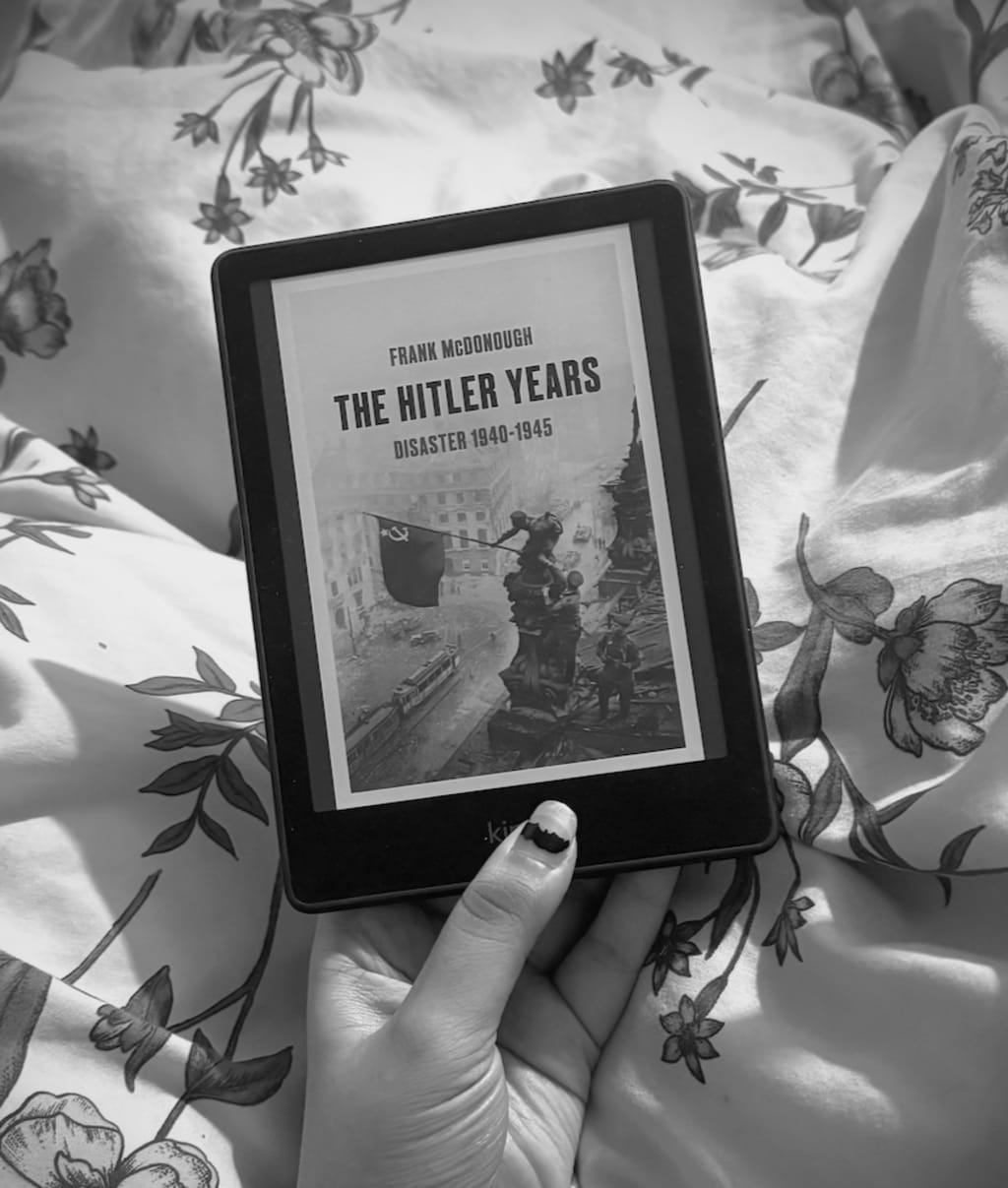
This review covers the chapter concerning 1942 through to the end of the book.
***
By 1942 the war began to shift decisively against the Third Reich. I mean, this was already happening but it is happening so much more now that it has become almost blindingly obvious that they are going to lose. The Allies begin to use their vast industrial resources and co-ordination to attack Germany in a systematic way. Germany’s overstretched supply lines and limited production capacity also becomes increasingly obvious to the point that I wouldn't be surprise if Hitler was second guessing himself by this point. The Eastern Front in particular drained German manpower and equipment at an unsustainable rate. At the same time, Allied bombing campaigns intensified, weakening German industry and morale. By the end of 1942, the momentum of Nazi expansion had been replaced by defensive struggles across multiple fronts. The author shows this from the perspective of the series of failures in 1940 and 1941 as being an inevitability by this point. It was as if there was no other way it could go.
The catastrophic German defeat at Battle of Stalingrad is another key moment in the book where the author takes us on yet another narrative of German failures during the war. The battle demonstrated both Hitler’s strategic rigidity and the limits of German military power. Despite warnings from his generals, Hitler refused to allow the trapped Sixth Army to retreat, leading to its destruction. This absolutely shatters the myth of German invicibility that was by this point almost a decade in the making. It is a full-on wipe-out of German forces, military and even morale. But it boosted the morale of the Soviets and marked the beginning of a counteroffensive that would push their enemies back to Berlin. After Stalingrad, Germany increasingly fought defensive battles while facing mounting losses in men and resources. This is a huge turn in the narrative because the way the author writes this section is as though the German military have just realised what has happened. They aren't invincible, they aren't stronger than the other countries and they are going to spend the rest of the war playing catch up and getting killed by the Soviets.
As the war situation deteriorated, the Nazi regime intensified its mobilisation of German society. Under figures such as Joseph Goebbels, propaganda campaigns called for “total war,” demanding greater sacrifices from civilians. The consequences of this would obviously lead to labour shortages as more men were going away to die at war, and of course there would be more of a requirement of labour from the territories that Germany had occupied, This meant in reality, forced labour. Allied bombing campaigns devastated German cities and industrial centers, further weakening morale and infrastructure. Despite these pressures, the regime maintained strict control through propaganda, repression, and surveillance. The author is actually quite surprised how resilient Germany remains in the face of inevitable defeat. Those at the top must have known there was no way to win the war, but to back down would be a humiliation. It would need to be a fight to the very end.

By 1944 Germany faced crises all across Europe. Allied forces launched the Western invasion of Europe through D-Day, while Soviet armies advanced relentlessly from the east. The author explains that Germany was running so low on resources, it could no longer really defend itself anymore. Hitler’s increasingly unrealistic military directives worsened the situation, as he forbade retreats and demanded impossible counterattacks. The year also saw growing internal dissent within Germany, culminating in the July 20 Plot, an assassination attempt against Hitler by German officers. This shows how unstable Germany was from the inside as well. The German officers having had enough and seeing their only way out as assassinating the guy in charge of the country. Although the plot failed, it revealed cracks within the regime and led to brutality against suspected conspirators.
The final chapters describe the collapse of Nazi Germany in early 1945. Soviet forces encircled Berlin while Western Allied armies advanced from the west. There are so many things wrong with Germany by this point including but not limited to: mass civilian displacement, relentless bombing, and desperate military resistance. Hitler retreated to his bunker in Berlin, where he continued issuing unrealistic orders while the situation deteriorated rapidly. In April 1945 he committed suicide as Soviet troops entered the city. Germany soon surrendered unconditionally, ending the Third Reich. It was inevitable yes, but it was also catastrophic.
According to the author, Nazi Germany was never really capable of winning the war. The economic base, he argues, was too limited and unstable to sustain a global fight of this kind and the combined power of the Allies was bound to take out a country that could barely defend its borders. The regime’s ideological extremism also undermined its strategic effectiveness, encouraging reckless decisions such as the invasion of the Soviet Union and the genocidal policies that diverted resources and intensified resistance. Hitler's authoritative leadership style, the author states, would have been the key factor in the rushing decline of Germany's chances of survival during this time.
Everything therefore is both a structural weakness in the system and the horrific nature of blinding ideology.
About the Creator
Annie Kapur
"Et in Arcadia Ego"
***
I am:
🙋🏽♀️ Annie
📚 Avid Reader
📝 Reviewer and Commentator
🎓 Post-Grad Millennial (M.A)
***
I have:
📖 300K+ reads on Vocal
🦋/X @AnnieWithBooks
📸 ThePrancingPonyBakery
🔗 PrancingPonyBakery.com
***
🏡 UK
Enjoyed the story? Support the Creator.
Subscribe for free to receive all their stories in your feed. You could also become a paid subscriber, letting them know you appreciate their work.
Comments
There are no comments for this story
Be the first to respond and start the conversation.