
Book Review: "The Hitler Years" by Frank McDonough (Pt.4)
4/5 - a lengthy and yet, very detailed account of the initial failures of the war and Germany's overconfidence...

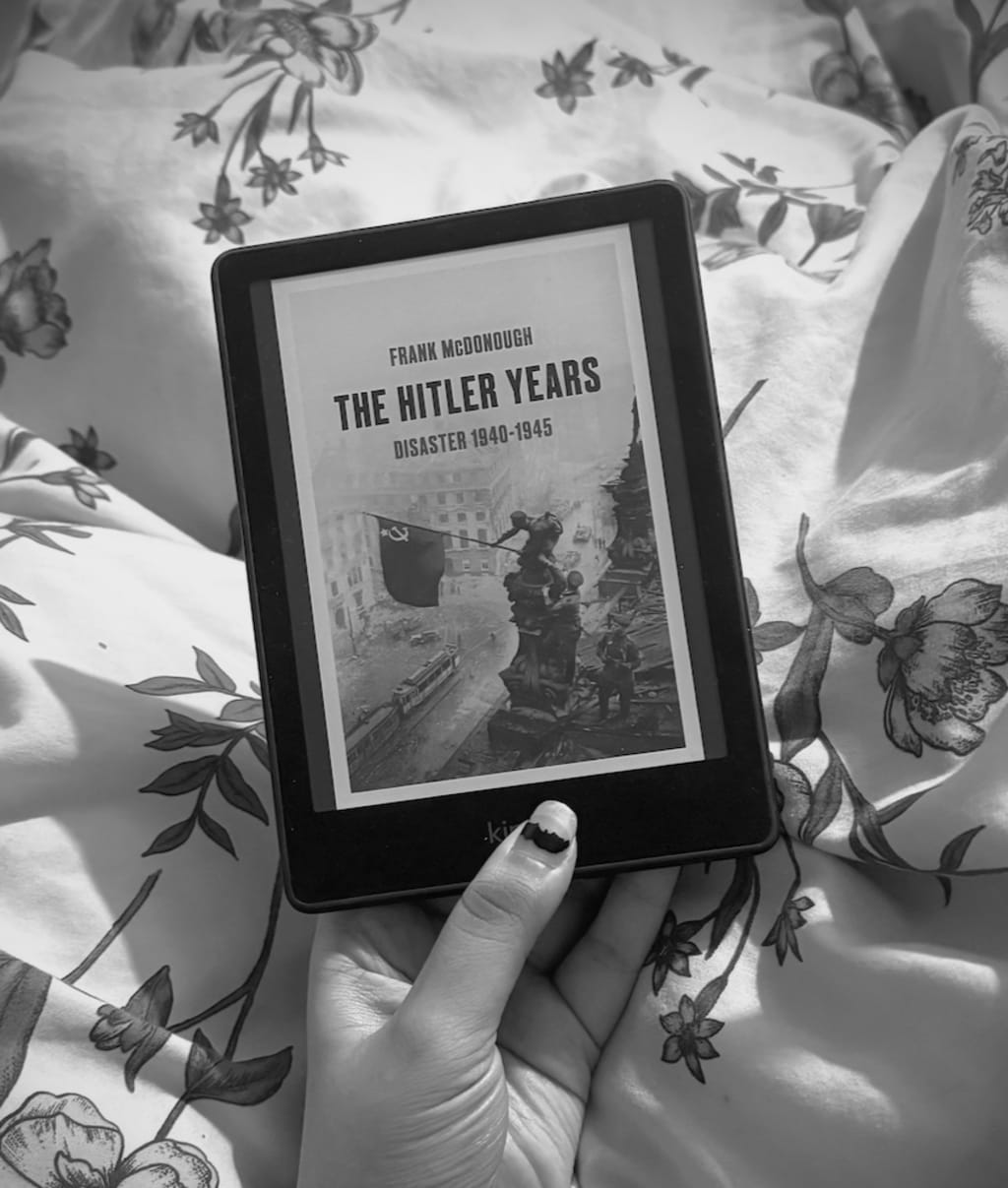
This review covers the book entitled "Disaster: 1940 to 1945" and will thus begin as 'part 4' of the review, continuing from the previous book.
This review covers the introduction to the end of 1941.
***
The Second World War has broken out and the introduction tells us that though Germany are basically at war with everyone, there are wars that they are actively fighting and wars they consider to be on the back-burner. For example: Hitler firmly believed that the war was really with the Soviets, but the allies were more interested in stopping Hitler's tanks than they were in comparison to shutting down the death camps. Much of the war showcased the inept nature of Germany's leader and the fact that he really didn't want to deal with the consequences of his actions. Before he would take his own life to escape the humiliation of defeat, he would be declining in health and getting other members of his inner circle to commit to things that perhaps he would have done himself if he were up to it.
The author writes the introduction as a great overview to the war, but also commits to stating that we don't know everything yet - but we know enough to write on it and study it. The author makes a point of stating that the majority of Germany's soldiers were killed by Soviet soldiers, not by the allies and thus the allies who became prisoners of war were treated so much nicer than the Soviets of the same kind. But we all know in our own minds that those who received the worst treatment were the Jewish people who were locked in death camps, forced to do manual labour without food or sleep, starved and tortured and ultimately killed.
In 1940, Hitler is blaming the whole situation on Germany not having enough room for its population growth. At the same time, he's attacking Chamberlain stating that he won't take orders from a country as horrifying as the UK and that the UK has no right to try to destroy Germany because it has the brutal history of the empire to deal with.
But the war was in fact, underway. After rapid early victories in Europe, Hitler’s regime seemed militarily unstoppable. Germany’s blitzkrieg tactics allowed the Wehrmacht to defeat several European states quickly, reshaping the political map of the continent. Frank McDonough writes this as seemingly, a false hope. It has the air of optimism whilst also allowing the reader to use their own knowledge to know that this won't last. Though there is this air of invicibility amongst the Nazis, there are structural difficulties in Germany's economy, making it difficult for the average person to live. Despite early triumphs, Germany lacked the industrial resources and long-term strategic planning required to sustain a global war. It was apparent from the beginning that it was all set to fail.

The Luftwaffe launched a sustained bombing campaign against British cities, known as The Blitz. The author analyses all of Hitler's miscalculations during this time, this includes the movement from hitting targets to hitting civilian areas. Unfortunately, this meant that the British bases that weren't being hit had time to recover and continue their resistance. It also strengthened the resolve of Britain to defeat Germany and eventually, they'd obliterate the enemy. The author portrays the failure to defeat Britain as a turning point that prolonged the war and forced Germany into a wider, more dangerous conflict. Next came the Soviet Union, and if you couldn't defeat a country as small as Britain, then you weren't going to even break into the Soviet Union.
1941 saw Operation Barbarossa and it makes up a pretty big chunk of the book. The author presents it not merely as a military campaign but as an ideological “war of annihilation.” Nazi leaders viewed the conflict as a racial struggle against Slavs and Jews, which justified extreme brutality. German forces committed horrific atrocities, including mass shootings of civilians and prisoners of war. As we know, the Soviet prisoners of war were treated much, much worse than the others - being encouraged to die as quickly as possible if they wanted to have any hope of escaping their misery. It was absolutely terrifying. At first, the Wehrmacht made rapid gains, but logistical problems, fierce Soviet resistance, and the vast distances of the Eastern Front soon stalled the offensive. This was a huge gamble which would prove catastrophic. Now Germany was basically fighting on two fronts and with bigger armies on both sides - one which was Russian and the other which was known for its Empire - it had little hope of actually winning.
SS Officers would increasingly adopt more and more extreme measures when it came to the situation regarding the Jewish population. The systematic genocide, the author states, began with cumulative radicalisation (as it was called). Mass shootings by mobile killing units in Eastern Europe were followed by the establishment of extermination camps and bureaucratic coordination at the Wannsee Conference in 1942. Hitler may have endorsed and allowed it but it was people like Himmler who planned, implemented and executed everything. The Holocaust is both an ideology and an administration - a state-driven process shaped by wartime conditions and the radicalisation of Nazi policy
As we can see, Germany is actually losing power whilst also trying to sustain its grip over its own population. Its seiges are failing and now it is being attacked from both sides. As we move through the book, we will be able to encounter even more tactical failures that were miscalculated by a country who had once believed it was going to be a superpower on the global stage. I personally think that the initial retaliation against Britain and the perceived achievements of the Blitz may have made Germany a bit overconfident in its own abilities.
About the Creator
Annie Kapur
"Et in Arcadia Ego"
***
I am:
🙋🏽♀️ Annie
📚 Avid Reader
📝 Reviewer and Commentator
🎓 Post-Grad Millennial (M.A)
***
I have:
📖 300K+ reads on Vocal
🦋/X @AnnieWithBooks
📸 ThePrancingPonyBakery
🔗 PrancingPonyBakery.com
***
🏡 UK
Enjoyed the story? Support the Creator.
Subscribe for free to receive all their stories in your feed. You could also become a paid subscriber, letting them know you appreciate their work.
Comments
There are no comments for this story
Be the first to respond and start the conversation.