
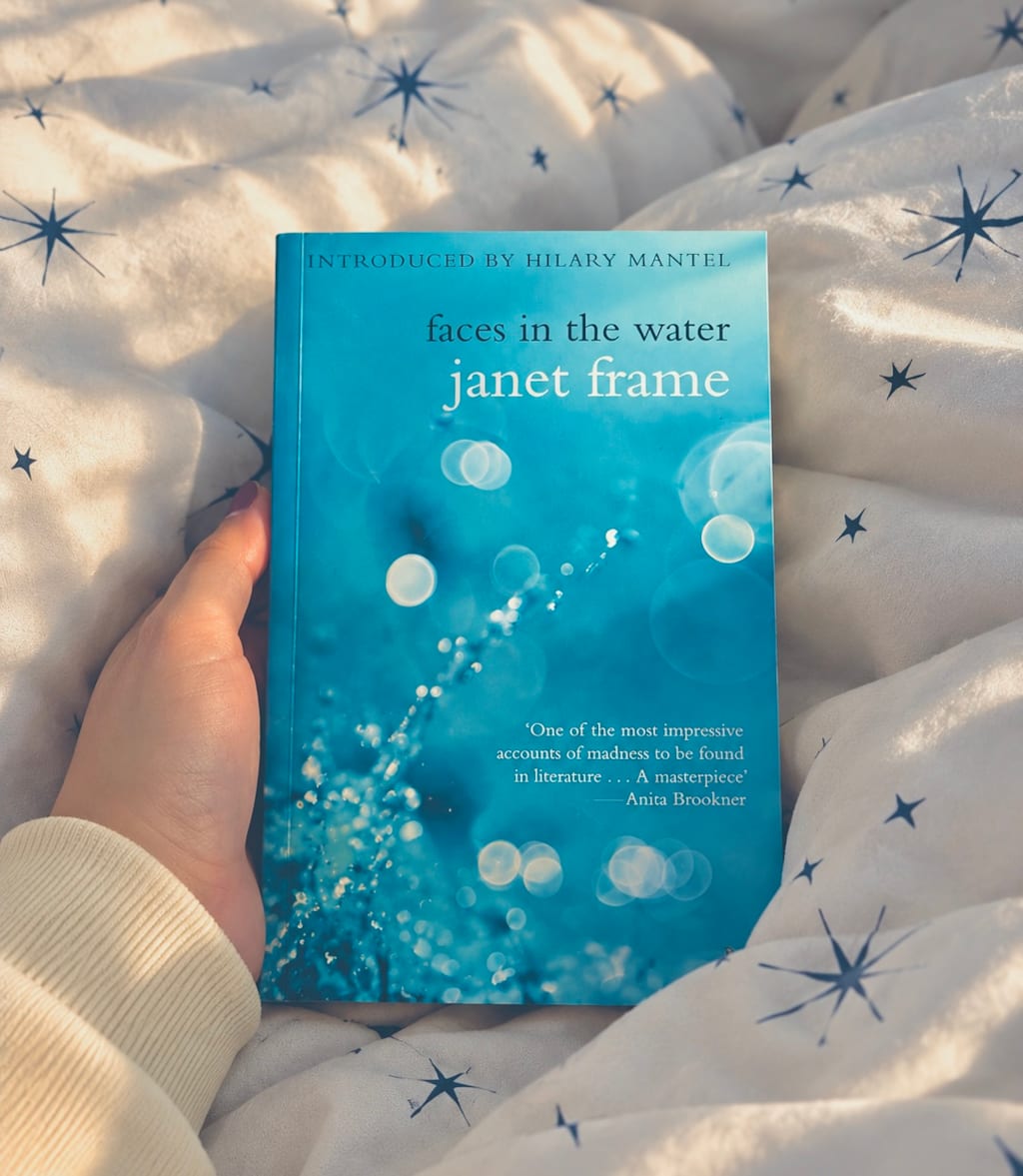
Book Review: "Faces in the Water" by Janet Frame
5/5 - another masterpiece by Janet Frame...

You can read my review for her book An Angel at My Table here:
If my review for Owls Do Cry has come out by now then I'm sorry for not linking it here, you will find it in my recent publications if anywhere.
Janet Frame's writing is of course, about mental illness and its complications (including the symptoms which are vague enough to both match every patient and be adequate to describe none of them) in the facilities she was committed to.
In An Angel at My Table she is misdiagnosed with schizophrenia and ultimately works her way out of the darkness and into a new era of her life. In Owls Do Cry, we see her portray herself as a character called Daphne in a life marred by tragedy and ultimately, she is committed to a facility in which she suffers almost continuously.
The book is a poetic masterpiece akin to The Bell Jar and Mrs Dalloway. In Faces in the Water, Janet Frame details life inside those walls as Istina - an unstable yet very perceptive woman who understands how this is meant to work and still doesn't think it is anything but extended torture. A fantastic and introspective book, it is perhaps one of the most incredible texts one could read on madness and how each life is special, unique and deeply individual.
“For your own good” is a persuasive argument that will eventually make man agree to his own destruction.”
Faces in the Water by Janet Frame
This text is perhaps one of the greatest examples of mental illness writing purely because we know it happened. Unlike The Bell Jar and Mrs Dalloway where we have little actual evidence that this stuff took place, An Angel at My Table is testament to the story of Faces in the Water. One of the scenes that was maybe one of the most important in the book was the scene where the main character is getting electro-convulsive therapy. I'm not going to lie when I say that this book absolutely hits the nail on the head about how frightening events can be as we lead up to them. The protagonist reasons with themselves in their own head, fighting for and against, going through each stage of grief and anger knowing that they cannot change the events to come.
You would probably think that a book where the protagonist spends so much time in their own head goes nowhere but in fact, this is exactly where the reader needs to be. We see a very marked change before and after the ECT in which the main character becomes more subdued which is why I included the quotation above. We as the readers, know she can do nothing about it. She is told that it is for her own good and yet, she is feeling worse, doing worse, and getting worse afterwards. There is a scene with communal bathing in which the main character comments on the fact that there is a strangeness to having the women bathe together whilst also giving them therapy separately. However, it also gives the women a chance to actually see each other, whether they are happy with what they see or not is never actually known. The main character though, constantly asks whether she can go home and I cannot lie to you when I say, I think this may have been the most common question in these facilities especially during the time period in which such violent methods were involved.
The writing is more than gorgeous and raw, the emotion pouring over the text and as the writer gets more introspective, you too enter their head, walking further and further in. The more you walk in though the more you ask the question of whether the main character actually needs to be here. You see all emotions being experienced just as you would, you see a perfectly normal human being with the capability for great art, but what you don't see is a person with a horrific mental illness and so, you too become distrusting of the system that keeps our protagonist locked away. You too, end up asking whether she can go home. It is important, beautiful and though it is short, there is so much within.
About the Creator
Annie Kapur
"Et in Arcadia Ego"
***
I am:
🙋🏽♀️ Annie
📚 Avid Reader
📝 Reviewer and Commentator
🎓 Post-Grad Millennial (M.A)
***
I have:
📖 300K+ reads on Vocal
🫶🏼 Love for reading & research
🦋/X @AnnieWithBooks
🔗 PrancingPonyBakery.com
***
🏡 UK
Enjoyed the story? Support the Creator.
Subscribe for free to receive all their stories in your feed. You could also become a paid subscriber, letting them know you appreciate their work.
Comments
There are no comments for this story
Be the first to respond and start the conversation.