
Book Review: "Arguably" by Christopher Hitchens (Pt. 5)
"Legacies of Totalitarianism" and "Words' Worth"

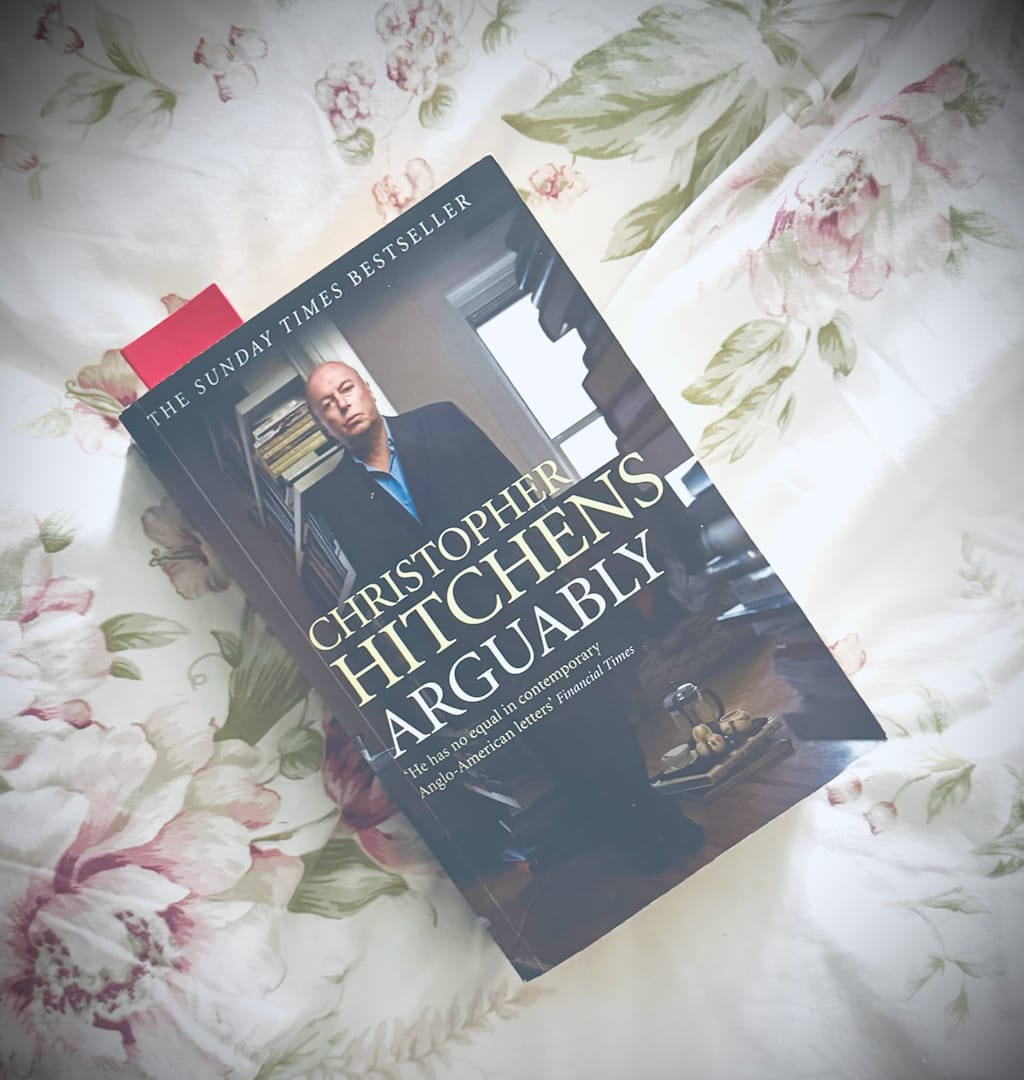
The section opens with an essay on the revolutionary Victor Serge, in which Hitchens discusses the origins of the word Totalitarian which Serge credits himself with creating. Serge's life and political 'career' (if you can call being imprisoned a career) was under the Stalinist regime he was so critical of. A man who clearly understood the word Totalitarian, I'm not sure he is the one who created it. Adapting a word and creating its use are two different things and I cannot see words like that being created so recently. Even though Hitchens uses Orwell's creation of the term 'Cold War' to denote how recent things are, I am still on the fence about the Totalitarian fact. This is by no means the only thing the essay is about, but it was the only fact presented to me that I showed concern towards.
Another essay I enjoyed is one I've read before and actually, when I read it back then it pointed me towards the text it was reviewing. Martin Amis: Lightness at Midnight is a review of the late Martin Amis' text Koba the Dread - a deep and insightful (however slightly controversial) review of the Stalinist era and regime featuring some pretty odd conclusions and methodologies. Hitchens makes the claim that the most unnerving periods of the Stalinist regime is when Stalin himself was in a good mood, because it just so happens that he was more experimental with the treatment of others at this time. Though the book itself only scored a 3/5 in my eyes for the strange claims made about Leon Trotsky - Hitchens is much more forgiving and of course, able to see the book from multiple angles. His question is not about what is said of communism, but the idea that if we are anti-communist then what kind of anti-communist are we? We need to make sure we specify.
You may read my review of Koba the Dread above.
When it comes to topics, Hitchens covers the major writers who speak on political topics and I don't think that is particularly any surprise. In Eschew the Taboo, Hitchens introduces his piece about language with the fiasco caused by Michael Richards (Kramer from Seinfeld) in which he went on a racially motivated hate tirade and uttered the 'N' word on camera. Hitchens states that in any case, a non-Black person uttering the 'N' word is doing it out of hatred and as a reminder to the Black folks of their former 'positions' as slaves and thus, shouldn't really be uttered at all by them though it does show you who people really are. He does not believe that the word should be banned, but at least we should allow the idiots to make idiots of themselves. I agree with him on this point - banning the word does nothing but if I see a non-Black person uttering it then I'm definitely going to know who to avoid for future reference.
The ideas of language that Hitchens has in his essays like Words Matter and The You Decide might have different conclusions because they are fundamentally about different things - but his point remains the same: we must be specific about our linguistic intents if we want to be understood. Essays on topics like the 'Me' generation (also known as ME, a millennial), and how language can have a difference not just on politics but on the social atmosphere in which we function shows that Hitchens was always paying every bit of attention to every facet of life. A simple conversation can become an essay on sentence structure, in the case of Michael Richards - his tirade became a Hitchens piece on ideas and a simple theory is put under the microscope to be analysed and scrutinsed. A man who read voraciously, thought incredibly and had such an interesting and thoughful mind - I think reading this book has made me feel the loss of Christopher Hitchens even more than when he died some fifteen years' ago.
I've thoroughly enjoyed this book, even though I'm not a big fan of the American essays, I have found some interesting ideas within them. Christopher Hitchens was a wonderful mind, if you ever get the chance, I would not skip over this one.
About the Creator
Annie Kapur
"Et in Arcadia Ego"
***
I am:
🙋🏽♀️ Annie
📚 Avid Reader
📝 Reviewer and Commentator
🎓 Post-Grad Millennial (M.A)
***
I have:
📖 300K+ reads on Vocal
🦋/X @AnnieWithBooks
📸 ThePrancingPonyBakery
🔗 PrancingPonyBakery.com
***
🏡 UK
Enjoyed the story? Support the Creator.
Subscribe for free to receive all their stories in your feed. You could also become a paid subscriber, letting them know you appreciate their work.
Comments
There are no comments for this story
Be the first to respond and start the conversation.