
Book Review: "Arguably" by Christopher Hitchens (Pt. 4)
"Offshore Accounts"

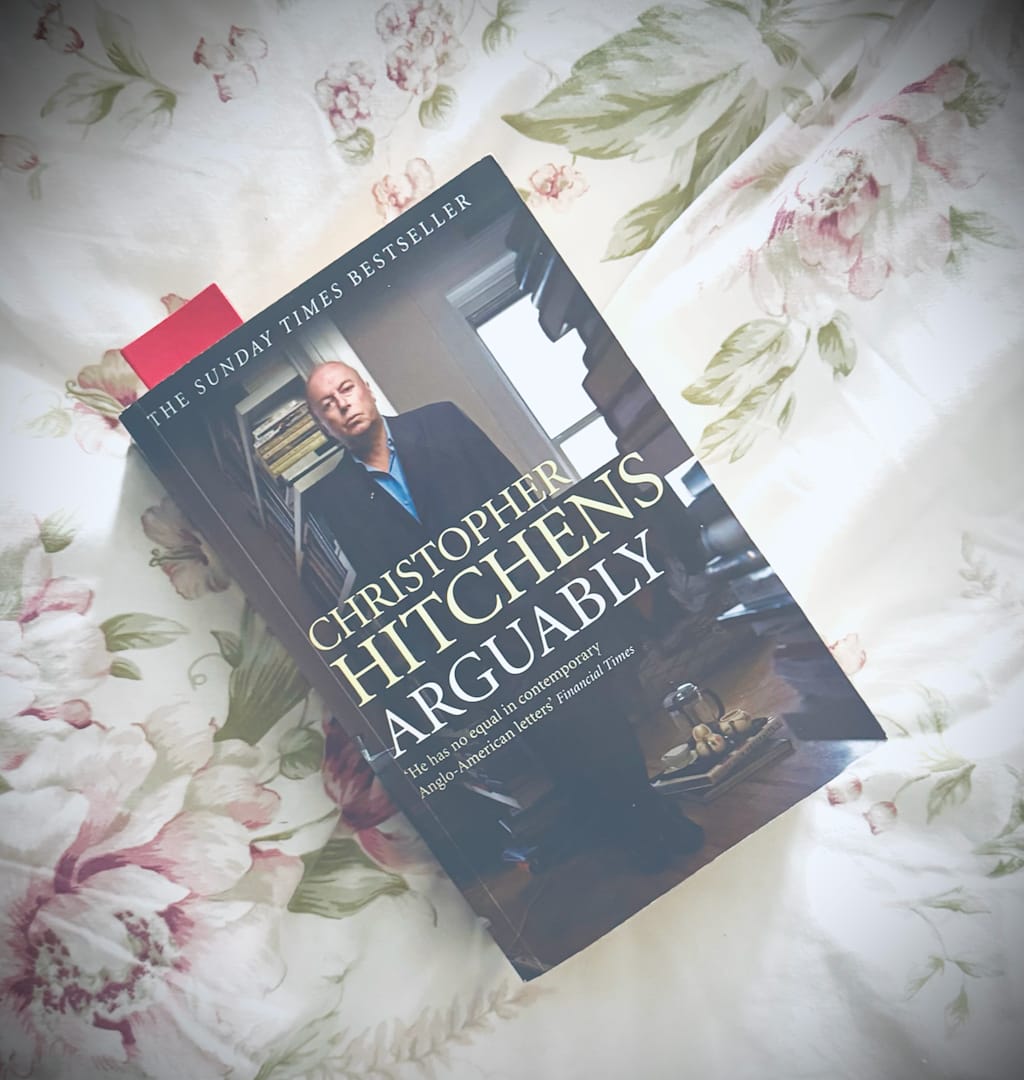
The section entitled Offshore Accounts is one that (I have to say) is probably the least interesting as most of it concerns Hitchens' opinions of the East of which I have heard multiple iterations of in his speeches and other books. I will, nonetheless, try to find things within that I have enjoyed such as his critique and response regarding arguments put forward in Edward Said's magnum opus Orientalism. This is a book I frequented whilst studying my undergraduate degree and ultimately using it, I wrote an essay.
Well, to begin with his travels in the East, they are by and large political visits even though Hitchens may address them slightly differently. His view always turns to fanaticism and religious fundamentalism, looking at the ways in which they have corrupted countries which would be stable and happy without it. This is a repeated theme in many of the essays, even the one concerning Algeria and its response by the (in his own words) "brutish" French right wing regime of the Le Pens.

In his essay regarding Orientalism however, Hitchens seems to take a slightly askew approach. Instead of his usual attack on religious forums, he goes after men like Karl Marx in the respect of a sort of 'class fundamentalism' which didn't really make much sense as Hitchens rightly shows us. The entirety of the Karl Marx colonialist narrative surrounds his opinions on the British in India. He admits that this is a torturous regime for the Indians and doesn't believe that the railway is a good trade off for slavery. However, in the same breath there is a spin of necessity within Marx's language - in which he implies that in fact, this is something that must be done in order to have class equality in the west.
And so, it seems, as Hitchens rightly points out, that class equality needs classism (though on the other side of the world) to work out. The irony kills me each time. In our own modern day it may look like the narrative that we require environmental friendliness and laws protecting children in the west which is a supportive tweet "sent from my iPhone". Unfortunately, this 'iPhone' is made from cobalt harvested by a 9-year-old in a 3rd-world country. This is usually the narrative that some use against Greta Thunberg and though again, it's not fair - it is technically true. A lot of our equalities depend on the inequalities we have with others.
Do I think it is done in bad faith? No. Do I think it's useful? Also no. We have to clean our room before we can try to clean the world. If we can't get equality in a country where it seems relatively easy to do so, what are we going to impose on countries where religious fundamentalism rules and protection for women and children practically doesn't exist? Nothing. We will get our butts kicked. Once again, Hitchens is technically correct - though not in the way that many would like to hear.
In his essay Worse Than 1984, Hitchens writes on the topic of North Korea. Now, everyone has questions about what is happening in North Korea and yet, with every new thing - Hitchens rightly points out - we are still horrified. He states that it is worse than the dystopia depicted in Orwell's nightmare novel. One of the things I found quite shocking was the idea that everyone has to be at home for a certain time, there is no wandering around the city, there is no aimlessness, everyone is kept on the same clock and rigid routine. Hitchens shows us the grim reality though. Far from the organised utopia it sends out as its image to the world, it is a "famine" and a "slave" state. This is where some are so poor that they drink from sewers and eat from the trash. Hitchens' tone here is much darker than many of his other essays as this propaganda machine has managed to almost fully control what is on display for the world to see. It is far, far from the truth.
Apart from a touchy few essays concerning the Israel-Palestine conflict and one in which he states his position on the Jewish influence, Hitchens remains rather journalistic in his views during this section. I have to say though, it doesn't offer us much insight in the way of religious fundamentalism and his views on that. Though it does make clear that religious fundamentalism often influences and builds regimes in which human rights violations are commonplace, especially against women and children - who are normally also first victims of any mass killing within.
About the Creator
Annie Kapur
"Et in Arcadia Ego"
***
I am:
🙋🏽♀️ Annie
📚 Avid Reader
📝 Reviewer and Commentator
🎓 Post-Grad Millennial (M.A)
***
I have:
📖 300K+ reads on Vocal
🦋/X @AnnieWithBooks
📸 ThePrancingPonyBakery
🔗 PrancingPonyBakery.com
***
🏡 UK
Enjoyed the story? Support the Creator.
Subscribe for free to receive all their stories in your feed. You could also become a paid subscriber, letting them know you appreciate their work.
Comments
There are no comments for this story
Be the first to respond and start the conversation.