
Book Review: "Arguably" by Christopher Hitchens (Pt. 2)
"Eclectic Affinities"

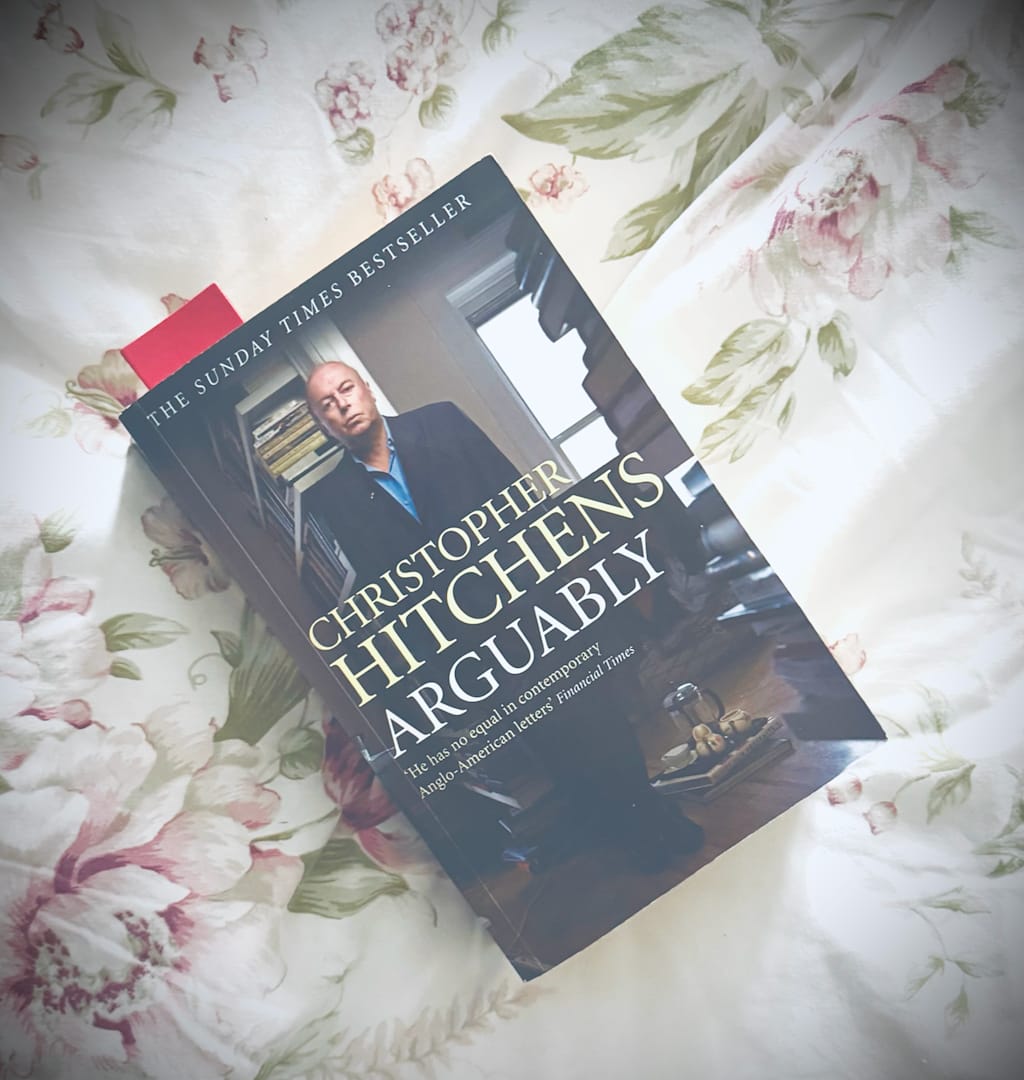
Rating: 5/5 = I find this part, in which Hitchens discusses literature, art and culture, far more interesting than the section on America.
***
“We tend to love anecdotes about apples and eurekas because they make scientific genius seem more human and more random…” (p.142)
In his essay on Isaac Newton, Christopher Hitchens takes us through the story of his time walking through Cambridge University but also makes way for how Isaac Newton once lived by looking at the realities surrounding his person and science. Connecting this to the biography of Newton written by Peter Ackroyd, Hitchens states that Ackroyd is one of the most prolific writers of his generation and that Newton, though many of the myths about him (especially concerning the apple) are not true - is possibly one of the greatest minds in history. He almost blinded himself for his science by staring at the sun for too long. This, I did not know.
In his essay on Edmund Burke, Hitchens wrongly states that Princess Diana’s death was in a “banal car accident” (of course, he didn’t have the information we now have which basically suggests her death was less of an ‘accident’ than first thought) but he does happen to take us correctly through Burke’s beliefs and ideas about the war in France and the slave trade. He states that though Burke is often seen as a conservative and evangelical icon, he was neither. He was a liberal who fought against slavery and he was an Irishman so most likely a Catholic.
In his essay concerning Michael Slater’s book about Charles Dickens, Hitchens makes comparisons usually made between Dickens, Shakespeare and Eliot (noting rightly that of all three, Eliot has the more natural notion towards human behaviour, even though she draws heavily on Shakespeare). Dickens, he states is at his best when feeding his morbid curiosity, often including death and class divide, hard labour and imprisonment and absolute misery of the worst degree. I genuinely agree with this and it has only made me want to read both the Michael Slater and the Peter Ackroyd books on Charles Dickens so watch this space, I may do that in the future.
Hitchens’ essay on Evelyn Waugh takes us through the time and place concerning his pathways of writing. At first, we are met with perhaps some of his most famed novels in which the ‘fall of aristocracy’ is as equally measured as Waugh’s clear hatred of the new modernising world. These are “Brideshead Revisited” and “Decline and Fall”, but sometimes also includes “Vile Bodies” and “A Handful of Dust”. The first thing Hitchens implies about Waugh is that these things are relatively well known and well documented across people who read Waugh. However, what is not well documented but rather suggested by his writing is that he clearly has some sort of hatred towards women and repressed homosexuality. This I can agree with having read and reread one of my favourite novels “Brideshead Revisited” over the years. The subtext of young love (and if you’ve read some of his books, it gets a bit too young) between men who are barely men is right in front of us. However, when we move on to Waugh’s more religiously motivated novels we can see that this sort of fades into the background to be replaced by what is implied to be a constant state of adolescence. Even though Waugh is writing on a new topic after joining the Catholic Church, he cannot seem to let go of implications in his writing that pop up here and there. Hitchens seems to finish by stating that though Waugh overstayed his literary welcome, he did not do too badly for a man who was basically a misogynistic misanthrope.
As we move through, we see “Fleet Street’s Finest” in which book reviewers and the press are often maligned to the position of the failure or the starving, the man with spectacles and a gaunt face, eye-holes that are empty sockets and suffering from malnutrition. Hitchens hilariously states that the reason that journalism has such a low reputation is because it has such bad press, but I think that the real reason is that the rich kids seem to be the ones who buy their way in whereas, the average person who gets a journalism degree must deal with the brunt of the world - never amounting to the best as those positions were sold to the children of the upper class.
The section ends with an essay on “Harry Potter and the Deathly Hallows” and seeks to understand what is so magical about it. Even though Hitchens seems to write favourably (at least not unfavourably) about the book, he does make the remark at the end that Pullman’s literature is better than Rowling’s. Though I have to say that I agree, “Harry Potter” had a great impact on my life. But “His Dark Materials” were amongst the first children’s books I gave full attention to. “Lord of the Rings” was a definite reread in my childhood. But few could have competed with the “Discworld” for me.
About the Creator
Annie Kapur
"Et in Arcadia Ego"
***
I am:
🙋🏽♀️ Annie
📚 Avid Reader
📝 Reviewer and Commentator
🎓 Post-Grad Millennial (M.A)
***
I have:
📖 300K+ reads on Vocal
🦋/X @AnnieWithBooks
📸 ThePrancingPonyBakery
🔗 PrancingPonyBakery.com
***
🏡 UK
Enjoyed the story? Support the Creator.
Subscribe for free to receive all their stories in your feed. You could also become a paid subscriber, letting them know you appreciate their work.
Comments
There are no comments for this story
Be the first to respond and start the conversation.