
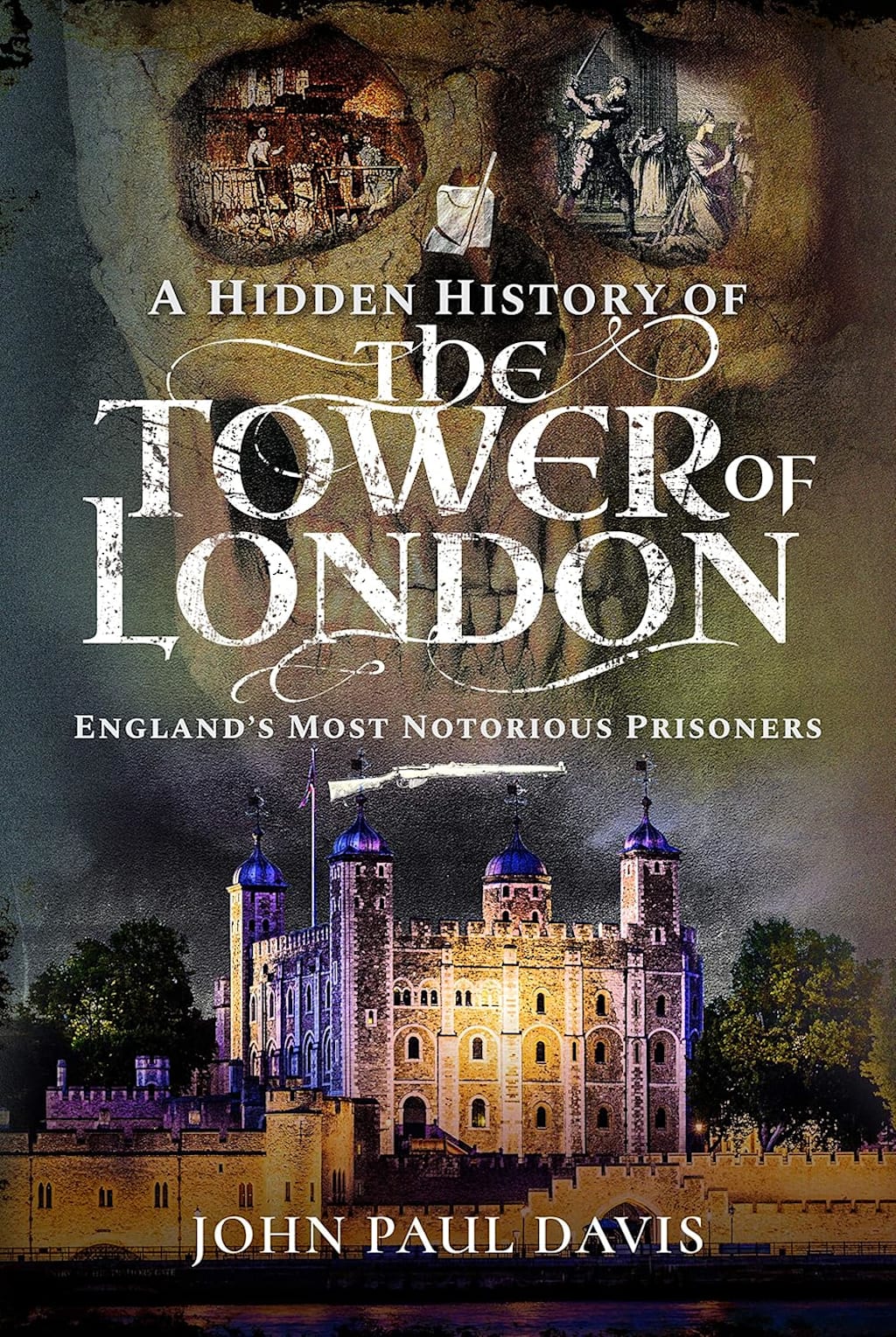
Book Review: "A Hidden History of the Tower of London" by John Paul Davis (Pt. 4)
Chapter 10 to Chapter 13

Chapter 10 showcases exactly how far Henry VIII goes in his paranoia. John Paul Davis implies that the King, now more paranoid after the death of Anne Boleyn is on the lookout far more often, is far more willing to send people to the Tower and to have them executed. People were forced to confess, even if they had not actually done anything wrong themselves, but knew people who did - some were even complete fabrications under torture. This is also where the Medieval form of hanging, drawing and quartering became a lot more fashionable. The author shows the King becoming more and more violent and so, we are obviously going to concentrate on individual executions.
Thomas Cromwell was once a trusted man in court and yet, he ended up in the Tower. Norfolk once referred to him as a traitor and that was really the straw that broke the camel's back. Cromwell was arrested, his possessions taken and he was locked in the Tower. He penned several letters to the King but none of them worked, he would not be released. the accusation of corruption was upheld by one of heresy, he would not be forgiven by the King. Cromwell met his death courageously and praised the King. His execution was messy and it took several hacks to take his head off. It was put on a pike and that was that. Henry VIII could pretty much have anyone killed, just like he has always done - his cruelty shines through in his ability to feel nothing as trusted advisors went to their deaths.
Next we have Margaret, Countess of Salisbury. I believe this woman was the subject of the book The King's Curse by Philippa Gregory as well (it goes into so much more detail about why her execution happened). She was executed after her stay in the Tower. She was brought from her cell and would not lay her head on the block as she was not a traitor. There are many different accounts of her execution - each more brutal than the last - one stating it took 11 hacks to kill her completely with gashes hitting her on the shoulder several times. The author definitely makes her death look like a tangled mess - as though there was no reason for her to be killed.
Catherine Howard is one of the most famous people to be executed at the Tower. She is accused of adultery amongst other crimes and must wait for her secret lover to be beheaded first before she too, is lead to the block. On the final weekend, Catherine asks to practice her last moments on the block itself and of course, she goes resolutely to her death. She is not even 20 years' old. But at least she is killed in a single stroke. It is almost instant. The King is very clearly getting a bit trigger happy with the execution methods on display.
In the following chapters one of the most shocking arrests is Anne Askew, as she became the first woman to really go through some torture in the Tower. She has reformist values but atop of this she engages in it in a way that the author is inclined to call it "Pre-Suffragette Feminism". Eventually, when she is arrested, she is placed on the rack and stretched until her bones break. Then the people who are stretching her on the rack do it themselves instead. There's much speculation about whether she was able to write afterwards since the rack makes that quite impossible. She was so weak that she had to be carried to the stake to be burned.
As Henry VIII executed his closest advisors, Edward VI his son would spare nobody, showcasing that he had definitely inherited his father's cruelty even though he was still in his teen years. Before he was to execute anyone though, Edward VI was said to have taken a great interest in the menagerie in the Tower, he had always loved the fact there were animals kept there. We can see this in two ways: the first is that Edward VI had a refined taste which made him interested in what was happening in the Tower - one that was ahead of his years. But I think the second one is probably the correct answer: a child enjoyed seeing animals. Children tend to enjoy animals.
Since Henry VIII would ultimately die a Catholic, Edward VI was the first Protestant King of England and first of all, turned his back on the very man who was set to care for him until he was old enough to rule for himself. The Duke of Somerset was trying to quell a revolution but could not completely and so, retreated looking like a coward in the eyes of his own people, including Edward. He lost his job as a protector and then would be executed after spending some time in the Tower. The author calls Edward cold here, stating that the Duke's death was only a footnote in the King's diaries. Could this be something he inherited from his father? Or was it that though Edward's name was on the death warrant, he didn't really know much about what was going on since he was so young?
Lady Jane Grey was perhaps the more famous of the people to be executed in the Tower. Described as an intelligent girl and one of the smartest in ther court, she was basically a political pawn to stave off Queen Mary coming to the throne. Though Jane was the queen, she did protest that the crown rightly belonged to Mary before settling into the role rather reluctantly. Many of the Dukes and the circles that ran in Edward VI's reign knew that a Catholic queen simply wasn't possible. I was definitely thinking about Jane's execution here - it genuinely was not her fault. She was executed as a formality rather than anything else. But support for Queen Mary was growing and so, Jane was ultimately overthrown. She was but in the Tower along with her husband, but was kept nicely - her ladies were allowed to tend to her and apparently, Queen Mary was not entirely looking forward to having her executed. A few nights before she died, Jane wrote a letter of apology to Mary and, due to feeling sorry for her, Mary changed the method of execution from burning to beheading. Jane was beheaded in private with a blind-fold on, Mary trying to give her some dignity in her last moments.
Unfortunately Mary also had her sister, the later Queen Elizabeth locked in the Tower for a few months, which is apparently where she met Robert Dudble. The author is definitely getting the story underway again - we have fully returned to the insides of the Tower, looking at the different people who cry for mercy within.
About the Creator
Annie Kapur
"Et in Arcadia Ego"
***
I am:
🙋🏽♀️ Annie
📚 Avid Reader
📝 Reviewer and Commentator
🎓 Post-Grad Millennial (M.A)
***
I have:
📖 300K+ reads on Vocal
🦋/X @AnnieWithBooks
📸 ThePrancingPonyBakery
🔗 PrancingPonyBakery.com
***
🏡 UK
Enjoyed the story? Support the Creator.
Subscribe for free to receive all their stories in your feed. You could also become a paid subscriber, letting them know you appreciate their work.
Comments
There are no comments for this story
Be the first to respond and start the conversation.