
Anime’s Safest Hero Is Also Its Most Exhausting
The gentle ordinary guy keeps winning because he costs nothing, and that is exactly why audiences are tuning out.
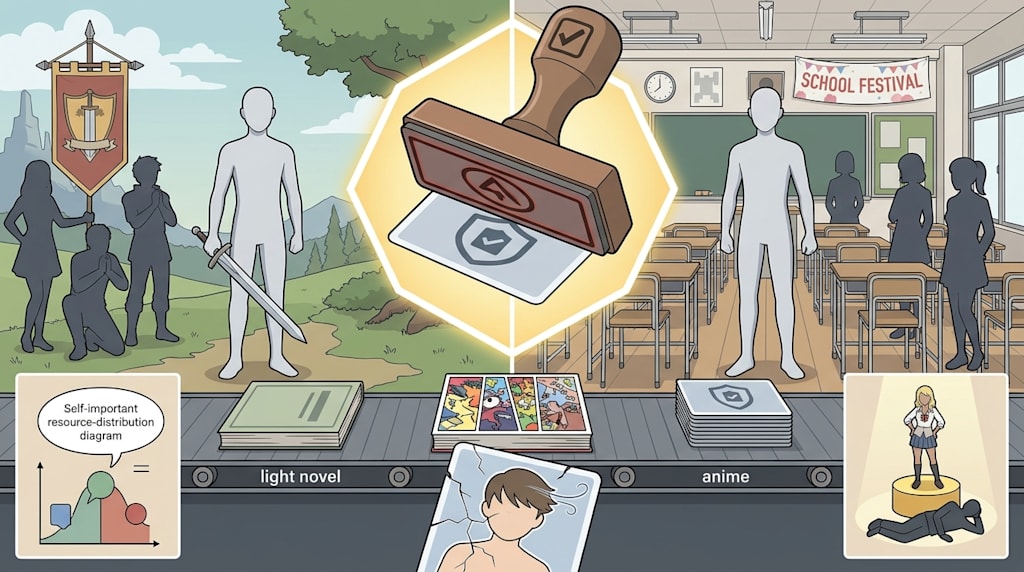
1. Two Scenes, One Interface
Look at two scenes.
On the isekai side, the male lead starts with nothing. A male character claps his shoulder: “You’ve got something, kid.” A female character blushes: “You’re actually very gentle.” He heads to the peak of life.
On the school side, the male lead sits in the back row. Female characters with a full set of attributes gather around him. He solves emotional knots, helps run events, and closes the school festival. At graduation, a girl tugs his sleeve: “You’re actually very gentle.”
One scene has swords and magic. The other has classrooms and clubs. List the two male leads’ attributes and you get the same table: not ugly, not absurdly poor, not so socially impaired he cannot hold a conversation. He is also not so handsome the audience feels distance, not so rich it breaks immersion, not so strong he suppresses the scene from the start. His ordinariness is a blank sheet the audience can paste itself onto. His gentleness is a passive skill. It guarantees he will not hurt any female character, and it guarantees every female character has a reason to come near him.
This male lead is a general-purpose preset: a hexagon with no weak sides. His story starts when the anime begins airing. The audience watches male characters discover that he has something and female characters discover that he has charm. Market mechanisms push him to the peak of life. The preset is safe. It lowers the threshold for identification, lowers the risk of conflict, and leaves room for leveling up. The male lead does not need to shine from the start, because shining would make the audience feel this is someone else’s story. He also cannot be worthless, or the audience would ask why it is watching. Ordinary is the entrance. Being discovered to have something is the reward. Gentle is the pass.
2. Chitose Is in the Ramune Bottle as a Negative Example: Why Self-Importance Crashes
That passage from the first volume of Chitose Is in the Ramune Bottle is a typical sample of a counter-formula male lead crashing in recent years:
“She’s my rou slave. If I say we’re doing a threesome, she won’t dare refuse. Even if she’s unwilling, she’ll help you lose your virginity. Besides, you know what Yuko looks like and her body, right? Her breasts are soft hemispherical E-cups, you could say they’re the ideal Japanese female breast shape. What do you think? Don’t you want to make the number-one girl in the grade submit and have sex with her?”
The passage is bold. It is also self-indulgent. The author wanted a socially successful male lead who is action-oriented, sharp-tongued, and gentle inside. The author wanted him to use social stimulation to drag the otaku out of self-seclusion. Readers smelled something else: the author indulging himself through the character’s mouth, distributing female characters as resources, and treating the otaku as a subordinate who needs a lecture from a socially successful man. Readers can tell the difference between a character preaching and an author preaching. When the author wins that contest, disgust follows.
The market test shows one thing. The audience can accept an ordinary male lead. It will not accept a male lead whom the author forcibly stamps as not ordinary while stepping on others to prove it. The gentle ordinary guy is safe because he offends no one. The self-important socially successful male lead, written badly, offends otaku and female readers at the same time. Otaku get looked down on. Female readers get objectified. The attempt at counter-formula went in the wrong direction. It added a layer of superiority and left the male lead without complexity.
3. “Otaku Paired with Gal”: Desire Inflation and Effort Deflation
Another formulaic theme is otaku paired with gal. Early works had a narrative of effort being seen. The otaku helps the gal study, solves her troubles, shows reliability at a critical moment, and the gal discovers his good points. Many recent works skip the process. The gal falls for him for no apparent reason. The otaku only needs to maintain the posture of I am ordinary, I am a coward, and he harvests a female lead with high symbolic value.
In economic terms, this is desire inflation and effort deflation. The audience is impatient with the effort stage and wants the sugar straight. Too much sugar makes them sick, so they need a high-symbolic-value prey like the gal to provide stimulation. The result is conservative and spineless. The stories avoid complex relationships, avoid making the male lead pay a price, avoid giving the gal a choice of her own, and dream a lying-flat offensive inside the safe zone. This narrative does not believe effort can change one’s position. It does not believe relationships need management. It believes that a man who lies flat deserves to be chosen by top-tier prey.
4. Conservative Anime and a Hundred Flowers in Manga: A Script Written by Cost Structure
Risk pricing produces formulaization. A creator who wants to keep working learns to read the cost structure.
An anime season costs hundreds of millions of yen. The production committee model means the project must avoid risk. A theme works in a light novel. A manga adaptation verifies it again. Only then does an anime adaptation dare to proceed. After layer upon layer of filtering, the audience gets safe cards. The manga artist’s cost is their own time and energy. Failure means getting axed. No committee falls back on them. That pressure forces differentiation. Manga gives us something as unhinged as Chainsaw Man, something as slow as Frieren: Beyond Journey’s End, and something as satirical of the entertainment industry as Oshi no Ko. Without breaking the formula, the artist cannot survive.
Trace it back further, and light novels are the source of the formulas. The barrier to entry for light novels is lower than for manga. Competition is fiercer. Formulas iterate faster. Anime magnifies themes that light novels have already worn out. The safe preset logic of light novels is the same. The male lead cannot have too many distinctive traits, or readers cannot identify with him. He cannot have too few, or readers feel cheated. A hexagon with no weak sides is the optimal solution calculated by the reader’s psychological ledger.
5. Breaking the Formula Means Giving the Character Design a Cost
The gentle ordinary guy is not the problem. The problem appears when he becomes a general-purpose preset. The story stops caring who this person is. It cares only about when this person will be discovered to have something. Isekai and school harem are two skins of the same story. Isekai resets social coordinates. School resets social coordinates. The male lead enters an environment where he can be repriced. Male characters discover that he has something. Female characters discover that he has charm. The value confirmation is complete. He is not growing. He is being stamped.
The audience gets tired because the narrative has no cost. The male lead does not need to choose, lose, or bear the consequences of gentleness. His ordinariness is safe. His gentleness is safe. Even his adventures are safe. When a safe card hits diminishing marginal returns, it goes from steady to tiresome.
The direction for breaking the formula is to write the ordinary guy as a person with costs, choices, and boundaries. He can be ordinary. His gentleness must have a cost. He can be passive. His passivity must have consequences. He can be discovered to have something. That something must require payment. Otherwise he remains an interface, not a character.
Formulaization is a conservative strategy in a heavy-asset, high-competition environment. It will not disappear. It will iterate. The audience’s fatigue shows that the safe card has been played to the end. Next comes a formula-breaker on the level of Attack on Titan, or the production committee model loosens under streaming pressure. Until then, the gentle ordinary guy will keep adventuring, keep building harems, and keep having his bangs blown by the wind in the opening theme. The audience is increasingly clear that this is not his life. It is the shape of a safe card.
About the Creator
Jin
Writer of reamstories
https://reamstories.com/jin
Enjoyed the story? Support the Creator.
Subscribe for free to receive all their stories in your feed. You could also become a paid subscriber, letting them know you appreciate their work.
Comments
There are no comments for this story
Be the first to respond and start the conversation.