
The Two-Day Demo Trap
AI can help you build a game in a weekend. It can also keep you from ever shipping one.
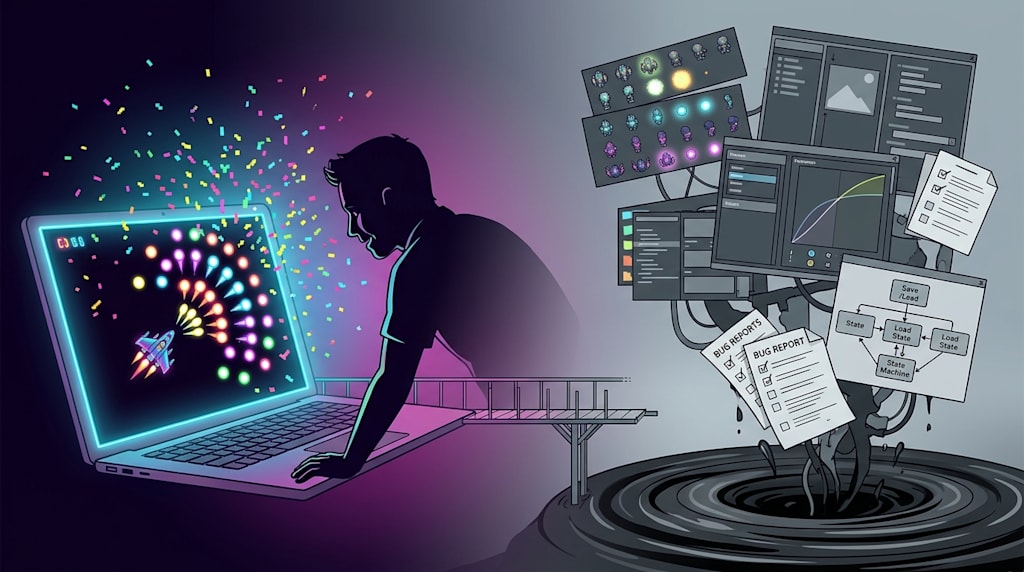
The most intoxicating moment in AI-assisted game development usually arrives on the second day.
On day one, you open an editor and type a prompt: make a cyberpunk bullet-hell demo, with a ship that fires glowing orbs and enemies pouring down from the top of the screen against a neon-rain background. A few hours later, the ship moves. The orbs fly. The enemies explode. You never checked whether the orbs travel at 500 or 800 pixels per second. You did not care whether the background is deep purple or dark blue. You stare at the screen with something close to vertigo: I created a world from nothing.
On day three, the taste changes. You want the jump to feel better. You tell the AI that the jump feels like stepping on cotton and ask for a crisper version. The AI changes it. You say it still feels floaty. It changes it again. Then you realize you cannot articulate what “crisp” means. What is the gravity acceleration during the ascent? Should it be stronger during the fall? Should coyote time after leaving a platform be 0.08 seconds or 0.12 seconds? Should there be a brief anticipation animation on the frame the button is pressed? Should the camera dip on landing? Natural language struggles to specify these things. The AI will not bear the consequence of a jump that feels wrong.
By the second week, the project enters the tar pit. The UI misaligns at one resolution. A monster’s hit frame has lighting reversed compared with every other character. The progression curve feels great for three hours and collapses in the fourth. The state machine deadlocks after a save and reload. You spent two days making a demo. Now you need two months to fix work that does not feel like creating a world. You close the project, open a new folder, and type a new prompt: make a medieval fantasy farming game demo.
Two days later, you feel the joy of creating a world again.
This is a structural trap in AI game development. AI has made the first 60 percent of a project cheap. It has barely reduced the cost of the last 40 percent. A real launch happens after 60.
Demo problems and product problems
A demo is a divergence problem. Its acceptance criterion is “it runs.” Your prompt says “cyberpunk bullet-hell shooter,” and the AI gives you a ship, glowing orbs, and a neon background. The orb speed is wrong. The background colors are inconsistent. The enemy AI only charges straight down. You are still amazed. At this stage, the developer meets AI’s randomness halfway. The output triggers the “from nothing to something” surprise, and you tolerate its deviations.
A product is a convergence problem. Its acceptance criterion is “nothing breaks across dozens of hours.” The art style must be unified. The UI interaction logic must be self-consistent. The progression curve must remain smooth over a long session. The game feel must be precise to the millisecond. A character’s sprite sequences for front, side, back, hit, and cast states must have consistent lighting, clean pixel edges, no costume drift, and full integration with twenty other monsters and the UI frame. At this stage, AI’s randomness becomes debt.
This is why many AI game projects get stuck in a middle state. The demo impresses. The official release stays out of reach. The developer can write prompts. AI can do useful work. The problem is that productization demands a density of constraints that natural-language prompts cannot carry.
Natural language is lossy
Natural language is a lossy compression protocol.
It is good at divergence. It is good at evoking direction. One sentence can make the AI understand “a space station with a sense of loneliness,” “snappier feel,” or “Ghibli but colder.” Those descriptions generate many candidates and bring a concept into existence. Natural language is terrible at convergence. One sentence cannot precisely describe why the current jump feels like stepping on cotton. One sentence cannot describe what ratio of gravity acceleration between ascent and descent matches player intuition. You can say “give coyote time 0.1 seconds,” but whether 0.1 is correct depends on character speed, animation frames, platform width, player expectations, and level rhythm. Adjectives cannot solve those problems. They must land in parameter tables, curves, state machines, reference videos, automated tests, and human acceptance.
AI can generate candidates. Convergence responsibility cannot be outsourced to prompts.
Art follows the same pattern. AI can produce a stunning concept image in seconds, which creates the illusion that asset production is solved. A product needs a full set of sprite sequences for the same character in front, side, back, hit, and cast states. It needs consistent lighting, clean pixel edges, no costume drift, and full integration with twenty other monsters and the UI frame. If you rely on natural-language prompts and gacha-style prompt roulette, the marginal cost becomes despair-inducing. The first image is a miracle. The tenth is luck. The hundredth is an engineering disaster.
A real launch demands strict convergence. Strict convergence requires engineering systems, not longer prompts.
Production hell
Traditional game development also dies in large numbers during the leap from vertical slice to full production. The industry calls this phase production hell. In the demo stage, you build only the coolest level, the coolest boss, and the coolest weapon. Full production requires you to replicate that quality across dozens of levels, hundreds of enemies, and hours of play. Everything must stay compatible, testable, maintainable, localizable, and shippable. Many teams fail because they cannot replicate and converge a demo, not because they cannot make one.
AI has not eliminated this hell. It has made the cost of starting a new project so low that more people reach the gates of hell faster.
AI has also changed the psychological reward structure of development. Making a demo used to take weeks or months. Sunk cost forced you to seriously consider whether to continue. Now you can re-experience the dopamine of creating a world from nothing every two days. The old project offers resolution adaptation, balance tables, full-flow testing, asset rework, performance optimization, and launch checklists. Abandoning the current project and starting a new demo becomes a rational choice. You are repeatedly consuming the illusion of creating a world instead of making a game.
This also explains why AI game projects bloom everywhere while few ship. The democratization of generation did not democratize productization. It made starting new projects cheap and finishing old ones seem expensive.
The way out
The way out is an engineering shell around AI, not better prompt writing.
First, turn the GDD into verifiable specifications. Do not write “the feel should be satisfying.” Write “jump ascent gravity 1800 px/s², descent gravity 2400 px/s², coyote time 0.1 s, jump buffer 0.12 s, landing camera dip 2 px for 80 ms.” Do not write “the art style should be unified.” Build an art bible, a palette, a reference library, a LoRA or ControlNet pipeline, and turn style constraints from adjectives into asset specifications.
Second, build vertical slices, not horizontal sprawl. Make one complete small loop: one character, one enemy, one level, one UI set, one progression curve, one save/load cycle, one fail-and-restart flow. Bring that loop to launch quality. Then replicate it. AI is best at generating candidates inside a closed loop. It is poor at infinitely expanding an open world.
Third, turn game feel from adjectives into instrumentation. Use parameter panels, replay comparisons, frame-level recording, and input-latency tests to translate “feels like stepping on cotton” into curves and numbers. Let AI generate tuning candidates. Let tests and player feedback handle convergence.
Fourth, build an asset consistency pipeline. Concept art can be gacha. Sprite sequences cannot be pure gacha. Reference images, skeletons, lighting direction, pixel grids, manual retouching, and style checklists are mandatory. AI is a candidate generator, not an asset owner.
Fifth, automate regression tests and launch checklists. Resolution adaptation, save compatibility, state-machine boundaries, balance-table validation, localization text, and performance budgets do not create worlds. They are the main body of shipping a product. AI can help you write tests. You cannot outsource “whether it passes” to AI’s feelings.
Sixth, freeze scope. A real launch means having the courage to say “this feature is not happening.” The demo stage can diverge infinitely. The product stage must converge. AI makes divergence too easy. Convergence must become an institution rather than a mood.
Generation is cheap; convergence is expensive
AI has pushed game development from “coding is hard” to “definition and convergence are hard.”
In the past, many ideas died on implementation cost. You could not code, could not make art, could not set up an engine, so you could not produce a demo. Now AI has lowered implementation cost, and ideas can quickly become something that runs. Productization has not become easier. Its core is selection, constraint, validation, and bearing consequences.
Two days to a demo is a victory of generation. Shipping is a victory of constraint.
AI can generate a hundred jump schemes. It cannot decide which one will still feel right to the player on the hundredth jump. AI can draw a hundred concept images. It cannot guarantee that the hundredth belongs to the same world as the first. AI can write a save system that runs. It cannot guarantee that the player will not get stuck when loading a save in the thirtieth hour.
AI can make games. AI will not bear the hard labor of product convergence for you. That hard labor is the entire distance from demo to launch.
The scarcest ability in the AI era is no longer “from nothing to something.” It is “from something to shippable.” Generation is cheap. Convergence is expensive. Whoever can fit AI’s random output into an engineering system has a chance to turn a two-day miracle into a two-year product.
About the Creator
Jin
Writer of reamstories
https://reamstories.com/jin
Enjoyed the story? Support the Creator.
Subscribe for free to receive all their stories in your feed. You could also become a paid subscriber, letting them know you appreciate their work.
Comments
There are no comments for this story
Be the first to respond and start the conversation.