
Table Top Basics: Terminology
20 Terms Every Table Top RPG Player Should Know


Adventurer: A player character in a fantasy setting, usually a member of a party. The term refers to the character's primary profession, not class. Also called a delver.
Character Build or Build: using character class options to create a desired archetype.
Crunchy: A system for difficulty scaling that is dependent on many extraneous modifiers added to a base score. Characterized by players having bonuses to add and subtract from their rolls (number crunching).
Example: Pathfinder is crunchy compared to Call of Cthulhu.
Dump Stat or Dump Statistic: A statistic that is intentionally low as a result of a min-maxing strategy that has optimized a key statistic(s) for the characters class or character build.
Example: A barbarian has an 18 in Strength but a 7 in Intelligence.
Dungeon Crawl: A style of game-play or session set inside a large, labyrinthine structure. It is part exploration, part combat, and game-play tends to move at a slower pace.
Example: After weeks of dungeon crawl sessions, the players were glad to see a city where they could spend the riches they found.
Dungeon Master or Game Master: A designated player who acts as a referee, adjudicates the rules, resolves actions, and makes all other decisions that keep the game moving.
Hack and Slash: A style of game-play or session that is more combat oriented.
Home Brew: Any material that is not published by the game producer or third party affiliates; source material created by another player or the Dungeon Master.
House Rule: A rule or guideline adopted by a group that does not appear in the text or errata; usually to clarify a rule as written or simplify a mechanic.
Investigation or Intrigue: A style of game play or session where the focus of play is finding clues, following leads, and solving a mystery. These games have a lot of NPC interactions, plot development, and storytelling.
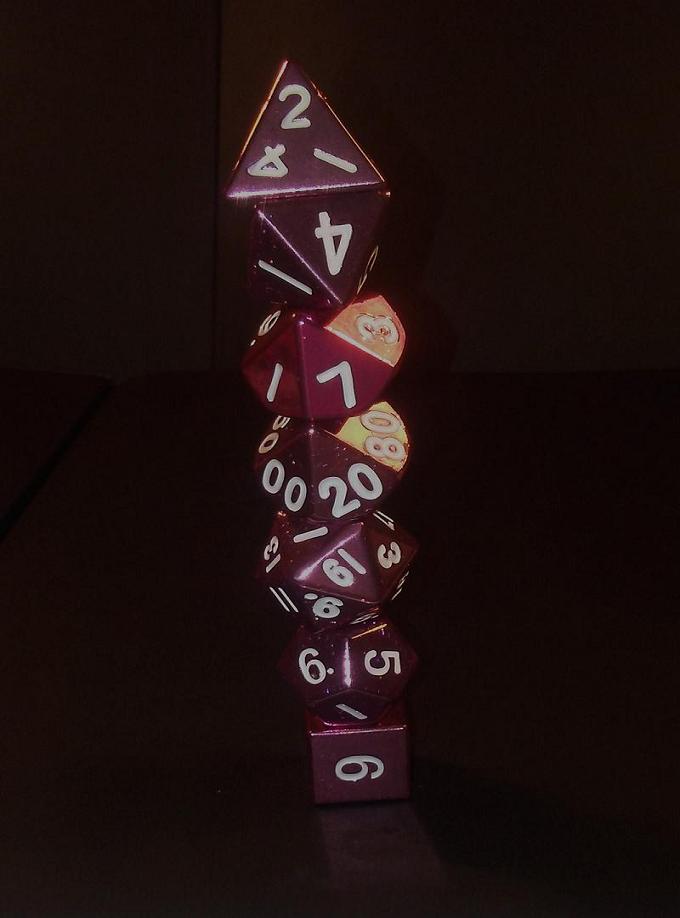
Dice Stacking: Why Do Gamers Do It?
Meat Grinder or Gauntlet: A style of game-play or session so lethal that players bring multiple characters to the table and introduce a new character as soon as the previous character dies. The player usually gets to keep the items the dead character had and transfer them to the new character.
Mechanic: The in-game function of a rule.
Min-Maxing: A strategy where a player will use a point-buy or similar system to create a highly optimized set of statistics for their character build.
Monty Haul: A style of game-play or session where the players receive large amounts of treasure disproportionate to the low risk their characters faced.
Example: “The goblin peon was carrying a +1 longsword, dragonscale armor, a ring of teleportation, and a gem worth 500gp. In his left pocket you find...”
Munchkin: A highly optimized and sometimes nonsensical character designed to capitalize on or exploit a certain in-game mechanic(s).
Example: “My wizard multi-classed and took a level of fighter to gain the heavy armor proficiency, so yeah, I am wearing full plate mail and casting lightning bolt...”
Murder Hobos: A style of game-play or session that has little character development, few storytelling or role playing interludes, and heavily favors combat or violence to advance the plot.
NPC: Non-player character, a character played by the Dungeon Master. If the group is small, an NPC may be a party member.
Party: A group of characters (usually PCs) who go adventuring together.
PC: Player character, a character played by a player, also they are an adventurer and usually a party member.
Point-Buy: A system where the statistics of a character are determined by the player spending an allotted budget of points to acquire and prioritize those statistics.
About the Creator
Jeromy Schulz-Arnold
Jeromy Schulz-Arnold is a freelance writer. He has a day job but he spends an irresponsible amount of time daydreaming...
Enjoyed the story? Support the Creator.
Subscribe for free to receive all their stories in your feed.
Comments
There are no comments for this story
Be the first to respond and start the conversation.