
Phantom Blade Zero’s 66 Days Mode Is a Death Clock the Developers Can’t Beat
Every death costs a day of your character’s life. The AI learns how you fight. And there is no reload.
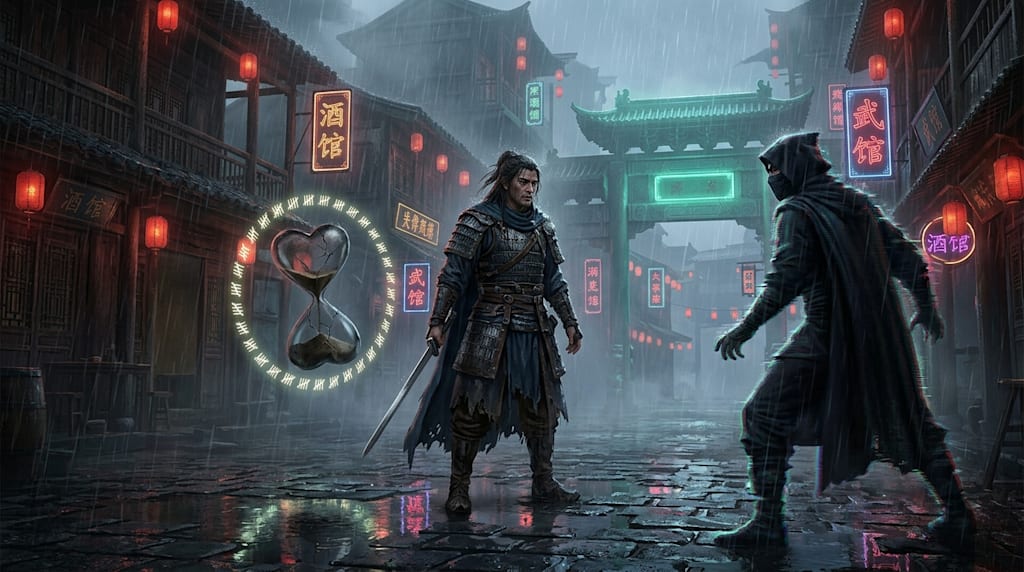
At Tokyo Game Show 2026, a 4Gamer reporter asked Liang Qiwei whether anyone on the development team had cleared the “66 Days” mode without dying once.
He said no.
That answer would sound like marketing at most game events. In Phantom Blade Zero, it sounds like a design fact. The mode was not built for most players to clear. It is not standard hard difficulty either. Standard hard difficulty raises enemy numbers and lowers your room for error. You die, learn the pattern, and eventually pass. 66 Days does something else. It turns death into a resource and writes every failure into the protagonist’s lifespan.
The producer later corrected one detail. Defier and 66 Days share the same difficulty. 66 Days adds a single restriction: you can die only 66 times. Both modes use the highest-level AI. There is no difference there.
The core experience stays the same. You lose unlimited retries. Death becomes blood loss.
The Equation: Days Spent Plus Deaths Equals Sixty-Six
Players have reduced the mode to one brutal equation:
In-game days spent + deaths = 66.
About two real hours equal one in-game day. Play thirty hours and fifteen days are gone. You have fifty-one lives left. Play sixty hours and thirty days are gone. You have thirty-six lives left. If you reach the final boss door after spending thirty days and thirty lives, you have six days left. You must kill the boss within two hours using five lives. If you fail, you start over.
You have to stay alert during boss fights, mob fights, exploration, and every choice. What you waste is time and life.
In most action games, death teaches you. You fail, adjust, and improve. Death is a ladder. In 66 Days, death drains you. Every failure cuts into a small lifeline. The closer you get to the end, the less you want to die. The less you want to die, the more you tighten up. The more you tighten up, the more mistakes you make. The more mistakes you make, the closer you come to zero.
The tension does not stay inside a single fight. It stretches across the whole run.
The AI Does Not Memorize Patterns. It Reads You.
A death limit alone would make 66 Days an extreme version of hard mode. The AI design is what gives it a different shape.
Liang Qiwei said the AI was built around a question: if the opponent were human, fighting a human, how would it act? It uses feints to pull out your moves. It stops mid-combo and waits for you to act. Then it chooses its next step based on what you do. The goal is to make you feel like you are fighting a person.
You cannot clear it by memorizing patterns.
Most action games give bosses fixed moves. You die, memorize the routine, build muscle memory, and pass. Higher difficulty raises numbers and lowers tolerance, but the logic holds. The AI in 66 Days adapts, counters, and learns your habits. If you dodge on reflex, it may delay its attack. If you lean on one combo, it may break the string. Every boss fight plays out differently. No-hit runs based on pure memorization are dead on arrival.
This feels closer to fighting-game PvP than PvE. You face an opponent that watches, fakes, and waits. It does not read your input. It reads your behavior. It does not cheat, but it makes you feel like it does.
Combat stops being a puzzle. It becomes a match. Puzzles have answers. Matches do not. You have to judge in real time, adjust in real time, and live with the result in real time. 66 Days adds the cruelest bet to that match. You cannot afford to lose.
Narrative and Mechanics Share the Same Clock
The best part of 66 Days is that it does not invent a difficulty mode from nothing. It grows out of the story.
In Phantom Blade Zero, the protagonist, Soul, suffers a heart wound. A famous doctor tells him he has 66 days left. That countdown drives the plot and hangs over the player. The 66 Days mode turns the fictional countdown into a real rule.
Every death costs a day. Every delay drains the clock. When the 66 days run out, the save file is deleted and the game restarts. You are not playing a man with 66 days left. You are fighting with those 66 days.
Death stops being a screen that says YOU DIED. It becomes a literal loss of lifespan. You spend the protagonist’s life and your own time. A failed fight costs more than a fight. It costs part of the jianghu dream.
That is why the mode does not count toward achievements. It exists for the experience, not the trophy. It does not block platinum. It does not hold anyone hostage. It is a slaughterhouse you enter on purpose.
Resource Management Turns Every Day Into an Audit
66 Days is a resource-management game. Life is the scarce resource.
You trade limited deaths against limited days. Do you level, explore, and collect, or rush the main story? Do you play safe or take risks? Every choice spends from the same account.
The account is irreversible. There is no manual save. Touching a save point saves automatically. Once the 66 deaths run out or the days hit zero, you get the “Regret in Jianghu” ending. The save is permanent. You cannot reload.
You have to stay disciplined for the whole run. You cannot die once to see what happens. You cannot test a boss’s moves. You cannot restart to optimize a route. Every step is final. Every failure is permanent.
That kind of pressure is rare. Sekiro’s dragonrot, Sifu’s aging, and Dark Souls’ hollowing all have ways to soften the blow. 66 Days has one path: forward or back to zero.
The Fight Over Hardcore Boundaries
After the mode was announced, players split.
Some called it one of the tightest integrations of story and mechanics. It creates tension that numbers alone cannot produce. It pushes hardcore play from execution into strategy, adaptation, and resource management. The fact that the development team has not cleared it in one life supports that reading.
Others called the frustration too high. One slip can erase dozens of hours. The AI’s dynamic play makes consistent clears feel impossible. For most players, that is not a challenge. It is punishment. It may only suit a small group of top players and stream viewers. For everyone else, it creates anxiety.
The producer’s position is simple. What you want decides whether you accept it. If you want the story and the wuxia experience, finish one playthrough. 66 Days does not count toward achievements, does not affect platinum, and does not force itself on anyone. It is closer to a concept piece, an ultimate challenge for a specific audience.
It Does Not Need to Be Cleared. It Deserves to Exist.
Most people will never clear 66 Days. The development team has not done it. That says enough. It does not mean the mode failed.
Its existence has value. It shows that games can be more than played. They can be lived. It pulls narrative out of cutscenes and pushes it into every fight, every death, and every countdown. It lets players feel the weight of a life inside a virtual jianghu.
If you ask whether I will try it, I will stay with the story, feel the wuxia, and finish the game once. I am still glad 66 Days exists. Games need people who push the boundary and ask a hard question: if death had a cost, how would we play?
Phantom Blade Zero answers with a simple rule. You become more careful, more focused, and more reverent. You treat every strike as your last. You treat every day as your final day.
That is the jianghu the mode builds toward.
About the Creator
Jin
Writer of reamstories
https://reamstories.com/jin
Enjoyed the story? Support the Creator.
Subscribe for free to receive all their stories in your feed. You could also become a paid subscriber, letting them know you appreciate their work.
Comments
There are no comments for this story
Be the first to respond and start the conversation.