
The Tomb of Amphipolis: A Mystery to Be Solved?
The sphinxes, the abduction of Persephone and the unanswered questions surrounding one of ancient Greece most extraordinary funerary monuments.

The Discovery of the Tomb
A burial monument that has survived for more than two thousand years, preserving the extraordinary efforts of those who constructed it, yet concealing the identity of the very people it was intended to commemorate. In 2014, an archaeological excavation near the ancient Greek city of Amphipolis, in northern Greece, attracted international attention. Beneath the enormous mound of Kasta Hill, archaeologists uncovered an elaborate Macedonian funerary complex decorated with monumental sphinxes, marble Caryatids and a remarkable mosaic depicting the abduction of Persephone by Hades. The discovery immediately raised questions. Who could have been important enough to receive such an extraordinary burial? Was the tomb connected to Alexander the Great, whose death had transformed the political world of ancient Macedonia? Or did it belong to one of the many figures whose lives became entangled in the violent struggles over his empire?
Although the excavations revealed human remains, the identity of the tomb's occupants remains uncertain. What interests me is not simply the possibility of discovering a famous historical figure, but the relationship between the monument, its extraordinary mythological imagery and the period in which it was constructed. A tomb is, after all, more than a place where the dead are buried. It can also be an expression of political authority, social position and the desire to preserve someone's existence beyond their death. But before considering who might have been buried at Amphipolis, we should examine what archaeologists actually discovered.
The Hill That Concealed the Mystery
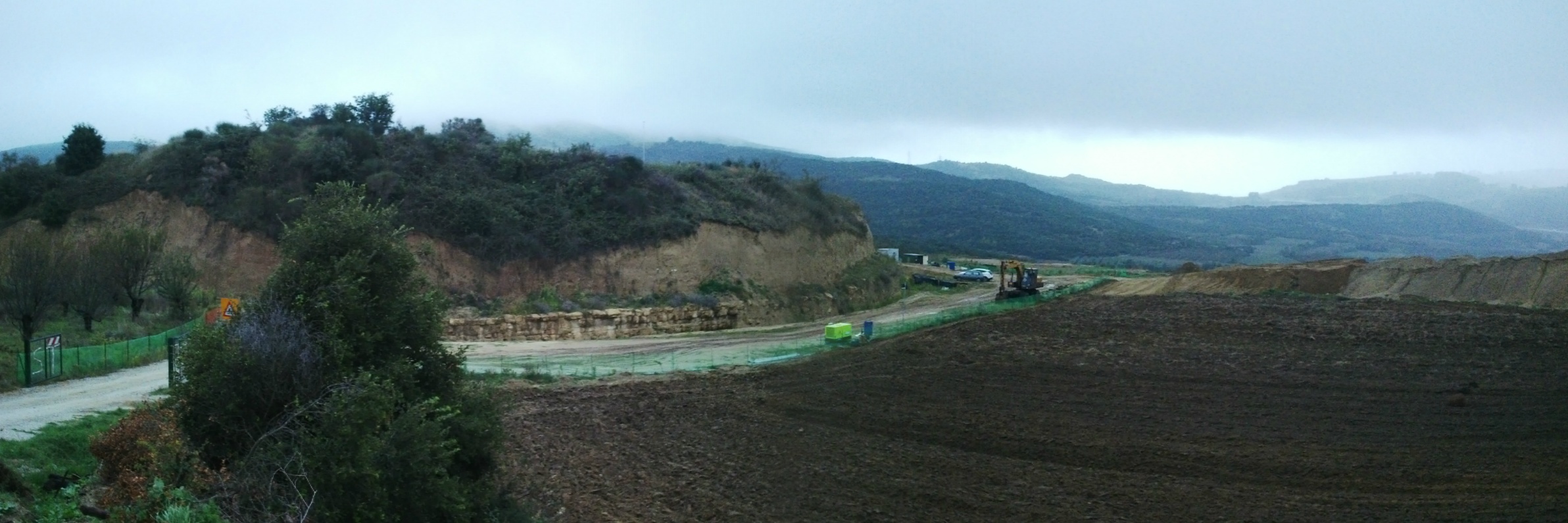
Archaeological interest in Kasta Hill did not begin in 2014. Excavations in the area had been conducted during the twentieth century, including investigations by archaeologist Dimitris Lazaridis. Further work in 2009 and 2010, under Katerina Peristeri, uncovered earlier burial structures and graves dating to the Archaic period.
From 2012, investigations revealed the impressive marble enclosure surrounding the mound. The breakthrough came in 2014, when archaeologists exposed the entrance to the monumental funerary complex. The mound is surrounded by a marble perimeter wall approximately 497 metres long, enclosing an area of more than two hectares. The tomb itself extends approximately 24 metres into the mound, with a succession of chambers leading towards the burial space. Its construction required considerable resources, labour and architectural expertise. This was clearly not an ordinary burial.
The location is also historically significant. Amphipolis was founded by the Athenians in 437 BCE, near the River Strymon, in a region rich in natural resources and strategically positioned between the Aegean and the interior of the Balkans. During the Peloponnesian War, the city became a source of conflict between Athens and Sparta. It eventually came under Macedonian control during the reign of Philip II, Alexander the Great's father, in 357 BCE.
The political importance of Amphipolis did not disappear with Alexander's death in 323 BCE. His enormous empire was soon divided by rivalries among his successors, the Diadochi, whose ambitions brought prolonged wars, betrayals and the elimination of competing claimants to power. Perhaps the most tragic connection with Amphipolis concerns Roxana, Alexander's wife, and their son, Alexander IV. Following the death of Alexander's mother, Olympias, the two were imprisoned in Amphipolis by Cassander, one of the most powerful figures in the struggle for Macedonia. Around 310 BCE, they were murdered on his orders.
The historian Diodorus Siculus describes how Cassander, fearing the political consequences of the young Alexander eventually claiming his father's throne, ordered their deaths and the concealment of their bodies. Against this historical background, it is hardly surprising that the discovery of an extraordinary Macedonian tomb should provoke speculation about its possible connection with the royal family. Nevertheless, historical proximity alone cannot establish the identity of its occupants.

The Sphinxes Guarding the Entrance
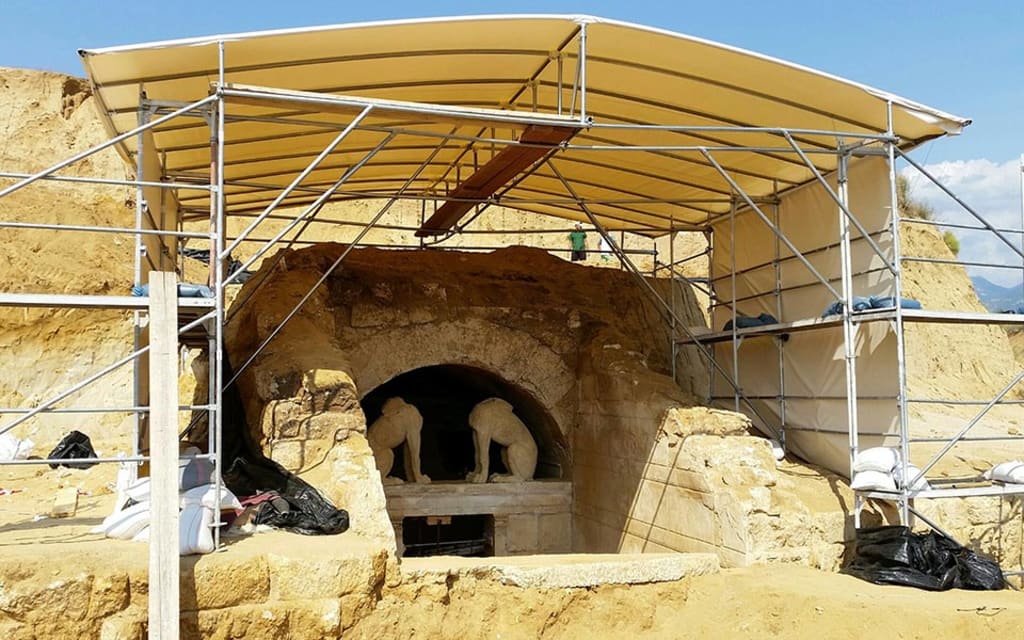
One of the first discoveries that attracted international attention was the entrance to the tomb, guarded by two monumental marble sphinxes. The sculptures, originally possessing heads and wings, were placed above the doorway through which visitors would enter the funerary complex. Their surviving bodies reveal carefully sculpted musculature, claws and other anatomical details.
Fragments of the missing sculptures were subsequently recovered inside the monument, including a sphinx's head found farther into the chambers. Their displacement provided additional evidence that the tomb had experienced disturbance after its original construction. But why were sphinxes chosen to guard the entrance?
In ancient Greek mythology and art, sphinxes appear in different contexts, frequently associated with danger, guardianship and the boundary between the familiar world and something beyond ordinary human experience. Perhaps the most recognisable example is the Sphinx encountered by Oedipus, whose riddle becomes inseparable from questions of knowledge, mortality and human existence. At Amphipolis, the sculptures occupy a funerary setting. It is therefore tempting to understand their presence as part of the symbolic separation between the world of the living and the space reserved for the dead.
This remains an interpretation rather than evidence of a specific religious intention. Yet the architectural arrangement is remarkable. Before reaching the burial chamber, a visitor would encounter a carefully organised sequence of sculptural and decorative images. The tomb was not simply a space in which someone had been buried. Its appearance had been deliberately constructed to communicate importance, and perhaps meanings that we can no longer reconstruct entirely.


The Caryatids and the Abduction of Persephone
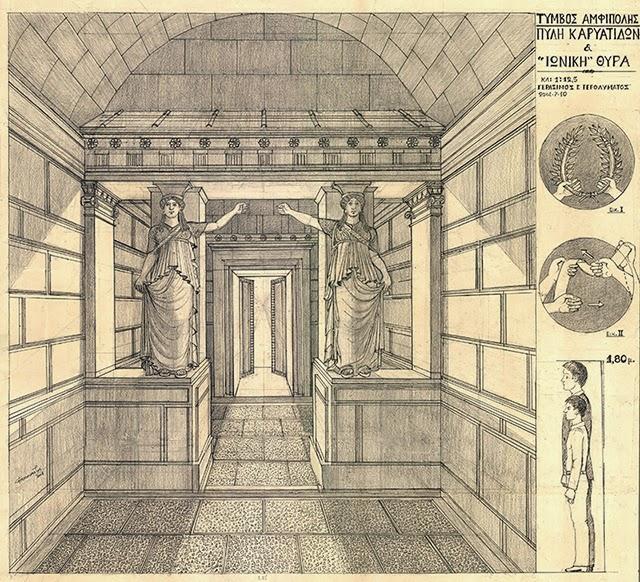
Beyond the entrance, archaeologists discovered two monumental female figures, known as Caryatids, positioned on either side of another doorway. Their sculptural details, clothing and surviving traces of painted decoration reveal the artistic sophistication of the monument. We often imagine ancient Greek sculpture through the whiteness of surviving marble, forgetting that many such works originally possessed colour.
The Caryatids, together with the sphinxes, contributed to an elaborate architectural arrangement leading visitors progressively deeper into the tomb. But perhaps the most fascinating discovery was the mosaic covering the floor of the chamber beyond them. Measuring approximately 3 by 4.5 metres, the mosaic depicts one of the most recognisable episodes of Greek mythology: the abduction of Persephone by Hades.
The god of the underworld drives a chariot drawn by two horses, carrying Persephone away, while Hermes appears ahead of them. In this scene, Hermes can be understood through his traditional role as psychopompos, the guide who accompanies souls between the world of the living and the realm of the dead. The mosaic is composed of differently coloured pebbles, producing an extraordinarily expressive representation of movement, mythology and human figures. What makes this particular choice of imagery interesting is its relationship with the function of the monument.
In the ancient myth, Persephone, daughter of Demeter, is taken into the underworld by Hades. Her disappearance brings grief to her mother, whose suffering becomes connected with the fertility of the earth and the changing seasons. Through the different versions of the myth, Persephone comes to occupy a complicated position between life and death, absence and return. Within a funerary monument, the image acquires an additional significance. Perhaps it reflects ancient beliefs about the passage from life into death, or the hope that existence might continue beyond the limits of the physical world. It may also communicate ideas of loss, transformation and the relationship between human mortality and divine authority.
However, the presence of Persephone does not establish that the tomb belonged to a woman, nor does it independently prove a royal burial. Similar mythological imagery appears in other Macedonian funerary contexts, including the royal cemetery at Aigai, modern Vergina. There is something particularly interesting about the way mythology survives through such artworks. An image created for a specific historical purpose can continue to communicate recognisable human concerns centuries after the people responsible for its creation have disappeared.
The abduction of Persephone reminds us that the experience of death was not represented only through the physical separation of the living and the dead. It could also be approached through narratives of loss, relationships and the possibility of return. At Amphipolis, the mosaic remains one of the most remarkable surviving elements of the monument, even if its precise significance to the original occupants is still uncertain.

Inside the Burial Chamber
Beyond the decorated chambers, archaeologists discovered the principal burial space and a stone-built cist grave beneath the floor. Unlike the extraordinary sculptures and mosaic encountered earlier, the burial itself offered relatively little information about the identities of those interred. The tomb had already been disturbed and robbed in antiquity. Its marble doors were found damaged, while human remains were scattered and incomplete.
An anthropological examination announced in January 2015 identified skeletal material belonging to at least five individuals: a woman older than 60, two adult men approximately 35–45 years old, a newborn infant and an adult whose remains had been cremated. Some of the bones displayed signs of injury, while others were sufficiently damaged or incomplete to complicate further examination. The discovery of multiple individuals introduced another difficulty. Was the tomb originally intended for one prominent person and later used for additional burials? Were the individuals related, or did their presence reflect different phases in the monument's history?
These questions remain unresolved.
DNA analysis has been discussed as a possible way of examining relationships among the individuals. However, the poor condition of the remains, including the absence of some material useful for ancient DNA research, presents significant difficulties. No publicly established genetic identification has resolved the question of who was buried there. And so, after passing through extraordinary sculptures and mythological imagery, we arrive at the very place that should have provided the answer, only to discover that the most important information is missing.
Who Was Buried at Amphipolis?
The uncertainty surrounding the burial has naturally produced several theories. Some of the earliest speculation concerned Alexander the Great himself. The size of the monument and its apparent connection to the period of his reign encouraged suggestions that his remains might have been buried somewhere in Macedonia. However, ancient literary evidence places Alexander's burial in Alexandria, Egypt. The geographer Strabo, writing during the early Roman imperial period, describes his tomb within the royal quarter of the city. There is no archaeological evidence establishing that Alexander was buried at Amphipolis.
Philip II has also appeared in popular speculation, although his burial is generally associated with the royal tombs at Aigai. More serious consideration has been given to other members of the Macedonian royal family. One possibility concerns Olympias, Alexander's mother, who was killed in 316 BCE following her defeat by Cassander. The remains of an older woman found inside the tomb have encouraged comparisons with her approximate age at death. Yet such a correspondence is hardly sufficient evidence. Diodorus records that Cassander denied Olympias burial, and the circumstances through which an elaborate funerary monument could have been constructed for her remain unclear.
Another hypothesis concerns Roxana and Alexander IV, whose deaths are directly connected with Amphipolis. Their imprisonment and murder make them historically relevant candidates for investigation, although the ages of the identified skeletal remains do not provide a straightforward match. The infant, for example, cannot be Alexander IV, who was no longer a newborn when he died. Other interpretations have considered additional members of the Macedonian aristocracy and royal family. The most prominent theory advanced by the excavation team, however, concerns Hephaestion, Alexander's closest companion and one of his leading generals.
Hephaestion: A Monument to Friendship or Political Memory?
Hephaestion died in 324 BCE, shortly before Alexander himself, following an illness during the Macedonian campaign in Asia. Ancient sources describe Alexander's profound grief and his intention to honour his companion with extraordinary funerary ceremonies and monuments. In 2015, archaeologist Katerina Peristeri and architect Michalis Lefantzis proposed that the Amphipolis complex had been constructed as a funerary monument dedicated to Hephaestion, possibly on Alexander's orders.
Their interpretation was partly based upon inscriptions found on architectural elements associated with the monument, including markings interpreted as references to Hephaestion. The hypothesis attracted considerable attention, but it was also challenged by other archaeologists who questioned whether the inscriptions and historical circumstances could support such an identification.
Importantly, even if the monument was dedicated to Hephaestion, this would not necessarily mean that his body had been buried there. A memorial intended to honour the dead could exist separately from the place containing their remains. This distinction interests me because it introduces another dimension to the problem. What if the monument was intended not simply to preserve a body, but to preserve the political and personal significance of someone whose death had affected one of the most powerful rulers of the ancient world?
In Macedonia, as elsewhere in antiquity, funerary monuments could express status, family identity and the memory of influential individuals. Their construction belonged not only to the private experience of grief, but also to the public representation of authority and honour. Nevertheless, an interpretation of that kind cannot substitute for archaeological evidence. The connection with Hephaestion remains a hypothesis, and the identities of the people whose remains were recovered have not been established.
The Tomb's Future: When Will the Public Be Able to Visit?
The discovery of the Amphipolis tomb generated extraordinary public interest in 2014. Yet the monument's preservation has required years of conservation, structural restoration and planning. As of October 2026, the Greek Ministry of Culture continues to carry out extensive work at the Kasta complex. The programme includes the conservation of the marble enclosure, restoration of architectural elements, protection of the burial chamber and development of facilities for visitors.
New scientific investigations are also contributing to our understanding of the monument. In 2025, specialists from the Factum Foundation undertook high-resolution documentation of the tomb. In 2026, a research programme involving the National Hellenic Research Foundation and the National Centre for Scientific Research Demokritos was established to investigate and reconstruct the monument's original polychromy.
The significance of these projects should not be underestimated. Understanding the colours and decorative details that originally covered the monument may help archaeologists examine its artistic programme more accurately, even if this research does not necessarily reveal the identities of its occupants. According to the Ministry of Culture's latest announcements, the monument is expected to become accessible to the public in 2028, subject to the completion of restoration and visitor infrastructure. For those interested in ancient history, its eventual opening will provide an opportunity to encounter a funerary complex whose architecture and decoration have already transformed our knowledge of ancient Macedonian art.
A Mystery That May Remain Unsolved
More than a decade after the remarkable discoveries of 2014, the Tomb of Amphipolis continues to raise questions about the people who constructed it, the individuals buried within it and the historical circumstances responsible for its existence. Perhaps future archaeological research will provide a more convincing identification. Perhaps further examination of the human remains, inscriptions and architectural history will reveal connections that are not yet apparent. But there is also the possibility that we may never discover the names of those buried beneath Kasta Hill.
I find something rather intriguing about this uncertainty. The monument was constructed with extraordinary care, using architecture, sculpture and mythology to preserve the importance of individuals whose identities have now been lost. Whatever the intentions of those who commissioned it, the tomb has survived the political world that produced it, the collapse of the Macedonian kingdoms and more than two thousand years of historical change.
The sphinxes remain, although damaged. The Caryatids still stand within the chambers. Persephone continues her journey into the underworld, preserved through the coloured stones assembled by artists whose own names we will probably never know. And beneath them lie the remains of individuals whose lives, relationships and experiences are almost entirely inaccessible to us.
Perhaps this is one of the more fascinating contradictions of archaeology. The material remains of a civilisation can survive long after the meanings that people once attached to them have disappeared. Through historical research and interpretation, we attempt to reconstruct those meanings, knowing that the surviving evidence may never permit a complete explanation. The Tomb of Amphipolis may eventually surrender the identity of its original occupants. Until then, its significance should not depend entirely upon whether those buried there belonged to Alexander's family or the Macedonian aristocracy.
The discovery itself has already revealed something remarkable about how the ancient Greek Macedonians represented death, preserved memory and expressed their understanding of existence through art.
Written and published by Sergios Saropoulos
Sources and Selected Bibliography
Hellenic Ministry of Culture. “Amphipolis.” Cultural Egnatia. Official archaeological and historical overview of the city, Kasta Tumulus, its architecture, excavations and interpretations.
https://culturalegnatia.culture.gov.gr/en/route-stops/amphipolis/French School at Athens / Archaeology in Greece Online. “Amphipolis — Tumulus de Kasta — 2010.” Archaeological record of the early excavations and Archaic-period burials.
https://chronique.efa.gr/?id=6483&r=reportArchaeology Magazine. Jarrett A. Lobell, “Greece's Biggest Tomb.” January/February 2015. Contemporary archaeological overview of the 2014 discoveries, the sphinxes, Caryatids and burial chambers.
https://archaeology.org/issues/january-february-2015/collection/greece-amphipolis-tomb-unearthed/top-10-discoveries-of-2014/Kathimerini. “Amphipolis Tomb Mosaic Depicts Abduction of Persephone, Say Archaeologists.” 16 October 2014. Reporting on the mosaic's dimensions, iconography and archaeological interpretation.
https://www.ekathimerini.com/news/163905/amphipolis-tomb-mosaic-depicts-abduction-of-persephone-say-archaeologists/Kathimerini. “Five Individuals in Amphipolis Tomb.” 19 January 2015. Contemporary reporting on the Ministry of Culture's osteological findings and the limitations of DNA analysis.
https://www.ekathimerini.com/news/166411/five-individuals-in-amphipolis-tomb/Archaeology Magazine. “Why Was the Tomb at Amphipolis Built?” 1 October 2015. The Hephaestion hypothesis proposed by the excavation team and objections raised by other archaeologists.
https://archaeology.org/news/2015/10/01/151001-greece-amphipolis-hephaestion/Diodorus Siculus. Bibliotheca Historica, Book XIX, 52 and 105. Ancient historical accounts of the confinement and murder of Roxana and Alexander IV. English translation hosted by Livius.
https://www.livius.org/sources/content/diodorus/the-end-of-the-argeads/Strabo. Geography, Book XVII, 1.8. Ancient account describing Alexander the Great's tomb within the royal precinct of Alexandria. Perseus Digital Library, Tufts University.
https://beta.perseus.tufts.edu/urn:cts:greekLit:tlg0099.tlg001.perseus-eng4:17.1/Greece Is / Kathimerini. Duncan Howitt-Marshall, “Who Was Buried in the Ancient Tomb at Amphipolis?” 15 May 2023. Comparative discussion of the proposed identities, historical evidence and archaeological difficulties.
https://www.greece-is.com/who-was-buried-in-the-ancient-tomb-at-amphipolis/Factum Foundation. “The Kasta Tomb of Amphipolis.” Documentation of the 2025 high-resolution recording of the funerary complex and its surviving decorative features.
https://factumfoundation.org/our-projects/digitisation/the-kasta-tomb-of-amphipolis/National Centre for Scientific Research Demokritos. “NCSR Demokritos Participates in the AmphiPoly Research Programme.” 10 February 2026. Official information about research on the monument's original painted decoration.
https://www.demokritos.gr/ncsr-demokritos-participates-in-the-amphipoly-research-programme-for-the-study-and-restoration-of-the-kasta-tumulus-monument-in-amphipolis/Hellenic Ministry of Culture. “Με γοργούς ρυθμούς εξελίσσονται οι εργασίες στον Τύμβο Καστά, στην Αμφίπολη.” 2026. Latest information on restoration, conservation, visitor facilities and the projected 2028 opening. In Greek.
https://www.culture.gov.gr/el/Information/SitePages/view.aspx?nID=5752
About the Creator
Sergios Saropoulos
As a Philosopher, Writer, Journalist and Educator. I bring a unique perspective to my writing, exploring how philosophical ideas intersect with cultural and social narratives, deepening our understanding of today's world.
Enjoyed the story? Support the Creator.
Subscribe for free to receive all their stories in your feed.
Comments
There are no comments for this story
Be the first to respond and start the conversation.