
The Paiute legend that spawned a giant Nevada mystery
Tall tales buried by the Smithsonian: PART TWO

The first part of this examination of the Smithsonian Institution’s role in suppressing evidence that giants once roamed the mountains and forests of North America focused on the man James Bailey introduced to audiences in Boston, New York and Philadelphia in 1894 as the Pennsylvania Giant, but it’s just one of many similar accounts relating to giants that filled newspapers and journals across the continent before and after the outbreak of World War I.
One of the earliest recorded instances featured the discovery of a giant skeleton in the “History of Bradford County, Pennsylvania” in 1878, which told how a “General Mckean” had uncovered an 8ft 2in giant in 1822 while a cellar, about six feet below ground, was being dug at his Bradford County farm.
The workers hit what they feared was “an impenetrable rock” but, on striking it with a crowbar, it gave out a hollow sound so they continued their efforts and eventually broke it, the pieces falling into what appeared to be a vault. So, with hopes of finding long-buried treasure, they carefully removed the earth around the area.
The hole the capstone had fallen into contained a sarcophagus about nine feet in length and more than two feet deep and wide. Careful examination of the tomb revealed sides that had been “artistically built up” with a flat stone laid across the top. On site, a Dr Williams from Troy, Pennsylvania, confirmed the discovery of a skeleton which he measured as it lay, finding bones that crumbled easily although “the teeth were sound and flawless”. Two sepulchres were found in the space, one of which had a pine tree, three feet in diameter, growing over it.
The entry in the historical document carries no further details about the 50-year-old discovery but came at a time when newspapers ran regular stories about similar finds as mounds across the continent began to be excavated.
The Smithsonian, established by an act of the United States Congress in 1846, was by the turn of the century the body responsible for documenting, cataloguing and, in many cases, excavating such finds but, despite extensive newspaper reports about giant skeletons being found, the records of the institution reveal virtually nothing.
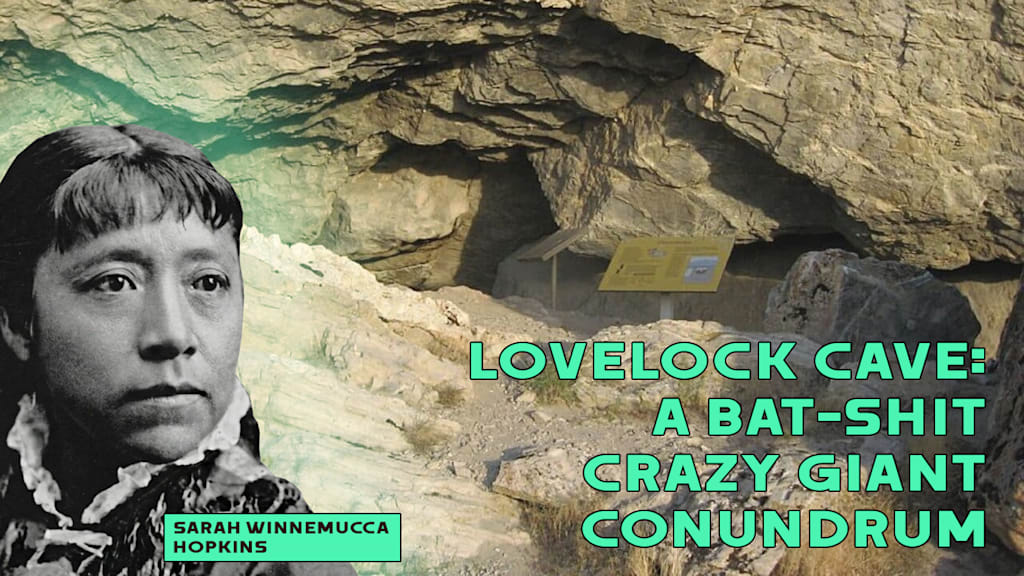
One of the most sensational stories about the discovery of giant skeletons focuses on Lovelock Cave in Nevada, where two official excavations are believed to have taken place, in 1912 and then 1924, when thousands of artefacts were recovered including what have become known as the Lovelock Giants... reportedly measuring between eight and 10 feet tall.
The story begins in 1886 when mining engineer John Reid met a group of Paiute Indians while prospecting near Lovelock, Nevada. They told him one of their legends about a nearby cave where a final showdown had taken place between the native people of the area and a race of red-haired giants, they called the Si-Te-Cah.
They told how the cannibalistic giants had come to the region long ago by crossing the ocean on rafts made from tule, a wetland grass plant, from a distant island, with similar stories repeating themselves all over the Americas. In “Cronicas del Peru” 16th-century Spanish conquistador Pedro Cieza De Leon recounted an ancient Peruvian tale about the origin of South American giants who “came by sea in rafts of reeds” with some men “so tall that from the knee down they were as big as the length of an ordinary fair-sized man”.
So the question becomes whether the giants of Peru and the Si-Te-Cah could have been survivors of some massive cataclysm that sent them across the ocean to the Americas? But whatever their origin, the stories provide a strong case for the authenticity of the Paiute legend about them, and neighbouring tribes, waging war against the Si-Te-Cah who had spread terror across the land until they were chased off and sought refuge in a cave, eventually being trapped inside by fire at the entrance, where they suffocated or were burned alive... any driven out by the smoke being killed by the natives.
Reid was taken to the cave and when he saw it for himself was sure there was substance to the story that warranted further investigation but, as tantalising as the Paiute legend was, the caves around Lovelock contained something of even greater interest... guano deposits.
Filled with nutrients, such as nitrogen and phosphorous, guano has been a much-sought fertiliser in agriculture for more than 1,500 years and vast areas of bat-droppings had made Lovelock Cave extremely rich in it.
By 1911 miners David Pugh and James Hart began excavating the precious resource, shipping tonnes of it to a fertiliser company in San Francisco. Then, when the surface layers had been mined, they began to uncover strange objects as they dug deeper, leading to an official excavation starting in 1912 by the University of California.
The dig uncovered remarkably well-preserved artefacts, some allegedly dating back 3,000 years. Among those still on display include examples of the oldest known duck decoys in the world, meticulously crafted from bundled reeds and painted with natural pigments.
But the archaeologists are also believed to have found human remains that sparked intense debate, reports from early excavations mentioning unusually large skulls and bones. Among the strangest discoveries was a collection of sandals, allegedly 2,000 years old and big enough for feet up to 15 inches long.
Some of the artefacts discovered, such as the sandals and duck decoys, ended up in the Humboldt Museum in Winnemucca, Nevada, but most of the evidence of red-haired giants has been lost over time, key skull specimens strangely disappearing although photographs remain of them being on display.
But time and again reports indicate the most significant finds from such excavations were carefully packed up and shipped off to the Smithsonian Smithsonian Institution... an active and eager collector that encouraged local excavators to send their findings, particularly skeletal remains, to Washington for study.
In the late 19th century the Smithsonian’s Bureau of American Ethnology (BAE), under the direction of John Wesley Powell, launched the Mound Exploration Division with a mission to survey and excavate tens of thousands of ancient earthworks across the eastern US. This official government-funded programme created a pipeline for countless artefacts and bones to flow from small towns across the US into the vaults of the national museum.
The institution’s own publications provide the evidence. For example, the Twelfth Annual Report of the Bureau of Ethnology, published in 1894, contains a comprehensive study by Cyrus Thomas detailing the BAE’s work in the Kanawha Valley of West Virginia. The official report includes the excavation of the Criel Mound, where agents found a central burial of a “once most powerful man”, whose skeleton was of “unusually large size”, surrounded by 10 other skeletons in a spoke-like ritualistic formation. The find was of such significance it was also reported in regional newspapers such as the Charleston Daily Mail.
Routinely the Smithsonian’s own field agents were finding and documenting precisely what the local newspapers were reporting. The press wasn’t fabricating stories, it was accurately reporting on the findings of the Smithsonian’s own scientific teams. It’s an anomaly that makes the institution’s modern-day denials extremely perplexing... a paper trail that leads directly to the Smithsonian’s doorstep only to vanish into the organisation’s bureaucratic abyss.
It’s not a contradiction between fringe newspapers and serious science, it represents a discrepancy between the Smithsonian’s own documented history of acquisition and its present-day public statements. Bones collected, catalogued and then, it would seem, deliberately mothballed.
A second excavation took place at Lovelock Cave in 1924, while other digs in the area were also revealing equally-strange finds. According to a 1931 article published in the Review-Miner, two giant skeletons were found buried in a dry lake bed close to Lovelock. The remains allegedly measured eight to 10 feet in height and were mummified in a manner similar to those discovered in ancient Egypt.
Although originating from a culture with a rich oral heritage, the Paiute legend about a prolonged battle with red-haired giants also featured in an 1883 publication “Life Among the Piutes: Their Wrongs And Claims” by Sarah Winnemucca Hopkins, a memoir and history considered to be the first known autobiography written by a Native American woman.
But perhaps the most interesting claim about giant skeletons being found in North America focuses on the Grand Canyon and a trip by Smithsonian contractor “G E Kinkaid” down the Colorado River in 1909. The year before, US President Teddy Roosevelt had begun efforts to declare the area off-limits to all timber and mining operations, so before legislation could be passed to close off the area for good Kinkaid began his journey to explore the canyon in search of minerals such as gold, silver and copper.
Starting out at Green River, Wyoming, Kinkaid was heading along the river to Yuma in a wooden boat when he spotted unusual staining in the sediment way up on the wall of the canyon and decided to do some unplanned exploring.
Kinkaid couldn't find a trail but after a short hike he came across hundreds of steps carved into the sandstone that wound their way up to a high shelf on the side of the canyon, about 700 yards above the river and only around 500 yards from its uppermost edge, where he found a cavern entrance that was clearly man-made, inside which he is believed to have discovered a vast “underground citadel” filled with ancient relics and the mummified remains of giants.
He sent some of the artefacts to the Smithsonian in Washington along with his notes and requested financial and logistical support for what he felt was perhaps the most significant archaeological discovery ever made on the continent. The Smithsonian agreed to his request and a few weeks later “Professor S A Jordan” arrived with a team of about 40 researchers and labourers to excavate and explore the cave.
Click here to read PART THREE of this investigation on the Smithsonian Institution’s role in suppressing incredible evidence of giant skeletons being discovered across North America in the early part of the 20th century.
About the Creator
Steve Harrison
From Covid to Gaza and Ukraine... nothing is as it seems in the world. Don't just accept the mainstream brainwashing, open your eyes to the bigger picture at the heart of these globalist agendas.
JOIN THE DOTS: https://not.wildaboutit.com
Enjoyed the story? Support the Creator.
Subscribe for free to receive all their stories in your feed.
Comments
There are no comments for this story
Be the first to respond and start the conversation.