
Kinkaid and the great Grand Canyon cover-up
Tall tales buried by the Smithsonian: PART THREE

Just 10 years after G E Kinkaid’s discovery of a huge complex cut out of the Grand Canyon rock in a cave located about 42 miles up the Colorado River from El Tovar Crystal Canyon, United States President Woodrow Wilson officially designated the area a national park, restricting access to vast areas of the geological wonder that would become one of continent's most popular tourist attractions.
The majority of the canyon remains open to hikers, rafters and sightseers but several parts were designated as no-go zones within the national park to allegedly protect sensitive land and cultural sites. These restrictions appear in permit rules and ranger guidance rather than dramatic warning signs but travellers being turned away from certain paths or areas is a common theme.
Mind you, the caution is understandable as the canyon is littered with hundreds of caves formed over thousands of years protecting endangered wildlife, containing rare minerals and historic remains, with bat colonies and fragile formations inside many of them requiring quiet and clean conditions. So the restrictions in many cases are totally justified and all caves are closed to visitors unless they have a formal research permit, as exploring them without training risks injury and damage. So, while some caves were explored long ago, they are now locked up to “protect” the history and life inside.
Indigenous communities also hold strong cultural and spiritual ties to parts of the canyon, including areas near the Little Colorado River and Havasupai land, so tribal authorities have been granted control over access to these areas with visitors having to follow tribal permit rules or reservation systems, like those used for Havasu Falls.
The canyon is also rich in minerals with mining operations also leaving behind environmental scars, particularly within the uranium mine zone. The Orphan Mine on the south rim once produced uranium and is closed under federal clean-up guidelines that allow only authorised teams to enter controlled sections. So when “samples” collected from the area that had found their way into museum rooms are transferred to the mine’s “secure zone” authorities can always cite routine safety steps for the items being hidden away.
Now these precautions are all well and good but what is not acceptable are the Smithsonian’s denials that they acquired large quantities of artefacts towards the end of, and around the turn of, the 19th century that show occupation of the cave systems when even their own records indicate they were indeed sent them.
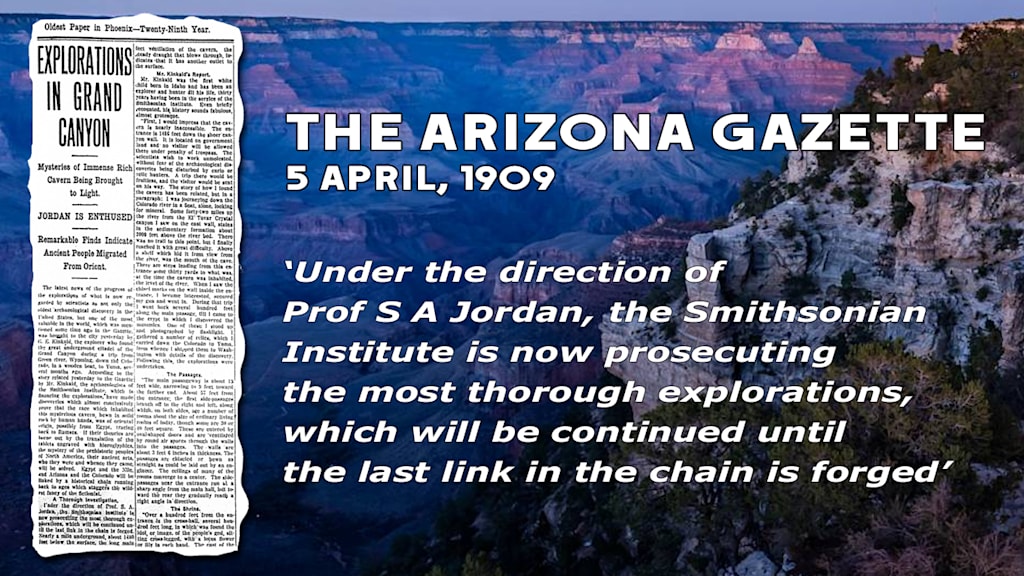
Details of Kinkaid’s discovery and the subsequent Smithsonian excavation of the cave were extensively reported in the 5 April edition of “The Arizona Gazette” in 1909. According to the report the Smithsonian, which was financing the dig, had made discoveries that almost conclusively proved people, possibly from ancient Egypt, had inhabited the cavern, with mummified bodies wrapped in dark linen measuring nine feet tall uncovered during the dig. A second report is also believed to have been published in the newspaper four days later.
After his initial discovery of the cave Kinkaid collected a few artefacts and then continued his trip down the Colorado River to Yuma, from where he sent them along with his notes of what he’d found to the Smithsonian asking for financial and logistical support for what he considered was possibly the most significant archaeological discovery ever made on the continent.
The institute agreed and a few weeks later Professor S A Jordan led a team of about 40 scientists, researchers and labourers to excavate and explore the site. They soon realised the layout in the cave system wasn't random but deliberately designed, with all the tunnels leading to a central chamber that housed a large statue Kinkaid thought resembled Buddha sitting cross-legged with a lotus or lily flower in each hand.
The walls of the main chamber were said to be adorned with copper weapons and tablets covered with hieroglyphics, with passages radiating from it like the spokes of a wheel. The article also talked about the discovery of ceramics and other artefacts the researchers believed had been manufactured far across the ocean.
The article does not give much more detail about what the Smithsonian scientists are believed to have discovered, while the institute denies an excavation even took place at all.
Of course none of this can be verified almost 120 years later but it’s extremely hard to believe The Arizona Gazette would have published such incredible claims without even first verifying the Smithsonian’s involvement in a dig in the Grand Canyon in 1909 under Professor Jordan’s leadership. And, if Kinkaid’s claims were fabricated, it’s even harder to understand why the Smithsonian would not have attempted to deny them through the press, but no such denials appear to exist or are quoted in articles that claim it was all just an elaborate hoax.
But, after years of exploring the area, researchers Jerry and Kathy Wills claim to have discovered the location of Kinkaid’s cave, although reaching it has so far proved an impossible challenge.
First though a little background on psychic healer Jerry from an "Exopolitics Today" interview with Michael Salla. According to the podcast Jerry claims he was found as an infant in 1953 at an abandoned farm near Fort Knox in rural Kentucky after authorities had been notified he was suffering from frostbite. He was taken to a US Army base where he recovered and was later adopted by an officer and his infertile wife who raised him as their son, along with two adopted daughters.
During his youth he claims he displayed strange psychic abilities that allowed him to see into people’s bodies and heal their illnesses and injuries. He was also able to communicate telepathically and even see into the future. In his teens he states that he had contact experiences with human-looking extraterrestrials from the Tau Ceti star system, learning that he had been sent to Earth through an agreement reached by US President Dwight Eisenhower and visiting extraterrestrials.
For the past 30 years he has focused his research on energy portals and ancient civilisations, while also helping people with his unusual healing abilities. Together with Kathy, the pair have travelled extensively throughout North and South America since 1998 in search of lost cities, ancient technology, unexplained locations and evidence that challenges accepted history, sharing their experiences through “The Jerry Wills Show” documentary podcast.
In an interview with Gaia presenter Regina Meredith, Jerry expanded on his research which suggests the location of Kinkaid’s Grand Canyon lost citadel is situated near the convergence of the Colorado and Little Colorado rivers, close to the Kwagunt rapids. The Wills’ investigation claims the site was near a natural dam that collapsed during a volcanic eruption as little as 800 years ago, sending the river level plummeting 700 yards.
The occupants of the Kinkaid cave system at that time became trapped high above the river and the “moqui” steps he discovered in 1909 had been cut into the sandstone in order for them to be able to climb down to the river.
He goes on to suggest that Kinkaid’s trip down the river followed an earlier expedition by John Wesley Powell, head of the Smithsonian’s Bureau of American Ethnology (BAE), who had himself led a mission down the Colorado in 1869, with a second during 1871-72.
Jerry says Powell was aware of the Hopi legends of an underground city in the Grand Canyon filled with gold and had himself got to Kinkaid’s steps up the canyon wall during his travels down the Colorado but, having lost an arm previously, had been unable to explore them further. However, as head of the BAE, he had agents monitoring locations in the region that traded in the precious metal and heard reports about two men turning up in Salt Lake City and selling large amounts of gold objects.
He tells how the brothers had been hunting and prospecting in the area when they encountered the daughter of a Paiute chief who was being attacked by a mountain lion. The brothers saved the woman, shooting the beast before it could attack her, but although the chief was grateful he wasn’t too happy they’d been trespassing on tribal land. So he made a deal with them, promising all the gold they could carry as long as they agreed never to return to the site.
So they were taken to a cave full of golden objects and they loaded up their mules and left for Salt Lake City to sell the items, with Powell notified by his spies soon afterwards, resulting in Kinkaid being brought on board to follow Powell’s journey down the Colorado River with the aid of his expedition notes.
During four years of exploration in the canyon during the turn of this century the Wills’ research led them to where they thought the moqui steps began, but since the time of Kinkaid’s exploration they had been destroyed. However, with the aid of thermal imaging, they were able to identify two spots at the top of the canyon where the tracks of a former narrow-gauge railway had led to where there was evidence of a pulley system having been constructed.
The Wills’ presumption was the holes had originally been used by the cave’s inhabitants to reach the surface to carry out farming atop the canyon, but had been converted by Kinkaid and Jordan during their exploration to hoist artefacts to be transported by rail back to the Smithsonian in Washington.
During her research Kathy had also come across evidence explaining the presence of Asian artefacts in the cave system. The documents told how pilgrims from the orient had once made the journey across the ocean and up the Colorado River to a “Canyon Of Light” to pay homage to the little “Child Of The Sun”.
So pilgrims from the orient visiting the Grand Canyon, red-haired giants crossing the ocean to settle in North and South America... it seems the history books may not be particularly reliable when it comes to understanding the ancient migration of populations around our planet. See PART FOUR of this investigation on the Smithsonian Institution’s suppression of the tall tales that have united cultures across the globe going way back into the distant past!
About the Creator
Steve Harrison
From Covid to Gaza and Ukraine... nothing is as it seems in the world. Don't just accept the mainstream brainwashing, open your eyes to the bigger picture at the heart of these globalist agendas.
JOIN THE DOTS: https://not.wildaboutit.com
Enjoyed the story? Support the Creator.
Subscribe for free to receive all their stories in your feed.
Comments
There are no comments for this story
Be the first to respond and start the conversation.