Historical
Information Warfare Amid India-Pakistan Tensions: The Faces Behind the Battle of Narratives
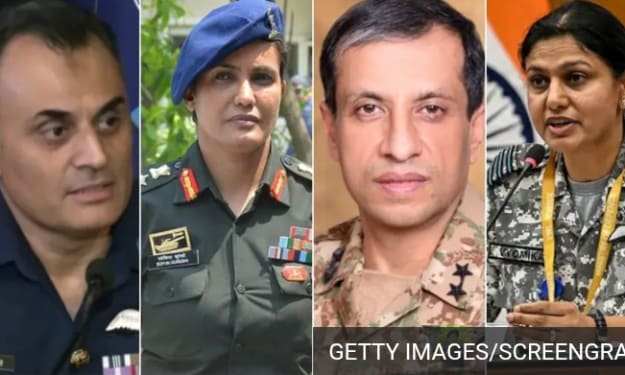
India-Pakistan Tensions: The 'Information War' and the Military Officers Who Became the Face of This 'War' On May 7, a press conference was held to share the initial details of India's 'Operation Sandur' carried out in Pakistan. Among others, two female officers from the Indian armed forces also participated. Following this initial press briefing, both India and Pakistan began holding similar press conferences almost daily over the past five days. These briefings featured military spokespersons from both countries, as well as officers who provided details about military operations. These officers include Colonel Sophia Qureshi of the Indian Army, Wing Commander Vyomika Singh of the Indian Air Force, Air Vice Marshal Aurangzeb Ahmed of the Pakistan Air Force, and Pakistan’s DG ISPR Ahmad Sharif Chaudhry—each of whom has been a topic of discussion on social media in both countries. Now that a ceasefire has been declared, the conversation has shifted to the 'information warfare' between the two nations. People are analyzing and comparing the press briefings and claims made from both sides. --- Air Vice Marshal Aurangzeb Ahmed In press briefings organized by Pakistan, details of Pakistan Air Force operations were shared by Air Vice Marshal Aurangzeb Ahmed. Many clips of his briefings have gone viral on social media in Pakistan. The spokesperson of the Pakistan Air Force told BBC Urdu’s Maniza Anwar that Air Vice Marshal Aurangzeb Ahmed was commissioned into the GD(P) branch of the Pakistan Air Force in December 1992. According to the spokesperson, during his career, he has commanded a fighter squadron and an operational airbase. He has also served as Assistant Chief of Air Staff (Operational Requirements and Development) at Air Headquarters in Islamabad. The spokesperson added that he holds a Master's degree in Military Arts from China and another Master's in National Security and War Studies from National Defence University, Islamabad. Aurangzeb Ahmed has also served at the National Defence University as Directing Staff and a faculty member. He also served as commander of the Pakistan Aeronautical Complex team in Saudi Arabia, and has held positions as DG PR Air Force and DG Warfare and Strategy. Currently, he is serving as Deputy Chief of Air Staff (Operations) at Air Headquarters. In the past, he has also been awarded the Sitara-e-Imtiaz (Military), a prestigious military award in Pakistan. --- Colonel Sophia Qureshi Colonel Sophia Qureshi, from the Indian state of Gujarat, is an officer in the Indian Army. She first gained media attention in 2016 during multinational field training exercises held in Pune, India. Named 'Force 18', these exercises included ASEAN Plus countries and were considered the largest ground forces exercises in India at the time. Colonel Qureshi, then a Lieutenant Colonel from the Signals Corps, led a 40-member Indian contingent. She became the first female officer to lead an Indian training team in a multinational exercise. At the time, India’s Ministry of Defence highlighted her on social media and shared her photos. Sophia Qureshi comes from a military family in Gujarat; her grandfather also served in the Indian Army. She has completed post-graduation in biochemistry. She has also served in the UN Peacekeeping Force for six years, and in 2006, she spent time in Congo, where her primary role was to support training related to peacekeeping operations. --- Lieutenant General Ahmed Sharif Chaudhry: DG ISPR Lieutenant General Ahmed Sharif Chaudhry, head of the Inter-Services Public Relations (ISPR) of the Pakistan Army, is known for conducting long press briefings on security matters. During the recent tensions between India and Pakistan, he was often seen leading joint briefings on behalf of the armed forces. At times, he appeared with the Deputy Prime Minister and Foreign Minister at the Foreign Office; at others, with Air Force and Navy officials detailing various operations. He was promoted to Lieutenant General in May of last year and has been serving as the 22nd DG ISPR since December 2022. In the past, he also served as head of Defence Science and Technology Organization (DESTO), which works on weapons systems and scientific research. He has also served in the Military Operations Directorate. General Ahmed Sharif belongs to the Corps of Electrical and Mechanical Engineers (EME), a branch from which very few officers reach the three-star rank. Senior journalist Baqir Sajjad Syed told the BBC that before his appointment as DG ISPR, General Sharif held numerous key positions and has vast operational experience. --- Vyomika Singh The second officer who briefed the media about Operation Sandur was Wing Commander Vyomika Singh of the Indian Air Force. Vyomika Singh is a helicopter pilot in the Indian Air Force. According to Indian media, she had always aspired to become a pilot, and her name itself means “one connected to the sky.” She was part of the National Cadet Corps (NCC) and has an academic background in engineering. In 2019, she received a permanent commission as a pilot in the flying branch of the Indian Air Force. She has more than 2,500 flying hours of experience and, according to the Indian Air Force, has flown in difficult conditions in Jammu & Kashmir and northeastern India. She has also played an important role in several rescue operations, one of which took place in November 2020 in Arunachal Pradesh.
By Ikram Ullahabout a year ago in FYI
Operation Bunyān Marsūs: Pakistan's Strategic Missile Response to Indian Airstrikes
What Do We Know About the 'Fateh Missile' That Initiated Operation Bunyān Marsūs? The government of Pakistan has announced that in the early hours of Saturday morning, it launched a retaliatory operation against India, named Operation Bunyān Marsūs. It is worth recalling that on the previous night, explosions were heard in several areas, including Rawalpindi in Punjab province. Shortly thereafter, Director General of the Inter-Services Public Relations (ISPR), Lt. Gen. Ahmed Sharif Chaudhry, claimed that during Indian airstrikes between Friday and Saturday night, missiles were launched targeting Noor Khan Airbase in Rawalpindi, Shorkot Airbase, and Murid Airbase. However, according to him, all air force assets remained safe. Soon after this information was shared, the launch of Operation Bunyān Marsūs was officially announced. According to ISPR, the operation began with Pakistan launching its Fateh-1 missile. ISPR also shared videos of the launch with BBC. According to the Pakistani military, “This operation is dedicated to the Pakistani children who were martyred as a result of India’s aggression against Pakistan.” It added, “Pakistan has not and will never forget the martyrdom of these innocent children.” What Does “Bunyān Marsūs” Mean? The term Bunyān Marsūs is derived from a verse in the Holy Quran and translates to “a solidly cemented wall.” This phrase appears in Surah As-Saff, verse 4, which states: > “Indeed, Allah loves those who fight in His cause in a row as though they are a solid structure.” According to ISPR, Bunyān Marsūs represents people who struggle in the path of Allah, standing firm like an iron wall — the most beloved to God. This spiritual sentiment inspired the naming of the operation. What Is the Fateh-1 Missile? According to ISPR, the operation began with the launch of the Fateh-1 missile. The public relations wing of the military also released videos of the launch, which have since gone viral on social media. The term “Fateh-1” has become one of the top trends in Pakistan. Fateh-1 is a modern, short-range, surface-to-surface guided missile developed by Pakistan with a range of up to 140 kilometers. On August 24, 2021, Pakistan successfully tested this locally developed rocket system. Fateh-1 is part of the “Fateh series,” which also includes Fateh-2. The Fateh-2 missile can reach targets up to 400 kilometers away and has precise targeting capabilities. The missile can carry a warhead weighing between 300–500 kg. Dr. Mansoor Ahmed, a lecturer in Strategic and Defence Studies at the National University of Canberra, notes that the Fateh missile represents a sophisticated addition to Pakistan’s long-range artillery rocket systems. These missiles can precisely strike high-value targets such as airbases, command and control centers, ammunition depots, logistic lines, and forward artillery. Dr. Ahmed explains that the key feature of these missiles is their stand-off capability — they can be launched from beyond the enemy's defensive perimeter. They also possess a “shoot-and-scoot” ability, meaning the launcher can relocate immediately after firing, reducing the risk of counter-strike. He likens them to the U.S.-made HIMARS system, currently used effectively in Ukraine. Since the Fateh series is locally produced, Pakistan is not dependent on external suppliers and can continue missile production independently. According to Dr. Ahmed, the Fateh series includes Fateh-1, Fateh-2 (both operational), and upcoming models like Fateh-3 and Fateh-4, with Fateh-4 expected to have a range of 700 km. Supersonic Accuracy and Tactical Maneuverability Defense analyst Syed Muhammad Ali, based in Islamabad, highlights that the Fateh missile series offers exceptional accuracy and operates at supersonic speeds. Its most significant feature is its terminal maneuverability — the ability to change direction during the final phase of flight. He draws a cricket analogy: just as Waqar Younis's late swing confused batters, the Fateh missile’s final-stage maneuvering confuses enemy defense systems, rendering interception nearly impossible. According to him, India has a three-layered defense system — the outermost being the Russian-made S-400 (range 300–400 km), followed by Israel’s Barak-8 surface-to-air missile, and the indigenous Akash system. He claims Fateh-1’s terminal-stage agility allows it to bypass all these layers, making it a vital tool in Pakistan’s full-spectrum deterrence strategy. Impact of the Fateh-1 on Airbases Targeting airbases with Fateh-1 yields strategic advantages. The missile can release hundreds of bomblets, destroying runways and creating craters that ground aircraft. Until runways are repaired, all air operations are effectively halted. Public Reaction and Naming Praise Many Pakistani social media users have praised the naming of the operation as Bunyān Marsūs. One user, Faraz, wrote on X (formerly Twitter): “I usually don’t favor naming military operations in any language other than Urdu, but considering the nature of our current adversary, Bunyān Marsūs is the perfect name.”
By Ikram Ullahabout a year ago in FYI
5 countries that have the most and largest financial institutions in the world
While it is challenging to pinpoint the exact number of financial institutions in each country and rank them definitively by quantity, we can discuss five countries that are recognized as having a significant presence of large financial institutions and are major global financial centers. Based on available data and general understanding, these countries are:
By Moharif Yuliantoabout a year ago in FYI