
Emotional
A guide to the confusing, messy, and beautiful journey of growing up

* Puberty Series Part 4: Understanding Yourself — Real Control in Your Hands*
So far, you’ve learned a lot in this series.
You’ve learned how puberty begins, what changes happen in the body, and why the mind gets confused.
Now here’s the final and most important step:
**How to handle it all correctly?**
Because the truth is, puberty itself isn’t a problem—the real difference is how you understand and manage it.
## Puberty: A Change, Not a Defect
First, keep one thing in mind:
There’s nothing “wrong” with you.
Your body and mind are entering a new phase.
This is an upgrade, not a downgrade.
But because this change is rapid and new, it can be confusing at first.
## Example 1: Anger — When a Reaction Gets Out of Control
Let’s say you come home from school, exhausted.
Mom tells you: “First change your clothes and eat”
On a normal day, you would have calmly agreed.
But today you immediately get angry:
“Not now!”
After a while, you think to yourself:
“Why did I get so angry?”
> Reality:
It’s not your attitude, but an imbalance of hormones and the brain.
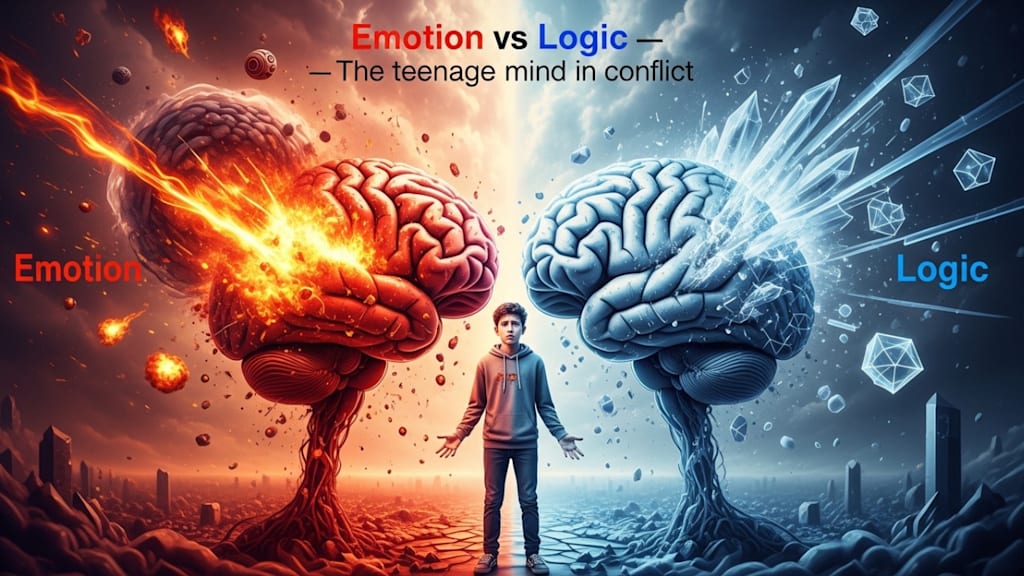
At this age, the emotional part reacts very quickly, while the thinking part is not yet fully strong.
**Solution:**
* When you get angry, don’t answer immediately
* Be silent for 10 seconds
* Drink water or go a little further
* Then talk calmly
## Example 2: Self-confidence — the trap of comparison
In class, you see your friends:
* Someone is taller than you
* Someone’s voice has already become deeper
* Someone’s beard has started to grow
You think:
“Why am I behind?”
> Fact:
Every person's body grows at its own pace.
Some people start puberty early, some a little later.
**Solution:**
* Stop comparing yourself to others
* Focus on your progress
* Remember: after a few years, this difference disappears
---
## Example 3: Attraction — the beginning of new feelings
You are sitting in class, and suddenly your attention is drawn to a particular person repeatedly.
You become confused:
“What is happening?”
> Fact:
This is attraction, and it is completely normal.
It is part of the new programming of your brain.
**But the important thing:**
Not every feeling needs to be acted upon.
**Solution:**
* Distract yourself (sports, studying)
* Understand feelings, but don't make hasty decisions
* Clarity will come with time
---
## Example 4: Peer pressure — trying to be “cool”
Friends say:
“If you don't do this, you're boring”
You're uncomfortable inside, but you still do it.
> Fact:
This is peer pressure, and it's very common in adolescence.
**Solution:**
* Learn to say “no”
* Set your boundaries
* Remember: real confidence is when you stand by your values
---
## Example 5: Mobile and screens — where did the time go?
You say:
“I'll just use my mobile for 5 minutes”
But before you know it, an hour passes.
> Fact:
In adolescence, the brain is more sensitive to things that give pleasure.
That's why scrolling seems addictive.
**Solution:**
* Set a screen time limit
* Turn off your mobile before going to bed
* Adopt alternative activities (sports, books, family time)
## Example 6: Mood swings — sometimes happy, sometimes sad
In a single day:
* You are energetic in the morning
* Bored in the afternoon
* Overthinking at night
You think:
“Why am I like this?”
>Fact:
These mood swings are caused by hormones.
**Solution:**
* Maintain a daily routine
* Get enough sleep
* Eat less junk food and more healthy food
## A powerful rule: Pause → Think → Act
If you want to handle puberty smartly, remember this one rule:
**Pause → Think → Act**
### Example:
* Get angry → Don’t respond immediately
* Make a risky decision → Think first
* Pressure from friends → Ask yourself “Is this right?”
This small habit will make you emotionally strong.
---
## Small daily habits that make a big difference
### 1. Sleep
Get 7–9 hours of sleep daily.
It keeps the brain balanced.
### 2. Exercise
Playing or exercising reduces stress and improves mood.
### 3. Water and Food
A lot of water and healthy food keep your energy stable.
### 4. Positive thinking
Talk to yourself.
“I am getting better” — this thought is very powerful.
---
## What is real strength?
In puberty, strong is not the one who:
* Is the tallest
* Is the strongest
But strong is the one who:
* Understands his emotions
* Makes his own decisions
Stays calm in difficult situations
## Will this phase last forever?
No.
Over time:
* The mind will mature
* Emotions will become balanced
* You will start to understand yourself better
What seems confusing today, will become your strength tomorrow.
---
## Full Series Summary
1. The brain begins puberty
2. Hormones bring about changes in the body
3. Confusion and emotions arise in the brain
4. With the right habits, you can control this phase
---
## Final Message
What is happening inside you is not weakness—it is growth.
You are not breaking down,
you are becoming.
And if you understand this time,
then this phase can take you ahead of everyone else.
About the Creator
Enjoyed the story? Support the Creator.
Subscribe for free to receive all their stories in your feed.
Comments
There are no comments for this story
Be the first to respond and start the conversation.