
Your Worst Nightmare Could Be a Lifesaver
Not next year, it’s already here

Hands up if you like cockroaches?
Not a fan, OK. Very few people are.
There is no venomous or deadly “killer” cockroach. The German cockroach (Blattella germanica) is the most harmful to human health globally.
They’re smelly, sneaky, and dirty little critters. They often frighten even the bravest households. They cause allergies and asthma, spread disease, and even if you catch them, they’re tough to kill. Why is it that they always die on their backs, legs in the air? (I will come back to that.)
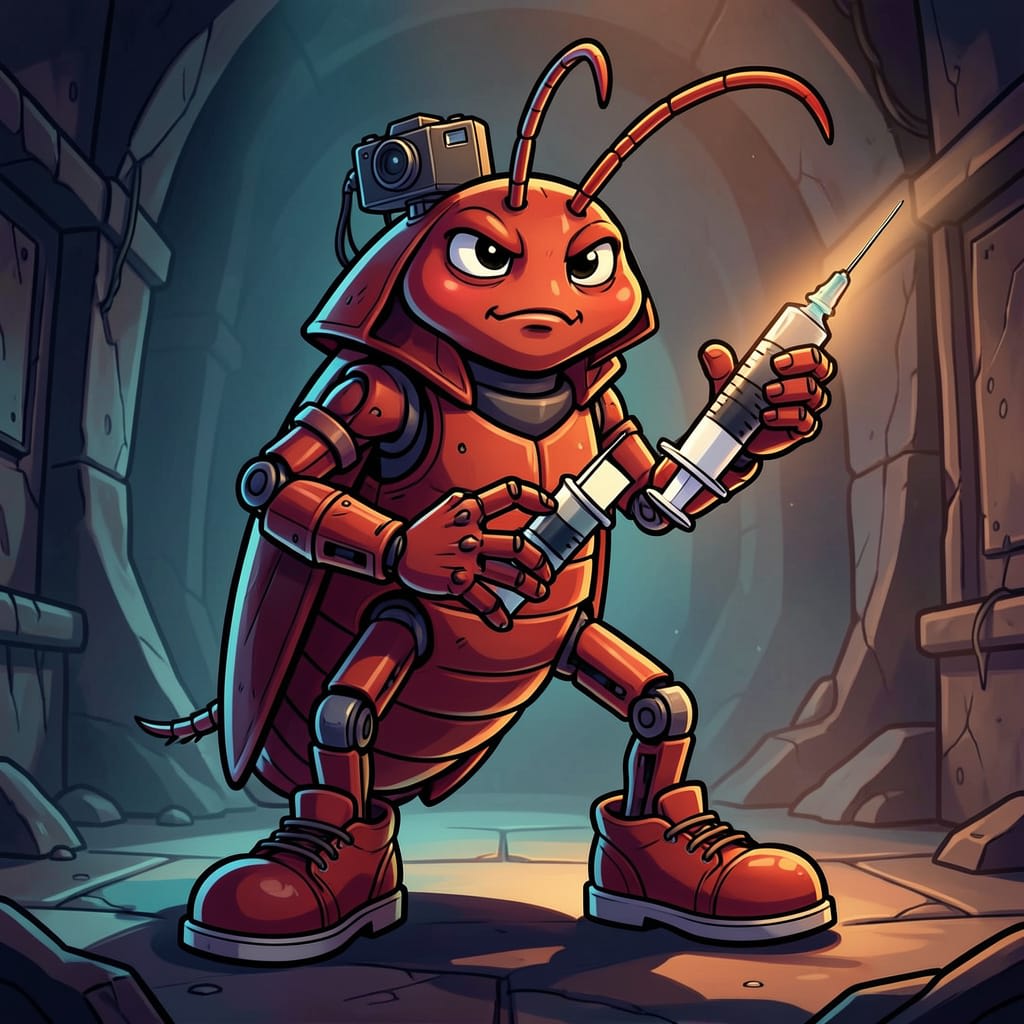
So, we don’t like cockroaches; in fact, most of us hate them. What’s more unnerving than a giant cockroach? Perhaps a part-robot, part-insect giant cockroach.
What if I said they could save lives? They might help people stuck in landslides or caves. They could also deliver life-saving medication. Would you think I had been drinking? Would you change your mind about these lovable little creatures?
Read on….
Cockroaches have been around for more than 280 million years. They have faced over 300 million years of volcanic eruptions, earthquakes, tornadoes, nuclear disasters, and bombings. That takes a special set of survival skills. They can hold their breath for over forty minutes and live without their heads for a week. They can run up to three miles an hour and go without food for a month.
They can learn new associations and behaviours in just one to two training trials. This can happen within hours or days of facing new conditions.
I have firsthand experience of this from my days at university. For my behavioural biology project, I decided to teach cockroaches to navigate a maze. I made my maze cognizant not to make it too complicated, just a couple of turns and choices. I ordered my cockroaches, and away I went.
Day 1 was a disaster. I had to do it under a red infrared lamp. There I was, struggling with a milkshake container full of twenty cockroaches in the dim light. I dropped the container, and they took off in all directions.
One week later, a new group of cockroaches arrived. I was ready to tackle the maze again, come what may. I selected two; there's nothing like companionship to boost learning. Eventually, they found their way to the end.
In later trials, I saw that the cockroaches learned better when I gently poked them in the backside with a pin. Yep! If the stimulation is right, they learn quickly.
Bio robotics engineers have created cyborg cockroaches using giant burrowing cockroaches. These roaches are about the size of your finger. Fitted with lightweight electronics and cameras, the goal is to help in search-and-rescue missions.
Some have been fitted with remote auto-injection systems. These small devices can provide medical help to people trapped in debris. In proof-of-concept testing, it reached 95% success. This was with close-range injection, positioned within 15 cm of the target. When they combined electronics, cameras, and autoinjectors, they succeeded in 72% of the trials.
Some researchers have taken it further. They've made cyborg cockroaches that can swim underwater for up to three hours. They created small diving suits to work in low-oxygen places, like underwater. This effectively transformed these naturally terrestrial insects into amphibious ones. They can move on land and swim underwater. This makes them useful for rescuing people trapped by floods or landslides.
Disaster sites, such as flooded areas, can be hard or dangerous for humans to navigate. With a fleet of mini amphibious survival machines, they could aid in many rescues.
Just like in the recent robot games in China, things take time to become perfect. The robots could run faster than Usain Bolt. But some couldn’t stop. They crashed into the wall and became a pile of junk.
So far, there appears to be only one flaw with the cyborg roaches. If these little robots flip over, they are in trouble. Generally, a cockroach dies on its back because it can’t right itself. Its long legs and convex back make it hard to grip or roll. Cockroaches lack the muscle strength and structure to flip themselves back over.
Being stuck under rubble and seeing a giant cockroach with a syringe doesn’t help my fear of them. Maybe I would just take my chances. How about you?
Submitted to the "Already Here" challenge:
Till next time,
Calvin
About the Creator
Calvin London
I write fiction, non-fiction and poetry about all things weird and wonderful, past and present. Life is full of different things to spark your imagination. All you have to do is embrace it - join me on my journey.
Enjoyed the story? Support the Creator.
Subscribe for free to receive all their stories in your feed. You could also become a paid subscriber, letting them know you appreciate their work.
Comments
There are no comments for this story
Be the first to respond and start the conversation.