
The Reverse Industrial Revolution
In my view, the real long-term transformation created by AI and robotics won't be widespread human unemployment, but a partial reversal of the economic order established by the Industrial Revolution over the last 200 years.

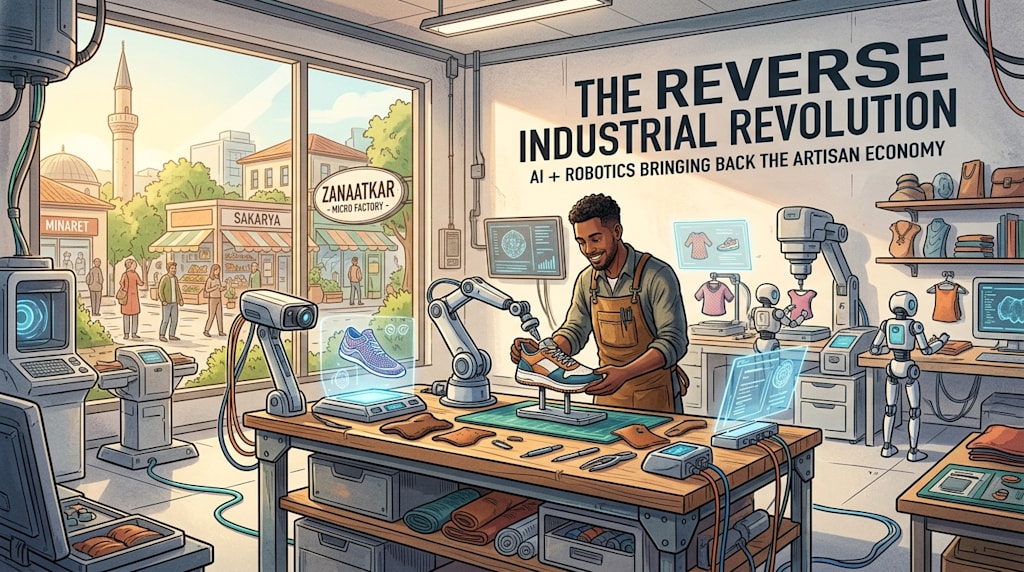
In my view, the real long-term transformation created by AI and robotics won't be widespread human unemployment, but a partial reversal of the economic order established by the Industrial Revolution over the last 200 years.
What Did the Industrial Revolution Do?
It centralized production. In the past, every city—and even every neighborhood—had its own shoemaker, tailor, carpenter, blacksmith, and maker. The items they produced were unique to each craftsperson; when you visited a city, you would see things distinct to that place.
Then came the factories. When a factory produced millions of identical units of the same item, it was impossible for local producers to compete in terms of price and efficiency. Afterwards, globalization took over and pushed this trend even further. Today, whether you walk into a shopping mall in Istanbul, Berlin, Dubai, or New York, it's all the same: Nike, Adidas, Zara, H&M, Starbucks. The cities differ, but the storefronts remain identical. A vast portion of the world began consuming the exact same products from a few hundred corporations. While efficiency increased, it came at the cost of a severe loss of authenticity.
The First Shift: The Software Industry
Now, AI and robotics technology might initiate the exact opposite trend. We will observe this first in the software sector.
For instance, paying a monthly subscription fee in 2026 for a simple word processor like Word seems absurd to me in the long run. Twenty years ago, developing software at the level of Word required hundreds of developers, QA teams, designers, project managers, and millions of dollars. In the near future, a few individuals leveraging AI agents will be able to build similar software in just a few months.
In fact, why should companies continue paying monthly subscriptions for 20 different SaaS products—one for CRM, another for mailing, project management, SEO, customer support, and reporting? A local software firm of just a few people could come in and build a single, fully customized system tailored specifically to that company's needs.
Consequently, I believe the initial blow will be hit by a significant portion of giant software corporations. As software development ceases to be expensive, software itself will become a commodity. Knowing what needs to be built will be far more valuable than simply knowing how to write code. A factory in Sakarya might choose to pay a local 3-person software firm for a custom system rather than paying thousands of dollars monthly to a SaaS company in San Francisco. Because those three people won't truly be just three people—they will be backed by dozens of AI agents.
Physical World and Mass Customization
However, the real major disruption will begin when robots step into the physical world.
Today, one of the biggest advantages of companies like Nike or Adidas is their immense scale of production. By manufacturing millions of identical pairs of shoes, they drive down unit costs. But what happens when a small business equipped with a $100,000 robotic production line can produce shoes at Nike-level quality?
Let's take it a step further:
1. A customer walks into a shop.
2. Their feet are scanned in 3D, taking precise measurements of the left and right foot independently and calculating pressure points.
3. The customer specifies their desired design, and AI drafts the shoe.
4. Robots cut, sew, manufacture the sole, and assemble everything.
5. One hour later, a unique pair of shoes tailored specifically to that individual is ready.
This setup could render Nike's current scale advantage largely irrelevant. Nike's model is 1 design x 10 million people, whereas the future model could become 10 million designs x 1 person—in other words, mass customization instead of mass production.
Fascinatingly, this would bring us back to the traditional artisan economy, but with a twist. An 18th-century shoemaker could produce two pairs of shoes a day. A future shoemaker, backed by 20 robots and AI, could produce hundreds of items daily. The small producer regains their old advantages of uniqueness, customization, and personal customer relations while acquiring the efficiency of a factory.
The same transition can occur in furniture, textiles, food, toy manufacturing, electronics to a certain extent, and even faster in cultural industries like film, gaming, and music:
* A game currently made by 500 people could be developed by 5.
* A movie shot by 200 people could be filmed by 10.
* A software company run by 100 people could be managed by 3.
The New Economic Structure: The Dumbbell Model
This is why I don't fully agree with the notion that AI will simply 'steal everyone's job.' Yes, it may cause significant initial unemployment, leading to a harsh transition period particularly for white-collar workers. However, a large portion of today's workforce could eventually shift from being traditional employees to becoming small business owners, producers, or independent entrepreneurs.
If 100 people are currently employed across 5 companies, those same 100 individuals could run 30 to 40 micro-businesses in the future:
* One person manages sales and business vision.
* AI handles accounting.
* AI creates the design.
* AI writes the code.
* AI manages most customer service.
* Robots handle production.
The human role gradually shifts from 'doing the work' to 'deciding what should be done.' Thus, I don't believe the future economy will consist of a few thousand giant megacorporations. On the contrary, millions of small businesses and micro-enterprises could emerge.
Yet, there is an exception: a few companies at the very top might grow even larger than today.
* Semiconductor manufacturers
* Robotics makers
* AI foundation model creators
* Data center operators
* Energy providers
* Cloud infrastructure providers
* Platforms possessing massive data
The economy could reshape into a dumbbell structure: at the top, a handful of the largest technology and infrastructure companies in history; at the bottom, millions of 1-to-10-person enterprises. The traditional middle-tier corporations employing tens of thousands may shrink or vanish altogether. Perhaps the next phase of capitalism isn't about giant corporations producing everything, but millions of micro-producers building on top of tech provided by massive infrastructure giants.
Cultural Shift and Conclusion
The most rewarding aspect of this shift could be cultural. Cities might regain their unique character. Instead of seeing the same IKEA furniture, Zara clothing, or Nike shoes everywhere, we could see products crafted by thousands of independent designers and producers. A city's distinct design culture could re-emerge, as people opt for custom-made goods over mass-produced items.
In short, while AI propels us technologically into the future, it could paradoxically return us economically to the localized production model of the 1800s. Only this time, the artisan won't hold a hammer; they will manage AI agents, robotics, and micro-factories.
That is why I call this the 'Reverse Industrial Revolution.' The first Industrial Revolution turned the artisan into a factory worker. Perhaps this revolution will turn the worker back into an artisan.
About the Creator
Enjoyed the story? Support the Creator.
Subscribe for free to receive all their stories in your feed.
Comments
There are no comments for this story
Be the first to respond and start the conversation.