
The Limits of Humanity in the Universe
How far can Humanity go?

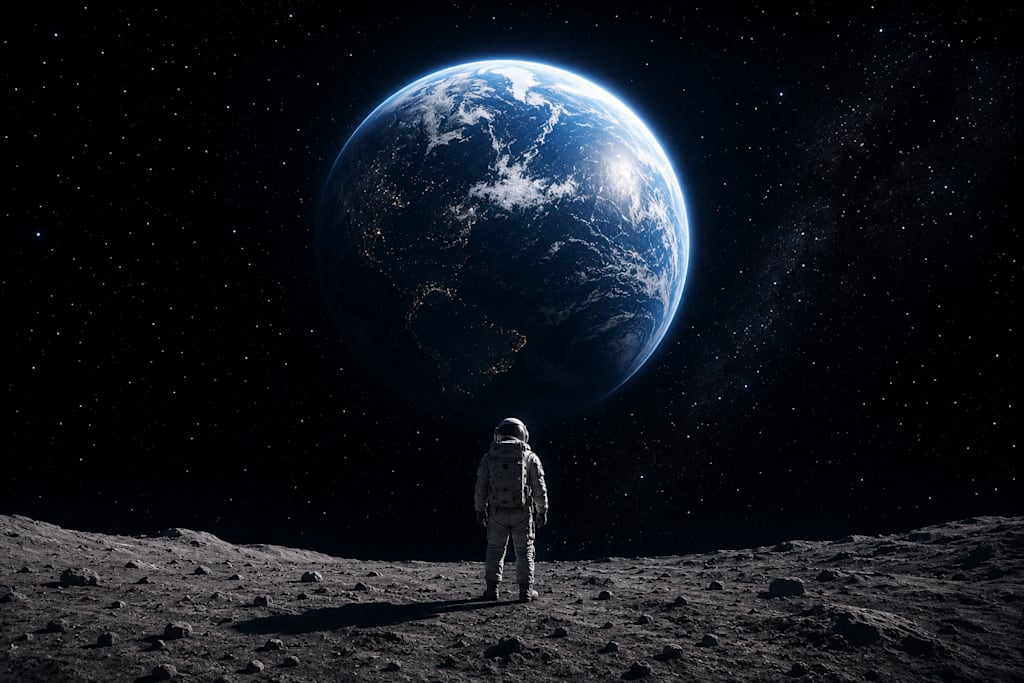
The universe is vast beyond imagination, yet despite all our dreams of exploration, there are boundaries humanity may never cross. No matter how advanced our technology becomes, there are regions of the cosmos forever beyond our reach. This realization is both awe-inspiring and unsettling. It forces us to confront a profound truth: even in a universe of unimaginable scale, humanity is confined to only a tiny corner of existence.
Our story begins in the Milky Way, a spiral galaxy stretching roughly one hundred thousand light-years across. From a distance, it appears dense and brilliant, filled with glowing stars and swirling clouds of gas and dust. In reality, however, the galaxy is mostly empty space. Between stars lie enormous distances so vast that even light, traveling at nearly 300,000 kilometers per second, requires years to cross them.
Within the Milky Way exist billions of stars, planetary systems, neutron stars, black holes, and mysterious dark matter structures. At its center resides a supermassive black hole around which the entire galaxy slowly rotates. Humanity occupies only a tiny position in one quiet spiral arm, orbiting an ordinary star we call the Sun.
Even reaching the nearest star system with our current technology would take thousands of years. The scale of our galaxy alone is almost incomprehensible. Yet the Milky Way is only a single island in an even larger cosmic ocean.
Nearby lies the Andromeda Galaxy, our closest giant galactic neighbor. Together with more than fifty smaller dwarf galaxies, both belong to a structure known as the Local Group, a region approximately ten million light-years wide. The Local Group itself is only one small component of the enormous Laniakea Supercluster, which contains hundreds of thousands of galaxies spread across hundreds of millions of light-years.
And even this supercluster is insignificant compared to the observable universe — a cosmic web containing trillions of galaxies stretching in every direction.
At first glance, this immense scale might suggest infinite possibility. Perhaps one day humanity could spread across the stars, travel between galaxies, and become a civilization spanning the cosmos. But the universe itself imposes a limit that no intelligence may ever overcome.
Imagine humanity surviving for millions or even billions of years. Suppose we avoid extinction, master interstellar travel, and develop technologies far beyond anything imaginable today. Even in this optimistic future, there is a final border we cannot cross.
That border is the Local Group.
No matter how advanced we become, the Local Group is likely the largest structure humanity will ever permanently inhabit. Although it contains trillions of stars and countless worlds, it represents only an unimaginably tiny fraction of the observable universe — approximately 0.00000000001 percent.
In other words, nearly the entire universe will forever remain inaccessible to us.
The reason lies in the nature of space itself.
What we call “empty space” is not truly empty. On quantum scales, space is alive with constant activity. Tiny particles and antiparticles continuously appear and disappear in fleeting moments, a phenomenon known as quantum fluctuation. Space behaves less like a silent void and more like a bubbling ocean of energy.
To understand why this matters, we must travel back approximately 13.8 billion years to the beginning of the universe.
Shortly after the Big Bang, the universe experienced an extraordinary event called cosmic inflation. During this brief moment, space itself expanded at unimaginable speed. A universe once smaller than an atom rapidly grew to astronomical size in a fraction of a second.
As space expanded, those tiny quantum fluctuations were stretched outward. Distances once smaller than subatomic particles became enormous cosmic structures. Slightly denser regions of matter formed alongside less dense regions, creating the seeds from which galaxies would eventually emerge.
After inflation slowed, gravity began shaping the universe. Matter gathered into stars, galaxies, and clusters. Regions where gravity was strong enough became gravitationally bound structures — cosmic islands where matter could remain connected despite the overall expansion of space.
Our Local Group is one of these islands.
However, the universe contains another force, one even more mysterious than gravity.
Around six billion years ago, dark energy began dominating the expansion of the cosmos. Scientists still do not fully understand what dark energy is, but its effects are undeniable. It acts like a repulsive force embedded within space itself, causing the universe to expand faster and faster over time.
This accelerating expansion changes everything.
Galaxies outside our Local Group are not gravitationally bound to us strongly enough to resist dark energy. As the universe expands, these distant galaxies move farther away at increasing speeds. Eventually, they recede so rapidly that traveling toward them becomes impossible, even at nearly the speed of light.
This means that while humanity may someday leave the Solar System, colonize nearby stars, and perhaps spread across the Milky Way, crossing the immense void between galaxy groups may forever remain beyond reach.
We could theoretically depart from the Local Group and venture into intergalactic darkness, but we would never arrive anywhere. The destination would continue retreating faster than we could pursue it.
Over billions of years, the situation becomes even stranger.
The Milky Way and Andromeda galaxies are moving toward each other and will eventually collide, merging into a giant elliptical galaxy often nicknamed “Milkdromeda.” Stars will rarely collide directly due to the enormous distances between them, but the structure of both galaxies will transform completely.
Meanwhile, everything outside the Local Group will drift away into darkness.
Distant galaxies will become fainter as their light stretches into longer wavelengths through cosmic expansion. Eventually, the remaining photons reaching us will be so weak and redshifted that they become impossible to detect.
At that point, the observable universe will effectively disappear.
Future civilizations living inside Milkdromeda may look into the night sky and see nothing beyond their own galaxy. No evidence of distant galaxies. No visible cosmic background radiation. No clues pointing toward the Big Bang or cosmic expansion.
To them, the universe may appear static, eternal, and empty.
They would have no way of discovering the true history of the cosmos that humanity can observe today. The evidence available to modern astronomy would be gone forever.
This is one of the most extraordinary coincidences of our existence: humanity lives during the brief cosmic era when the universe is still visible.
We exist at precisely the right moment to observe both the distant past and the large-scale structure of the cosmos. By studying ancient light traveling billions of years across space, we can reconstruct the history of the universe itself.
We can see galaxies as they existed shortly after the Big Bang. We can observe cosmic expansion in real time. We can measure the afterglow of creation itself.
Future civilizations may lose this ability entirely.
And yet, despite the apparent loneliness of our cosmic fate, there is still immense beauty in our situation. The Local Group alone contains trillions of stars and potentially countless habitable worlds. Humanity has not even fully explored its own planet, much less the Solar System.
The scale of opportunity before us remains staggering.
For now, the stars are still visible. The universe is still illuminated. We can still look outward and witness a cosmos filled with structure, motion, and wonder.
Although we may never touch most of the universe, we are among the few beings who may ever understand that it exists at all.
And perhaps that knowledge is valuable in itself.
The universe may place limits on where humanity can go, but it has also granted us something extraordinary: the ability to observe, to question, and to comprehend the grandeur of existence. Even if we remain forever confined to our tiny gravitational island, we are still capable of seeing the cosmos in all its breathtaking scale.
For a brief moment in cosmic history, the universe has revealed itself to us.
About the Creator
NGUYEN NGOC TRUNG
Daily Thoughts & Stories
Enjoyed the story? Support the Creator.
Subscribe for free to receive all their stories in your feed.
Comments
There are no comments for this story
Be the first to respond and start the conversation.