science
Topics and developments in science and medicine, presented by Futurism.
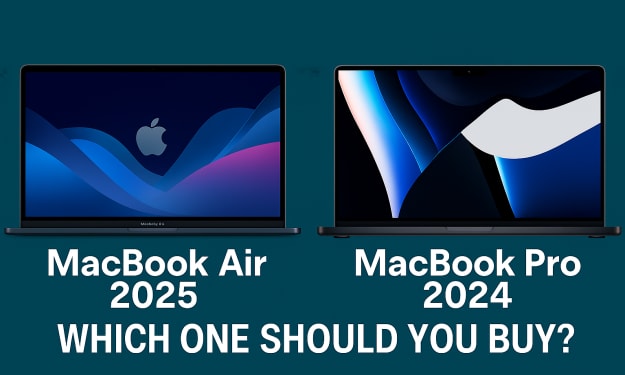
MacBook Pro M4 vs MacBook Air M4 (2025): Which Apple Laptop Should You Buy?
Discover the ultimate 2025 comparison between the MacBook Pro M4 and MacBook Air M4. Explore key specs, performance, battery life, pros and cons, and find out which Apple laptop is the best choice for students, creators, and professionals this year. Apple’s 2025 laptop lineup has set the bar high — again. The MacBook Pro M4 Pro and the MacBook Air M4 are both powered by Apple’s latest silicon and built around Apple Intelligence, the company’s new on-device AI system that enhances productivity, creativity, and everyday tasks. But which one is better for you — the powerful Pro or the ultra-efficient Air? Let’s dive deep into a full comparison to help you make the smartest buying decision in 2025. MacBook Pro M4: The Powerhouse for Creators and Professionals The 2024 MacBook Pro (14-inch) featuring the M4 Pro chip is designed for creators, developers, and professionals who need uncompromised performance. With a 12-core CPU and 16-core GPU, it delivers desktop-class power in a portable form. The Liquid Retina XDR display hits up to 1600 nits of brightness, making HDR video editing and photo work look absolutely stunning. Apple’s M4 architecture also enhances energy efficiency, so you can edit 4K videos, render 3D models, or run multiple apps simultaneously — all without plugging in. Key Highlights 14.2-inch Liquid Retina XDR display M4 Pro or M4 Max chip options Up to 24GB Unified Memory and 512GB SSD All-day battery life macOS Sequoia with Apple Intelligence integration Pros ✅ Incredible performance for creative and professional workloads ✅ XDR display is perfect for editing and color-accurate work ✅ Excellent build quality and cooling system ✅ Wide port selection including HDMI and SDXC slot Cons ❌ Higher starting price ($1,749+) ❌ Slightly heavier than MacBook Air ❌ Overkill for casual users MacBook Air M4: The Perfect Everyday Laptop The MacBook Air 15-inch (2025) is Apple’s most balanced laptop yet — now running on the M4 chip. It’s designed for students, remote workers, and anyone who wants premium performance without the Pro price tag. The M4 chip provides faster app switching, smoother multitasking, and even light video editing without breaking a sweat. Add to that a 15.3-inch Liquid Retina display, 18-hour battery life, and super-slim design, and you’ve got the best value MacBook ever made. Key Highlights 15.3-inch Liquid Retina display (500 nits) M4 chip with 8-core CPU, 10-core GPU 24GB Unified Memory, 512GB SSD 12MP Center Stage camera + six-speaker audio macOS Sequoia with Apple Intelligence Pros ✅ Exceptional performance for the price ✅ Incredibly lightweight and silent ✅ Longest battery life ever on a MacBook ✅ Gorgeous design and multiple color options Cons ❌ Limited port selection ❌ Not ideal for heavy 3D or video production ❌ Display not as bright as the Pro MacBook Pro M4 vs MacBook Air M4: Side-by-Side Comparison Processor (Chip): MacBook Pro M4 Pro → 12-core CPU, 16-core GPU MacBook Air M4 → 8-core CPU, 10-core GPU Display: MacBook Pro → 14.2-inch Liquid Retina XDR (up to 1600 nits brightness) MacBook Air → 15.3-inch Liquid Retina (500 nits brightness) Performance: MacBook Pro → Designed for professional workloads and AI-driven tasks MacBook Air → Great for daily productivity and light creative work
By NextGen Mobile Techabout a year ago in Futurism
Pandora Mission: Opening a Cosmic Box of Secrets
For centuries, humanity has looked to the night sky in wonder — to predict the seasons, to navigate oceans, or to seek meaning among the stars. Today, our gaze has a new purpose: to find out whether we’re alone in the universe. And leading this quest is NASA’s Pandora mission, a small but mighty space telescope designed to study the atmospheres of 39 distant exoplanets — all while watching their host stars and planets simultaneously.
By Holianyk Ihorabout a year ago in Futurism
SPHEREx: The Space Telescope That Will Redraw Our Map of the Universe
When we gaze up at the night sky, we see a silent ocean of stars — calm, timeless, and still. But behind that peaceful illusion lies a dynamic history: galaxies forming, stars igniting, and cosmic structures evolving over billions of years. To truly understand where we came from, astronomers must look back — far back — into the cosmic dawn. And soon, a new explorer will help them do just that.
By Holianyk Ihorabout a year ago in Futurism
The Quantum Echo: How Ancient Sages Understood the Universe a Thousand Years Before Modern Physics
New science is revealing a startling truth: the mystical concepts of consciousness, reality, and a connected universe found in ancient texts are being mirrored in the bizarre and wonderful world of quantum mechanics.
By The Secret History Of The Worldabout a year ago in Futurism
The “Planet Y” Hypothesis: A Hidden World at the Edge of Our Solar System
For decades, astronomers have known that the Solar System doesn’t end with Neptune. Beyond it stretches the Kuiper Belt — a vast, icy frontier filled with dwarf planets, comets, and frozen remnants from the early days of planetary formation. Yet, recent discoveries suggest that something strange is happening out there.
By Holianyk Ihorabout a year ago in Futurism
Top 5 Drones to Buy in 2025: From Pro-Level 8K Shooters to Budget-Friendly Flyers
In 2025, drones have evolved beyond just hobby gadgets — they’re powerful tools for creators, photographers, and travelers. Whether you’re chasing cinematic shots or exploring new landscapes, the right drone makes all the difference. After testing and analyzing the top-rated drones on the market, we’ve rounded up the 5 best drones of 2025 that balance image quality, performance, and value. If you love tech comparisons, check out our Apple Watch Ultra vs Series 10 breakdown.”) 🟡 1. SKYROVER X1 Fly More Combo — The Pro’s Compact Powerhouse Key Specs: Camera: 8K Photos / 4K 60fps HDR Video Flight Time: 96 minutes (3 batteries) Weight: Under 249g (no FAA registration needed) Range: 50,000 ft (15KM) Special Feature: 360° Obstacle Sensing The SKYROVER X1 redefines what a lightweight drone can do. Despite being under 249g, it delivers flagship performance. Its 8K photo capability and 4K/60fps HDR video offer vibrant, crisp visuals that rival professional cameras. The 360° obstacle sensing makes it beginner-friendly yet powerful enough for advanced creators. Pros: ✅ Stunning 8K photos and 4K HDR video ✅ Longest flight time in its class (96 mins) ✅ 360° obstacle avoidance ✅ Vertical video for social media Cons: ❌ Pricey for beginners ❌ Slight learning curve for new pilots ⚫ 2. DJI Mini 3 — Compact Creativity for Everyone Key Specs: Camera: 4K HDR Flight Time: Up to 51 mins Range: 32,800 ft (10KM) Weight: 249g Gimbal: 3-Axis DJI’s Mini 3 remains the go-to drone for travelers and casual creators. It captures 4K HDR video with vibrant detail and its dual native ISO ensures sharp results even in low light. What makes it stand out? True Vertical Shooting — perfect for Reels, TikToks, and Instagram stories. Want to see another Apple-inspired innovation? Don’t miss our MacBook Air M4 Review.”) Pros: ✅ Lightweight, foldable, and travel-ready ✅ 4K HDR video with smooth stabilization ✅ Vertical shooting for social media ✅ Impressive wind resistance Cons: ❌ Limited obstacle detection ❌ Flight time slightly shorter without extra battery 🩶 3. Ruko F11PRO 2 — Stability Meets Cinematic Performance Key Specs: Camera: 6K / 4K 30fps Flight Time: 70 mins (2 batteries) Gimbal: 3-Axis Brushless Range: 10,000 ft The Ruko F11PRO 2 shines for its cinematic precision. With a 3-axis brushless gimbal, it captures smooth footage even in windy conditions. The 6K lens captures more depth, texture, and detail, making it perfect for professional filmmakers or vloggers. Its smart flight modes — Follow Me, Orbit, and Waypoint — make it easy to film dynamic shots hands-free. Pros: ✅ 6K image clarity with stabilized gimbal ✅ Dual batteries for 70-minute flight ✅ Smart GPS-assisted flight modes ✅ Night mode for low-light creativity Cons: ❌ Slightly bulkier than ultra-light drones ❌ App could be more intuitive
By NextGen Mobile Techabout a year ago in Futurism
Augmented Reality in Space Training: How AR Is Redefining the Way Astronauts Learn
For decades, astronaut training has been a blend of cutting-edge science, engineering precision, and pure human endurance. From massive simulators to underwater training tanks mimicking zero gravity, preparing for spaceflight has always required an intense and costly mix of physical and mental conditioning.
By Holianyk Ihorabout a year ago in Futurism