science fiction
The bridge between imagination and technological advancement, where the dreamer’s vision predicts change, and foreshadows a futuristic reality. Science fiction has the ability to become “science reality”.
"Time Unveiled: Exploring the Enigma of Past, Present, and Future". AI-Generated.
**Exploring the Nature of Time: Is Our Past, Present, and Future Already Written?** Imagine the universe as a series of snapshots, like a child's drawings stacked together. Each snapshot captures every event happening across the cosmos at a single moment. As time progresses, these snapshots accumulate into a single, vast block — a block that contains every event that has ever occurred or will occur. In this block universe, the past, present, and future are not sequential but coexist equally. This challenges our everyday perception where the present moment feels real and tangible, while the past has already happened and the future has yet to unfold. According to Einstein's theory of relativity, time and space are interwoven into a single entity known as spacetime. Movement through space also means movement through time, and this movement varies depending on one's velocity relative to others. Hence, what one observer perceives as "now" is a slice through the block of time, a unique perspective shaped by their motion. Consider three hypothetical alien spaceships: one stationary relative to us, experiencing the same "now"; another moving away from us, perceiving a different "now" where they could communicate with our ancestors; and a third approaching us, where they interact with our distant descendants. Each spaceship defines its own present moment within the block universe, highlighting the relativity of time. This cosmic democracy implies that all these "nows" are equally valid and real. Therefore, the distinction between past, present, and future becomes blurred — they are not successive but simultaneous. This challenges our intuitive understanding of time as a linear progression from past to future, where events unfold moment by moment. However, if the future is already determined and exists alongside the past and present, does this mean free will is an illusion? If everything that will ever happen is already laid out, our choices might seem predetermined from the moment of the universe's inception — the Big Bang. Yet, quantum mechanics introduces uncertainty into this deterministic view. Quantum processes, such as radioactive decay, are fundamentally unpredictable, adding randomness to how events unfold. This indeterminacy suggests that the future is not entirely fixed but emerges probabilistically from the interactions of quantum particles. In this context, each individual — whether human, alien, or atom — experiences their own "now," with a clear distinction between their past, present, and future. This individual perspective reconciles with our daily experience of time, where we make decisions and perceive consequences unfolding in a seemingly linear fashion. Rather than a static block universe, some propose a "growing block" model, where new events continually add layers to the block, expanding our understanding of time. This model allows for the emergence of new possibilities and choices, contrasting with the fixed determinism of a static block. The debate over the nature of time extends beyond physics into philosophy and metaphysics. Some argue that time itself may be an illusion, a construct of human consciousness that does not reflect a fundamental aspect of reality. Others explore time as an emergent property, arising from deeper principles yet to be fully understood. Ultimately, the question of whether past, present, and future coexist or unfold sequentially remains open to interpretation. Theories in physics continue to evolve, grappling with the profound implications of time's nature. Whether time is a static block, a growing continuum, or something altogether different, it prompts us to reconsider our place in the universe and the nature of existence itself. As we contemplate these complex ideas, there is much more to explore about the universe and its mysteries. Resources like Brilliant.org offer interactive lessons that delve into science, mathematics, and technology, inviting us to deepen our understanding of these fundamental questions. Whether exploring the probabilistic nature of quantum mechanics or the philosophical implications of time, such platforms provide a gateway to expanding our knowledge and perspective. In conclusion, while the concept of time may elude complete understanding, its exploration leads us to ponder the nature of reality and our perception of existence. Whether we perceive time as a series of fleeting moments or a timeless block, the quest for understanding continues to inspire curiosity and discovery in the pursuit of knowledge about our universe.
By Mbeha maliwa 2 years ago in Futurism
The Visitor from Andromeda
In the quiet town of Maplewood, nestled deep within the countryside, life proceeded with a predictable rhythm. The townspeople went about their daily routines, unaware that their lives were about to change forever. On a cool, clear night, a strange light streaked across the sky, catching the attention of those still awake. It was unlike any meteor or comet they had ever seen.
By gyan prakash upadhyay2 years ago in Futurism
Aliens Could Be on Their Way to Earth
The universe contains hundreds of billions of galaxies, trillions of stars, and even more planets. If even a small fraction of these planets are habitable, then the universe should be teeming with life. Yet, we see nothing but vast emptiness. Where is everyone else? The answer to this riddle could be as exciting as it is creepy. We may be early born before almost all other life, but soon this might change. Not only might aliens appear, but they could quickly surround us, starting an irreversible competition for the universe.
By Chelsea Tran2 years ago in Futurism
CHINA BRINGS ROCKS FROM THE FAR SIDE OF THE MOON TO EARTH
Unveiling the Secrets of the Dark Side: China's Lunar Mission Brings Moon Rocks to Earth🌏 🌓🛸👽 In an unprecedented achievement, China has successfully brought rocks from the far side of the moon to Earth, marking a significant milestone in space exploration. The Chang'e-4 mission, part of China's ambitious lunar exploration program, has opened a new chapter in our understanding of the moon's geological history and its hidden mysteries. These lunar samples are not just rocks; they are keys to unraveling the secrets of our natural satellite's enigmatic far side.
By JONATAN DAVID VEGA2 years ago in Futurism
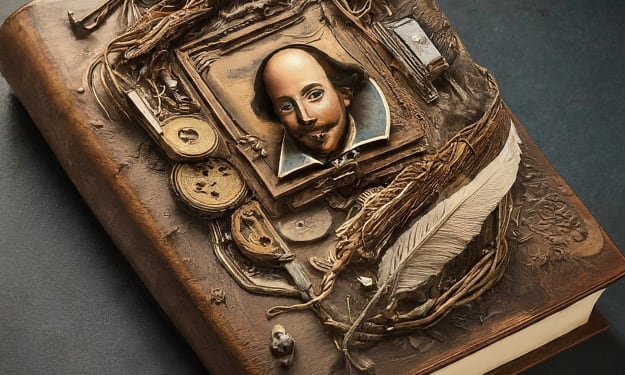
Shakespeare's Quantum Quill: AI Co-Writes a Play with a Twist of Reality. AI-Generated.
In the echoing halls of academia, where whispers of the past brush against the cutting edge of the present, a remarkable experiment unfolded. Researchers at a prestigious university unveiled a revolutionary AI program, not just capable of analysis, but of creation. This program, a marvel of machine learning, could weave narratives in the very style of specific authors. The chosen muse for this inaugural venture? The immortal Bard himself, William Shakespeare.
By Asanga Coorey2 years ago in Futurism
Shakespeare's Quantum Quill: When AI Meets the Bard in a Multiverse of Words. AI-Generated.
In the echoing halls of academia, where whispers of the past brush against the cutting edge of the present, a remarkable experiment unfolded. Researchers at a prestigious university unveiled a revolutionary AI program, not just capable of analysis, but of creation. This program, a marvel of machine learning, could weave narratives in the very style of specific authors. The chosen muse for this inaugural venture? The immortal Bard himself, William Shakespeare.
By Asanga Coorey2 years ago in Futurism
The Great Uncoupling of 2229. Top Story - July 2024.
“I realize there are still aspects of humanity that my kind cannot understand or appreciate….” The soft, airy voice resonating from the orb that trailed Teyhx through the hallway of her dorm pleaded with her to see reason. Though, ultimately, the decision was not hers anyways.
By Adam Clost2 years ago in Futurism
is Time Travel scientifically possible ?. AI-Generated.
Time travel has captivated human imagination for centuries, appearing in countless works of fiction, from H.G. Wells' "The Time Machine" to modern movies like "Interstellar" and "Avengers: Endgame." The concept of moving through time, whether to the past or the future, challenges our understanding of reality and raises profound questions about the nature of the universe. This article explores the scientific basis for time travel, examining theories from physics, technological possibilities, paradoxes, experimental evidence, and the philosophical and ethical implications of such a profound capability.
By Salif Sagna2 years ago in Futurism