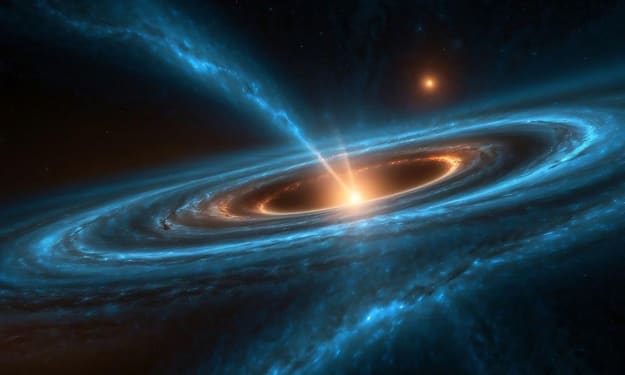
science fiction
The bridge between imagination and technological advancement, where the dreamer’s vision predicts change, and foreshadows a futuristic reality. Science fiction has the ability to become “science reality”.
The Ultimate Guide to SEO: How to Rank Higher on google
### The Ultimate Guide to SEO: How to Rank Higher on Google Search Engine Optimization (SEO) is a critical component of digital marketing that can significantly impact your website's visibility and traffic. Ranking higher on Google is the ultimate goal for many businesses, as it leads to increased organic traffic and potential customers. This guide will walk you through essential SEO strategies to help you achieve better rankings on Google.
By About Tech2 years ago in Futurism
10 Proven Digital Marketing Strategies to Boost Your Business
Digital marketing is ever-evolving, and staying ahead of the curve is crucial for any business looking to grow. As we step into 2024, leveraging the latest trends and technologies can significantly impact your online presence and revenue. Here are 10 proven digital marketing strategies to boost your business this year:
By About Tech2 years ago in Futurism
How to find the best keywords
Finding the best keywords is a crucial component of search engine optimization (SEO) and content marketing strategies. Keywords are the terms and phrases that users type into search engines when looking for information, products, or services. Identifying the right keywords can significantly enhance your website’s visibility, attract more organic traffic, and ultimately drive conversions. Here’s a comprehensive guide on how to find the best keywords.
By About Tech2 years ago in Futurism
Importance of Software Maintenance
Story 1: Raina was very intent on having a laptop from his father after getting admission to the college. As her attainment in the first term examination was good, her father bought her a branded laptop with a Core i5 processor. Raina was impressed with the quality and speed of the laptop. She installed many pieces of software within a few days. However, she noticed a gradual decline in its performance. After one year, she observed that the laptop was running too slow and it was irksome working on the computer. After some days, she made a capricious demand to her father for purchasing another one for her.
By About Tech2 years ago in Futurism
The Future Unveiled: How Artificial Intelligence and Automation Will Transform Humanity
Artificial Intelligence (AI) and automation are among the most transformative technological advancements of our era. Their potential to revolutionize industries, enhance productivity, and reshape daily life is profound. However, these technologies also present significant challenges that need to be addressed to ensure their benefits are maximized and their risks mitigated. This article explores the impact of AI and automation, delving into industry transformations, job dynamics, decision-making enhancements, and the ethical considerations that accompany these advances.
By bachir boukhalfa 2 years ago in Futurism
Beyond Earth: The Rise of Space Tourism and Its Transformative Impact on Exploration
The vast expanse of space, once the exclusive domain of astronauts and scientists, is now opening its doors to a new breed of explorers—space tourists. In recent years, advances in aerospace technology and the advent of private space companies have transformed the dream of commercial space travel into a tangible reality. This article delves into the burgeoning industry of space tourism, its technological underpinnings, economic implications, cultural impacts, and the ethical considerations that accompany humanity's expansion beyond Earth.
By bachir boukhalfa 2 years ago in Futurism
Title: Unveiling the Cosmic Enigma: Exploring the Great Attractor and Our Galactic Journey. AI-Generated.
**Title: Unraveling the Mystery of the Great Attractor: What Lies Beyond Our Galactic Neighborhood** In the 1970s, astronomers studying the Cosmic Microwave Background, the residual light from the universe's birth, made a startling discovery: our Milky Way galaxy and its vast cosmic entourage are hurtling through space at an astounding 390 kilometers per second. This revelation not only set a milestone in our understanding of galactic dynamics but also sparked a perplexing mystery about why our galaxy moves with such incredible speed. A significant portion of our galaxy's velocity can be attributed to the expansive force of the universe itself, known as the Hubble flow. This phenomenon causes all cosmic objects to drift apart due to the universe's ongoing expansion. Additional gravitational interactions with neighboring galaxies like Andromeda also contribute to our galactic motion. However, even after accounting for these factors, there remained an unexplained deviation in our trajectory, suggesting an external force was at play. Enter the Great Attractor—a mysterious gravitational anomaly pulling not just our Milky Way, but a staggering assemblage of around 100,000 galaxies spanning over 500 million light-years. Initially dubbed the "Great Attractor," this enigma posed a fundamental question: what could exert such a profound influence over such vast cosmic distances? The only force capable of orchestrating the movement of entire galaxies across hundreds of millions of light-years is gravity, governed by mass. To nudge 100,000 galaxies, the Great Attractor must possess a mass so immense that it defies conventional comprehension—a gravitational behemoth unlike anything else known in the universe. Early attempts to directly observe the Great Attractor faced immediate challenges. Situated within the "zone of avoidance," a swath of sky obscured by dense clouds of interstellar dust within our own Milky Way, traditional telescopes proved ineffective. For decades, astronomers were left to infer its presence indirectly, primarily through the gravitational effects it exerted on surrounding galaxies. Approximately located between 150 and 250 million light-years away in the direction of the Norma constellation, the Great Attractor's sheer scale began to emerge. Estimates suggested it harbors mass equivalent to 10 quadrillion Suns, far surpassing any known celestial object in size and gravitational influence. However, recent advancements in radio and infrared astronomy have offered fleeting glimpses into the obscured region, enabling scientists to peer deeper into this cosmic puzzle. These technological strides have illuminated the heart of the Laniakea Supercluster—a colossal structure encompassing not only the Great Attractor but also revealing the intricate web of galaxies in our cosmic neighborhood. The Laniakea Supercluster spans a mind-boggling 520 million light-years and houses approximately 100,000 galaxies, positioning the Great Attractor at its gravitational center. Rather than a discrete entity, it emerges as the gravitational focal point within this vast superstructure—an anchor around which galaxies, including our own, are inexorably drawn. The concept of the Great Attractor challenges our perception of cosmic order, illustrating the universe's intricate large-scale structure known as the cosmic web. This web isn't random but shaped by the gravitational tug-of-war between denser regions and cosmic voids since the universe's infancy. These gravitational dynamics have coalesced galaxies into clusters, superclusters, and beyond, weaving an elaborate tapestry across the cosmos. Despite these insights, the ultimate fate of our journey towards the Great Attractor remains shrouded in cosmic uncertainty. While hurtling towards it at breakneck speeds—approximately 390 kilometers per second—we face an inevitable cosmic irony. The universe's accelerating expansion ensures that despite our trajectory, the distance to the Great Attractor will continue to grow over time. This phenomenon mirrors two ants crawling towards each other on an inflating balloon: no matter their speed, the expanding space between them ensures they will never meet. Similarly, while the Milky Way advances towards the Great Attractor, the universe's expansion ensures we will perpetually fall short of reaching it, forever destined to recede from its gravitational grasp. As we ponder the implications of this celestial ballet, a chilling realization emerges. The accelerating expansion of the universe will not only separate us from the Great Attractor but will eventually sever our view of distant galaxies beyond those gravitationally bound to us. In time, the grand cosmic web we observe today will fade into obscurity, leaving only our local group of galaxies visible in the vast, expanding darkness. In conclusion, the Great Attractor stands as a testament to the universe's grandeur and mysteries, challenging our understanding of gravity, mass, and cosmic structure. While we may never physically reach its epicenter, the journey towards understanding it has illuminated the complex interplay of forces shaping our cosmic neighborhood and beyond. As we continue to probe the depths of space, the enigma of the Great Attractor serves as a reminder of the boundless wonders awaiting discovery in the universe—wonders that defy our imagination and inspire us to unravel the secrets of our cosmic existence.
By Mbeha maliwa 2 years ago in Futurism