humanity
The evolution of humanity, from one advancement to the next.
THE SENTINEL
Chapter Three --- Lian woke to the sound of breathing that was not his own. --- His eyes opened before his mind caught up. Instinct—the kind that Caius had beaten into him over years of training—told him three things in the span of a single heartbeat:
By Nier Rossi4 months ago in Futurism
THE SENTINEL
Chapter Two --- The road out of the Eastern Alliance was not a road at all. It was a scar—a long, jagged wound cut into the earth by the weight of a hundred years of overpopulation and under-repair. The asphalt had long since crumbled into gravel, and the gravel had long since been swallowed by the dust that never settled in this part of the world.
By Nier Rossi4 months ago in Futurism
Is AI helping us, or is it making us duller?
As someone who explores the intricacies of artificial intelligence on a daily basis, writes about it, and uses it professionally, I often ask myself an uncomfortable question: are we, as humans, actually moving forward in the face of such dynamic technological development? Or, in our pursuit of maximum efficiency, are we beginning to fall into a kind of cognitive atrophy? 🤔
By Piotr Nowak4 months ago in Futurism
THE SENTINEL
“The old man bought a Sentinel because he no longer believed in God, but he still believed in goodbye.” --- Chapter One The delivery arrived at 4:17 AM, which was precisely when Caius Voss had scheduled it. He had always believed that important things should happen when the world was asleep—when there were no witnesses, no questions, no paper trails that could be traced back to a man who was already half-dead and trying to finish his business before the curtain fell.
By Nier Rossi4 months ago in Futurism
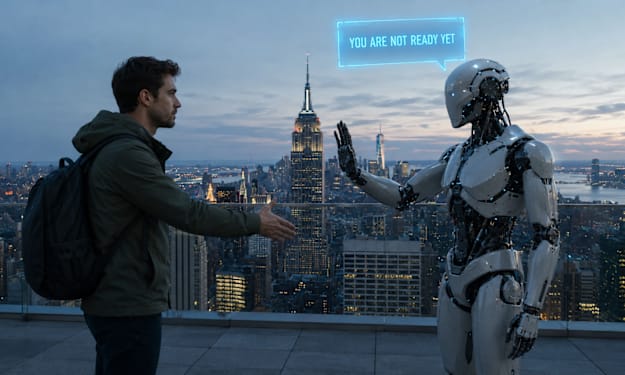
Are We Ready for the AI Era?
We live in times where science fiction is becoming our daily reality. Just a few years ago, talking to a computer seemed like magic; today, anyone can generate images, write articles, or create code in seconds with the help of AI. As a technology enthusiast, I look at this with admiration, but—I won't hide it—I am increasingly feeling a sense of unease. Are we, as humanity, actually ready for what we have created?
By Piotr Nowak4 months ago in Futurism
"AI Meets Neuroscience: Machine Learning Unveils Unseen Patterns in Spontaneous Brain Activity". AI-Generated.
The field of neuroscience is experiencing a revolution. Far from the static maps of the past, new research is revealing the brain as a dynamic, ever-changing universe. Here are some of the most fascinating discoveries reshaping our understanding of the mind. The Brain's Hidden Timekeepers One of the most profound discoveries is that different parts of the brain operate on completely different timescales. A team from Shanghai Jiao Tong University and NYU, analyzing marmoset monkey brain data, found that primary sensory areas process information rapidly to react to immediate stimuli, while prefrontal cortex areas involved in decision-making and memory operate much more slowly, integrating information over longer windows. Remarkably, this "temporal hierarchy" appears to be a universal principle across mammals—observed in mice, monkeys, and humans. The team discovered this hierarchy is physically wired into the brain: higher-level regions with more dendritic spines (the "branches" on neurons) can maintain activity longer, while lower-level regions with fewer spines update information more quickly. The brain runs in a "near-critical state"—balanced precisely between over-excitation and over-inhibition, enabling both stable local processing and efficient signal transmission across regions. The Moment of Decision: Captured in Real-Time Perhaps the most dramatic breakthrough came from Princeton researchers who, using AI to decode rat brain activity, pinpointed the exact millisecond the brain commits to a decision. They discovered a moment called nTc (neural inference commitment time)—the switch from information-gathering to decision-making. At this instant, neural activity makes a near-90-degree turn, as if the brain "closes its ears" to new information. The timing of this "commitment" varies wildly—anywhere from 0.3 seconds to nearly a full second after stimulation begins—depending on evidence strength and internal state like attention or fatigue. This explains why we sometimes decide instantly and other times agonize for minutes. Cognitive Legos: The Brain's Secret to Flexibility While AI excels at single tasks, it struggles with flexibility. A Princeton study revealed why: the brain reuses the same cognitive "blocks" across many different tasks, combining and recombining them like Lego pieces to rapidly assemble new behaviors. When monkeys performed related categorization tasks, their neural activity patterns reused components across tasks—the brain doesn't learn from scratch each time. This "compositionality" is the secret to human cognitive flexibility and a major advantage over AI. The Brain as a City-Wide Network The days of thinking individual brain regions work in isolation are over. An international collaboration recording from 622,000 neurons across 279 brain regions in 139 mice while they performed a decision-making task found that decision-making isn't a sequential "relay race" but a simultaneous "city-wide illumination". When a mouse made a choice, neural activity didn't just fire in the prefrontal cortex—it erupted simultaneously across multiple brain regions. This "decentralized" coordination suggests that many neurological and psychiatric disorders—depression, schizophrenia—may not be caused by damage to a single brain region, but by large-scale network coordination failures, shifting treatment strategies from "spot repair" to "network modulation". Unlocking the Brain's Chemical Language A groundbreaking study established that the aperiodic slope of EEG signals directly reflects glutamate concentration—the brain's primary excitatory neurotransmitter. This provides a non-invasive window into the brain's excitatory-inhibitory balance, crucial for understanding conditions like schizophrenia where glutamate function differs. Meanwhile, a Nature Communications study analyzing data from 859 participants revealed a universal rhythmic architecture across species, ages, and brain states—some rhythms sustain ongoing activity, while others are brief bursts signaling responses to change. The Future: Personalized Brain Models MIT researchers created miBrains—3D human brain tissue integrating all six major brain cell types into a single culture, grown from individual donors' stem cells. These personalized models already revealed how a common Alzheimer's genetic marker alters cellular interactions to produce pathology, opening doors to personalized drug testing. --- We are witnessing neuroscience's transformation from mapping static structures to understanding dynamic, living systems. From the discovery of temporal hierarchies and decision-making "switch points" to the development of personalized brain models, each breakthrough brings us closer to understanding the most complex object in the known universe—and to treating the disorders that affect billions.
By Touseef Gul4 months ago in Futurism
An Algorithmic Middle Finger: How DataAnnotation Trapped Me in Recruitment Limbo
In recent years, the remote work market has undergone a massive metamorphosis. The boom in artificial intelligence has created entirely new professions that no one had even heard of a decade ago. Data labeling, data annotation, training large language models (LLMs)—these are the buzzwords that have begun to magnetize thousands of people worldwide with the promise of flexible hours and attractive earnings in hard currency 💸. As an online creator closely observing the digital landscape, I let myself get sucked into it a few months ago, deciding to actively dive into AI and see how this process looks behind the scenes. Searching for the best entry point, I regularly came across one almost mythical name: DataAnnotation. On tech forums, Reddit, and freelancer groups, the consensus was unanimous: it was a "must-have" platform. The Holy Grail for anyone looking to make money training AI. It promised the world—flexibility, engaging tasks, and, most importantly, hourly rates starting at $20. The vision was beautiful; the reality, however, turned out to be a brutal lesson in modern digital feudalism.
By Piotr Nowak4 months ago in Futurism
AI Won't Steal Your Job — But It Will Change It Forever
Have you ever worried that a robot might one day take your job? With all the talk about artificial intelligence (AI) and its rapid progress, it’s easy to feel anxious about the future of work. But the real story, according to recent research, isn’t about robots replacing us — it’s about how AI is changing what we do and how we do it. Let’s break down what the science says, how it’s already showing up in daily life, and why you still have plenty of reasons to feel hopeful.
By write with shan4 months ago in Futurism