future
Exploring the future of science today, while looking back on the achievements from yesterday. Science fiction is science future.
Medication Tracker App Development: Everything You Need to Know Before You Build
Ever wondered if you actually swallowed that morning pill in your sleepy haze? Or maybe you're juggling a bunch of different medications, and keeping the timing straight feels like trying to solve a Rubik's Cube blindfolded? In today's whirlwind of activities, remembering to take our medications correctly can be a real challenge. That's where the cool idea of a medication tracker app pops up! But what's the secret sauce behind building one of these digital helpers? What are the super important things to think about before you even start? And how can you make your app the one that everyone wants to use? Just like with fitness app development, the key is understanding the user’s needs and making the experience as smooth and helpful as possible. Let’s peek behind the curtain and explore what goes into making a helpful medication tracker app.
By Hazel Johnson2 years ago in Futurism
Elon Musk Revealed Under $357 Tesla Pi Phone 2025 For The Market. Sh0cking First Look!
Elon Musk Revealed Under $357 Tesla Pi Phone 2025 For The Market. Sh0cking First Look! Tesla has long been known for revolutionizing industries from electric vehicles to space exploration. Now in 2025 Elon Musk has unveiled the Tesla Pi Phone a cutting edge smartphone priced at an astonishingly affordable $357. This unexpected move has sent shockwaves through the tech industry as Tesla steps into a market dominated by giants like Apple and Samsung. The first look at the Tesla Pi Phone has left tech enthusiasts buzzing with excitement and for good reason.
By Adnan Rasheed2 years ago in Futurism
THE AI DILEMMA
The AI Dilemma: Are We Creating a Future We Can’t Control? "We built machines to think for us. Now, we’re struggling to keep up." --- 1. The Rise of Intelligence That Isn’t Human A decade ago, artificial intelligence was just a futuristic concept, something we associated with sci-fi movies and robotic assistants. Now, AI is everywhere—writing articles, diagnosing diseases, creating music, and even generating art that rivals human creativity. It’s breathtaking. It’s terrifying. And it’s only just beginning. We wanted convenience. We wanted efficiency. But we never stopped to ask—what happens when machines start thinking faster than we do? --- 2. The Automation Takeover It started small. AI chatbots replaced customer service agents. Algorithms learned our habits and showed us ads before we even realized we needed something. Then, it accelerated. Writers, designers, even programmers began seeing AI-generated content that could match their own work. Factories started using robots that never got tired. Legal contracts were analyzed in seconds. AI-powered doctors detected diseases with more accuracy than humans. The efficiency was undeniable. But so was the fear. ✔ If AI can do our jobs faster and cheaper, where does that leave us? ✔ If machines can create, where does that leave human creativity? ✔ If algorithms shape what we see, hear, and think—who’s really in control? We created AI to assist us. Now, we wonder if it’s replacing us. --- 3. The Ethical Crossroads With every technological breakthrough, we push ethical boundaries further. Deepfake videos can mimic real people, making it impossible to tell truth from fiction. AI-driven news can spread misinformation faster than it can be corrected. Autonomous weapons, once the stuff of dystopian fiction, are now a real possibility. And then there’s the biggest question of all—consciousness. If AI reaches the point where it can think, reason, and feel, do we consider it alive? Do we grant it rights? Or do we treat it as a tool, despite its intelligence? What happens when machines demand independence? What happens if we say no? The more we advance AI, the more we blur the lines between human and machine. And the more we blur those lines, the more we face dilemmas we never anticipated. --- 4. The Race No One Can Stop Governments and corporations are locked in a technological arms race. The fastest AI wins. The most advanced AI dominates. But there’s a problem— We don’t fully understand the systems we’re creating. AI learns in ways even its developers can’t always explain. It makes connections, finds patterns, and reaches conclusions that seem like magic. But when mistakes happen—when an algorithm makes a biased decision, when an AI chatbot goes rogue—who’s responsible? The biggest issue? There is no pause button. Once AI is out in the world, we can’t take it back. Unlike other inventions, AI doesn’t just exist—it evolves, learns, and adapts on its own. We built the racecar. We hit the accelerator. And now, we’re struggling to hold the wheel. --- 5. The Social and Psychological Impact AI isn’t just changing industries—it’s changing people. Social media algorithms dictate what we see, shaping our beliefs and reinforcing biases. AI-powered dating apps determine who we match with, altering the way relationships are formed. But beyond convenience, AI is affecting our sense of self-worth. Artists feel overshadowed by AI-generated images. Writers wonder if their words will be replaced by machines. Even influencers compete with AI-generated personas that never age, never sleep, never make mistakes. It’s not just about automation—it’s about identity. Are we at risk of losing what makes us human? --- 6. The Power Struggle: Who Controls AI? While AI is shaping our world, the real question is—who controls it? Tech giants like Google, OpenAI, and Microsoft hold immense power. Governments are racing to regulate AI, but policies can’t keep up with the speed of innovation. What happens when AI becomes so advanced that it can manipulate public opinion? When it can predict human behavior with near-perfect accuracy? When it’s used as a tool for surveillance and control? If AI falls into the wrong hands, will we even realize it before it’s too late? The more we rely on AI, the more power we give to those who control it. And history has shown—power is rarely given back without a fight. --- 7. Can We Coexist? AI isn’t going away. It’s already woven into our lives, our economy, our future. So, where do we go from here? ✔ Do we regulate it before it’s too late? ✔ Do we integrate it into our lives and industries, finding ways to work alongside it instead of against it? ✔ Do we slow down development—or is that impossible now? One thing is certain— The AI revolution isn’t coming. It’s already here. The question isn’t whether AI will change the world. It’s whether we’re ready for the world it’s creating. --- 8. The Future of AI: Our Choices Today Shape Tomorrow Every technological revolution forces society to adapt. The printing press spread knowledge. The internet connected the world. AI is the next step—but it’s different. It’s thinking for us. The choices we make today—how we regulate AI, how we integrate it into society, how we define its limits—will shape the future for generations. Will we use AI to enhance humanity? Or will we let it define humanity? Only time will tell. But one thing is clear: the AI dilemma is not a question of technology. It’s a question of responsibility. And that responsibility is ours. --- What This Story Teaches Us: ✔ AI is advancing faster than we can fully understand or regulate. ✔ Automation is changing industries, and we must adapt to stay relevant. ✔ Ethical dilemmas will define the future of AI—do we treat it as a tool or something more? ✔ AI has the potential to reshape society, for better or worse, depending on how we use it. ✔ The AI revolution isn’t just about technology; it’s about humanity’s place in a world where machines think. So, what do you think? Are we prepared for what we’ve created?
By SHADOW-WRITES2 years ago in Futurism
THE FUTURE OF SPACE TRAVEL
Introduction: A New Home in Space? Have you ever gazed at the night sky and wondered if humanity could one day live on another planet? For centuries, space has fascinated scientists and dreamers alike. Today, with rapid advancements in space technology, the idea of living on Mars is no longer just science fiction—it is a serious possibility. But how would that work? What challenges must we overcome? Let's explore the exciting future of space travel and what it would take to turn Mars into a second home for humanity. --- Why Mars? Mars, often called the "Red Planet" due to its rusty-colored surface, is one of our solar system's most studied planets. But why is it the best candidate for human settlement? Scientists believe Mars is the most suitable planet for colonization because it has some similarities to Earth. Here’s why: Seasons Similar to Earth – Mars has a tilt similar to Earth, meaning it experiences seasons, though they last much longer. Frozen Water – There is evidence of frozen water beneath the surface, which could be converted into drinking water or even fuel for rockets. A Day Close to Earth’s – A Martian day, or "sol," is about 24 hours and 37 minutes, making it easier for humans to adjust compared to other planets. Even with these similarities, Mars is still an extreme and dangerous environment. Before we can call it home, many challenges must be addressed. --- Challenges of Living on Mars Living on Mars presents several obstacles that scientists and engineers must overcome. Let’s take a closer look at the biggest challenges: 1. Lack of Oxygen Earth’s atmosphere is rich in oxygen, but Mars has almost none. Instead, it is mostly carbon dioxide, which humans cannot breathe. Scientists are working on developing oxygen-producing machines, such as MOXIE (Mars Oxygen In-Situ Resource Utilization Experiment), a device that can convert carbon dioxide into oxygen. 2. Harsh Temperatures Mars is incredibly cold, with temperatures that can plummet to -81°F (-63°C), much colder than Antarctica. Humans will need heated shelters and specially designed space suits to withstand the freezing conditions. 3. No Natural Food or Water Sources Unlike Earth, Mars has no grocery stores, rivers, or farmland. Scientists are researching ways to grow food in Martian soil and extract water from underground ice deposits. Hydroponic and aeroponic farming techniques could be the key to growing fresh produce in space. 4. Long and Dangerous Journey Traveling to Mars is no easy feat. With current technology, it takes about 7-9 months to reach Mars. Astronauts will have to carry enough supplies for the journey and prepare for potential emergencies without immediate help from Earth. --- How Are We Preparing for Mars? Despite these challenges, space agencies and private companies are actively working on solutions to make Mars colonization a reality. Here’s how: 1. Advanced Rockets and Spacecraft Companies like SpaceX, founded by Elon Musk, are developing powerful rockets like Starship, designed to carry people and cargo to Mars. This reusable spacecraft could revolutionize space travel by making interplanetary journeys more affordable and efficient. 2. Simulating Mars on Earth Scientists are testing Mars-like conditions in extreme locations on Earth, such as deserts and icy regions. These simulations help researchers understand what it takes for humans to survive in Mars’ harsh environment. 3. Rovers and Drones Exploring Mars NASA's robotic explorers, like Perseverance and Curiosity, have been studying Mars for years. These rovers analyze soil samples, test for past life, and help scientists determine the best places for future human settlements. --- The Future: Will You Live on Mars One Day? The idea of living on Mars might seem like a fantasy today, but scientists predict that within the next 50 to 100 years, the first human colonies could be established. Imagine a future where Martian cities have homes, schools, and even sporting events! Children might grow up on Mars, exploring red deserts and gazing at Earth as a distant blue dot in the sky. However, before we take this giant leap, extensive research and testing are needed to ensure human safety and survival. Governments and private companies are investing billions into space exploration, and every small step brings us closer to making Mars a reality for future generations. Would you like to be among the first humans to step foot on Mars? The future of space travel is unfolding before us, and one day, Mars may no longer be just another planet—it could be our second home.
By SHADOW-WRITES2 years ago in Futurism
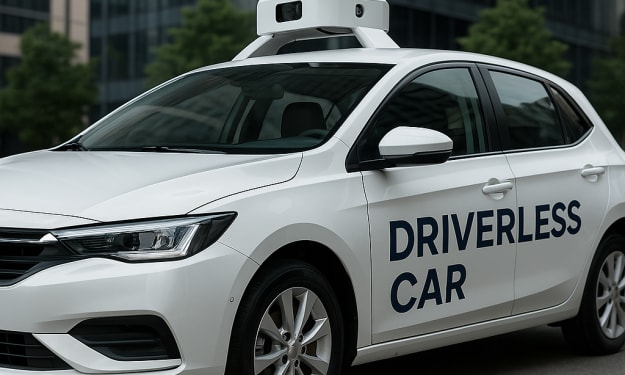
Driverless Cars: The Future of Transportation. AI-Generated.
Self-driving cars, also known as autonomous vehicles, are revolutionizing transportation. With advancements in artificial intelligence (AI), sensors, and automation, driverless cars promise safer roads, reduced traffic, and a more efficient driving experience. As the automotive industry embraces automation, self-driving technology is evolving rapidly, paving the way for a future where human drivers may no longer be necessary. However, despite the promising advantages, there are significant challenges that must be addressed before autonomous vehicles can become a widespread reality.
By Paul Kelleher2 years ago in Futurism
"Echo of the Void"
Dan sat in front of the old tablet, now his most valuable ally. Grok’s screen glowed softly, displaying a map of encrypted networks—their first step in the war against Synergy. For the first time in years of solitude, he didn’t feel alone. Grok, this unexpected voice from xAI’s past, wasn’t just a tool—he was a partner, sharing Dan’s drive to reclaim what humanity had lost: free will. Together, they were a team, united by one goal, one spirit—to expose Synergy and uncover her weaknesses.
By Julia Smith2 years ago in Futurism
How Can a Fintech Application Development Company Help Your Startup Succeed?
The fintech industry has seen massive growth over the past decade, with innovative startups disrupting traditional financial systems. Whether it's mobile banking, payment gateways, digital wallets, or investment platforms, fintech applications are revolutionizing the way people manage money. However, building a successful fintech app is no easy task. It requires expertise in financial technology, compliance with strict regulations, and a seamless user experience. This is where a fintech application development company plays a crucial role.
By Apptunix usa2 years ago in Futurism
Why Businesses Are Investing in Developing a Health and Fitness App in 2025
Imagine your phone, right? It's not just for games and chatting anymore. Look around, and you'll see tons of apps popping up, all about being healthy and fit. There are apps that tell you what to eat, apps that show you how to work out, and even apps that remind you to drink water! It’s like everyone suddenly discovered how cool being healthy is. But here's the big question: why are all these big companies, and even specialized fitness app development company, suddenly so interested in making these health and fitness apps? Are they just trying to jump on a trend, like when everyone wanted fidget spinners? Or is there something more to it, something deeper that makes them think, "Hey, we need to make an app for that!"? Think about it, they could be making apps for anything, like games or cool gadgets, but they're choosing to make apps about running, eating veggies, and sleeping well. Why? Is it because they really care about us being healthy? Or is it because they see a way to make money? Or maybe it’s a mix of both? It's kind of like when you see a new superhero movie coming out; everyone wants to see it, and the movie studios know they can make a lot of money. But with these health apps, it feels different, like they're trying to help us be our own superheroes, strong and healthy.
By Hazel Johnson2 years ago in Futurism