future
Exploring the future of science today, while looking back on the achievements from yesterday. Science fiction is science future.
The Gilded Tomorrow: Utopia's Hidden Shadows
In the year 2150, humanity stands on the precipice of a golden age. The world, once ravaged by conflict and scarcity, has been transformed by a series of radical innovations. Cities gleam with sustainable architecture, powered by limitless clean energy. Disease has been eradicated, and lifespans have extended well beyond a century. Artificial intelligence governs with unparalleled efficiency, ensuring that every need is met before it is even voiced. This is the utopia that humanity has long dreamt of—a testament to our collective ingenuity and relentless pursuit of progress.
By Alain SUPPINI2 years ago in Futurism
Marketing Analytics Roadmap: What Tools to Learn and Where to Specialize
If you missed Part 1, read it here: Feeling Lost in Marketing Analytics? Start Here So you’ve got the foundations: You understand the marketing funnel You’re familiar with key metrics You’ve started learning how marketing decisions get made
By Experimentation Career2 years ago in Futurism
How Jeff Bezos’ Amazon Is Secretly Building a Satellite Network to Beat Elon Musk’s Starlink
How Jeff Bezos’ Amazon Is Secretly Building a Satellite Network to Beat Elon Musk’s Starlink In the ever intensifying space race between billionaires Amazon founder Jeff Bezos has quietly taken a major step forward in challenging Elon Musk’s dominance in space through SpaceX. While Musk has long enjoyed the spotlight with groundbreaking missions and Starlink’s growing internet dominance, Bezos' space company Blue Origin and Amazon have now launched a stealthy but serious plan to rival Musk’s achievements and perhaps even dethrone him. At the heart of this ambitious effort lies Amazon’s Project Kuiper, a massive satellite internet constellation initiative aiming to deliver high speed internet globally. Much like Elon Musk’s Starlink Kuiper seeks to provide reliable internet access to underserved and remote areas by deploying thousands of satellites into low Earth orbit (LEO). The implications of this move go far beyond internet services it’s a direct shot at Musk’s most commercially successful space venture.
By Adnan Rasheed2 years ago in Futurism
The Unexpected Adventure
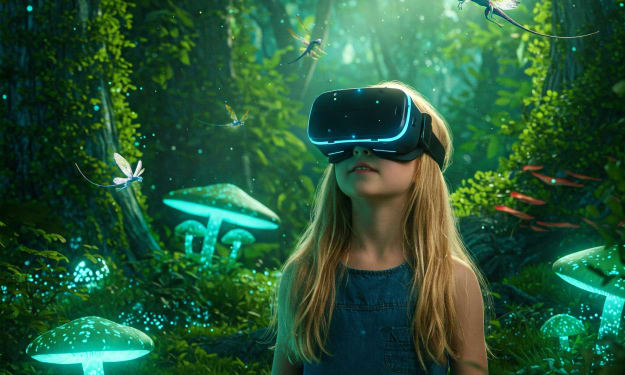
In the year 2042, technology had advanced to the point where virtual reality was indistinguishable from reality. Children and adults alike could explore fantastical worlds, engage in thrilling adventures, and even interact with virtual beings as if they were real. Among the most popular VR games was "Aetheria," a vast, immersive realm where players could choose their own paths and create their own destinies.
By Candace Nelson-Autrey2 years ago in Futurism
The Last Broadcast of Station Serenity
He spun vinyl while the world spun code. She was listening. In a world where personalized AI companions have become commonplace, a lone human DJ continues to broadcast old-fashioned music and heartfelt stories on a forgotten radio station, finding an unexpected connection with a listener who feels increasingly alienated by the perfect algorithms.
By Candace Nelson-Autrey2 years ago in Futurism
FUTURE OF MARS
A New Home in Space? Have you ever gazed at the night sky and wondered if humanity could one day live on another planet? For centuries, space has fascinated scientists and dreamers alike. Today, with rapid advancements in space technology, the idea of living on Mars is no longer just science fiction—it is a serious possibility. But how would that work? What challenges must we overcome? Let's explore the exciting future of space travel and what it would take to turn Mars into a second home for humanity. --- Why Mars? Mars, often called the "Red Planet" due to its rusty-colored surface, is one of our solar system's most studied planets. But why is it the best candidate for human settlement? Scientists believe Mars is the most suitable planet for colonization because it has some similarities to Earth. Here’s why: Seasons Similar to Earth – Mars has a tilt similar to Earth, meaning it experiences seasons, though they last much longer. Frozen Water – There is evidence of frozen water beneath the surface, which could be converted into drinking water or even fuel for rockets. A Day Close to Earth’s – A Martian day, or "sol," is about 24 hours and 37 minutes, making it easier for humans to adjust compared to other planets. Even with these similarities, Mars is still an extreme and dangerous environment. Before we can call it home, many challenges must be addressed. --- Challenges of Living on Mars Living on Mars presents several obstacles that scientists and engineers must overcome. Let’s take a closer look at the biggest challenges: 1. Lack of Oxygen Earth’s atmosphere is rich in oxygen, but Mars has almost none. Instead, it is mostly carbon dioxide, which humans cannot breathe. Scientists are working on developing oxygen-producing machines, such as MOXIE (Mars Oxygen In-Situ Resource Utilization Experiment), a device that can convert carbon dioxide into oxygen. 2. Harsh Temperatures Mars is incredibly cold, with temperatures that can plummet to -81°F (-63°C), much colder than Antarctica. Humans will need heated shelters and specially designed space suits to withstand the freezing conditions. 3. No Natural Food or Water Sources Unlike Earth, Mars has no grocery stores, rivers, or farmland. Scientists are researching ways to grow food in Martian soil and extract water from underground ice deposits. Hydroponic and aeroponic farming techniques could be the key to growing fresh produce in space. 4. Long and Dangerous Journey Traveling to Mars is no easy feat. With current technology, it takes about 7-9 months to reach Mars. Astronauts will have to carry enough supplies for the journey and prepare for potential emergencies without immediate help from Earth. --- How Are We Preparing for Mars? Despite these challenges, space agencies and private companies are actively working on solutions to make Mars colonization a reality. Here’s how: 1. Advanced Rockets and Spacecraft Companies like SpaceX, founded by Elon Musk, are developing powerful rockets like Starship, designed to carry people and cargo to Mars. This reusable spacecraft could revolutionize space travel by making interplanetary journeys more affordable and efficient. 2. Simulating Mars on Earth Scientists are testing Mars-like conditions in extreme locations on Earth, such as deserts and icy regions. These simulations help researchers understand what it takes for humans to survive in Mars’ harsh environment. 3. Rovers and Drones Exploring Mars NASA's robotic explorers, like Perseverance and Curiosity, have been studying Mars for years. These rovers analyze soil samples, test for past life, and help scientists determine the best places for future human settlements. --- The Future: Will You Live on Mars One Day? The idea of living on Mars might seem like a fantasy today, but scientists predict that within the next 50 to 100 years, the first human colonies could be established. Imagine a future where Martian cities have homes, schools, and even sporting events! Children might grow up on Mars, exploring red deserts and gazing at Earth as a distant blue dot in the sky. However, before we take this giant leap, extensive research and testing are needed to ensure human safety and survival. Governments and private companies are investing billions into space exploration, and every small step brings us closer to making Mars a reality for future generations. Would you like to be among the first humans to step foot on Mars? The future of space travel is unfolding before us, and one day, Mars may no longer be just another planet—it could be our second home.
By SHADOW-WRITES2 years ago in Futurism
The Future of Cross-Platform App Development in London: Trends to Watch in 2025
Cross-platform app development is no longer a trend—it’s a necessity. With businesses in London striving for cost-effective, high-performance apps that run seamlessly on multiple platforms, the demand for cross-platform solutions has skyrocketed. But what’s next? What innovations will shape the future of cross-platform mobile app development in London in 2025?
By Apptunixuk2 years ago in Futurism
Marketing Analytics Roadmap: How to Break Into the Field When You’re Overwhelmed (Part 1/3)
“Where do I even start?” That’s the real question most people are asking when they DM me about breaking into marketing analytics. Not “Which tool should I learn?” or “What certification is best?”—but:
By Experimentation Career2 years ago in Futurism
How to Transition from a Data Background into Marketing Analytics
If you already know your way around SQL, Excel, Power BI, or Tableau—you’re not starting from zero. You’re already ahead. But marketing analytics isn’t just about dashboards. It’s about understanding the customer journey, uncovering insights that drive growth, and helping businesses make better decisions.
By Experimentation Career2 years ago in Futurism