future
Exploring the future of science today, while looking back on the achievements from yesterday. Science fiction is science future.
City of Echoes
I. The Weight of Silence Silence wasn’t peace in Veritas. It was law. In a city where sound was outlawed, silence echoed louder than screams. Every building, every street, every breath was soaked in stillness—enforced by fear, monitored by the ever-present eyes of the Voice, a faceless regime that had surgically removed speech from humanity’s throat. The punishment for sound was simple: disappearance. First, your voice. Then, your name. Finally, your face from every record, as if you’d never existed at all. Seventeen-year-old Liora had never heard a lullaby. Her parents vanished when she was six—arrested for vocal misconduct, a crime as vague as it was fatal. She remembered only fragments: her father’s lips moving in a silent plea as enforcers dragged him away, her mother’s fingers signing I love you in outlawed hand-speak before the door slammed shut. Since then, she’d lived under the rule of soundless obedience, communicating through approved gestures and sterile digital screens called ComSlates. But one month ago, everything changed. ---------------------------------------------------------------------------------------------------------- II. The Book of Forbidden Sound It started with a crack in the wall of a crumbling library—one of the last standing after the Literacy Purge, when the Voice burned every book to ensure words couldn’t ignite rebellion. Liora had crawled through the dust and mold like a ghost haunting the past and found it: a forgotten, mold-flecked book of poetry. Real paper. Real ink. Words no longer sanctioned. The first line she read sparked something electric and painful: > Even silence remembers The scream it swallowed— And waits for it to rise. It wasn’t just beautiful. It was treason. And she was hooked. Now, each night, she slipped from her dormitory at the orphan block with stolen chalk and a smuggled pen, leaving handwritten notes around the city—poems, questions, truths. Park benches. Elevator panels. The underside of café tables. Each signed simply: —TheSilentPen ---------------------------------------------------------------------------------------------------------- III. A Spark in the Stillness Then, one day, she found something that stopped her breath. A reply. Folded under one of her original notes was a scrap of brown paper: > “I remember my brother’s voice. Thank you.” No name. No signature. Just proof—someone else remembered the world before the silence. The replies grew: > “My mother used to hum when she baked bread.” “Words taste better than silence.” “We are still alive.” Liora’s hands shook as she collected them, pressing each scrap into a hidden compartment beneath her floorboard. They were evidence of a crime punishable by erasure—and the only thing that made her feel human. The city was still silent. But not asleep. ---------------------------------------------------------------------------------------------------------- IV. The Boy Who Remembered One night, crouched beneath a stairwell taping a new message, she was caught. “Citizen. Stand still.” A patrol drone hovered, red lens gleaming. “Suspected alias: TheSilentPen. You will be detained.” Liora’s blood turned to ice. Detainment meant the Sound Rooms—where they’d carve the voice from her throat like her parents, like all the others. Before the drone could strike, a shadow leapt from the dark— CRACK. A metal pipe shattered the drone’s core, spraying sparks like dying stars. A boy—maybe nineteen, with scars raked across his neck—grabbed her wrist. “Run!” ----------------------------------------------------------------------------------------------------------
By TheSilentPenabout a year ago in Futurism
Declassified FBI Document Hints at Visitors from Other Dimensions, What It Could Mean for Humanity
A Glimpse Behind the Curtain In a world filled with secrecy, surveillance, and speculation, it’s not every day that a government agency like the FBI releases a document that raises more questions than it answers. Yet, buried within the thousands of pages made public through the Freedom of Information Act, one peculiar memo stands out, one that hints at the presence of “beings from other dimensions” visiting Earth.
By The Secret History Of The Worldabout a year ago in Futurism
The Quarero Security Robot and the Great Thunderstorm. AI-Generated.
In a cozy village tucked deep between the thick fir trees of the Black Forest, where the moss grows soft as pillows and every house has a chimney that puffs like a teapot, something curious rolled into town one Tuesday morning.
By Marcus Köhnleinabout a year ago in Futurism
Trump's Controversial Push to Mine the Ocean Floor: A Resource War to Challenge China’s 80% Control
In a bold and contentious move, former U.S. President Donald Trump has declared a “resource war” aimed at tapping into the vast and largely unexploited resources of the ocean floor. The controversial move, outlined in an executive order, is set to expedite the process of deep-sea mining within U.S. and international waters. The primary goal behind this initiative is to break China’s stranglehold on the global supply chains of critical minerals, which are vital for numerous industries, including electronics, defense, and renewable energy technologies. This article delves deep into the implications of this move, exploring the rationale behind Trump's decision, the potential risks involved, the ongoing debates around it, and the broader geopolitical and environmental ramifications. The Geopolitical Landscape and the Resource War For years, China has held a dominant position in global supply chains for essential minerals, commanding control over nearly 80% of the global supply of critical materials such as lithium, cobalt, and rare earth elements. These minerals are integral to the production of technologies ranging from smartphones to electric vehicles (EVs) and renewable energy solutions like wind turbines and solar panels. However, this overwhelming control has raised concerns, especially in Western nations, where dependency on China for such critical resources is seen as a strategic vulnerability. The Trump administration’s push to exploit ocean floor mining is fundamentally aimed at reducing the United States' reliance on Chinese resources. By tapping into deep-sea mineral deposits, particularly those found in international waters, Trump aims to build a more self-sufficient supply chain for the U.S. and reduce China's grip on the market. The United States, along with its allies, has been increasingly concerned about the security risks posed by this dependency. As global tensions rise, especially concerning trade and technology, Trump’s executive order seeks to safeguard the U.S. economy and national security by diversifying its resource base. The shift toward ocean floor mining also serves as a response to the geopolitical competition between the U.S. and China, particularly in the field of renewable energy and technology. While China has been making significant strides in advancing green technology, the U.S. is striving to catch up, and having access to rare minerals is essential for the nation's growth in these industries. What is Deep-Sea Mining? Deep-sea mining refers to the process of extracting valuable minerals from the ocean floor, particularly from polymetallic nodules that lie on the seabed. These nodules contain a mix of metals such as nickel, cobalt, copper, and manganese, all of which are crucial for manufacturing batteries, electronics, and other high-tech products. As global demand for electric vehicles, renewable energy infrastructure, and electronic devices continues to rise, the need for these minerals has skyrocketed. Polymetallic nodules, one of the primary targets for deep-sea mining, are seen as a potentially rich source of these crucial metals. They are found in the Clarion-Clipperton Zone (CCZ), a vast area of the Pacific Ocean that stretches between Hawaii and Mexico. The metals found in these nodules are critical to the production of lithium-ion batteries, which power everything from cell phones to electric cars, as well as renewable energy systems. However, while the economic benefits of deep-sea mining are clear, the process is fraught with risks and uncertainties. These include the potential for severe environmental damage, the disruption of fragile marine ecosystems, and the legal complexities surrounding the exploration of international waters. Environmental Concerns: A Risk to Marine Ecosystems? One of the biggest points of contention surrounding Trump’s initiative to mine the ocean floor is the environmental risk it poses to marine ecosystems. The deep ocean is a largely unexplored frontier, teeming with unique species and delicate ecosystems that have evolved over millions of years. The extraction of polymetallic nodules and other resources from the ocean floor could have significant long-term impacts on these ecosystems, leading to the destruction of biodiversity and the disruption of critical oceanic processes. Environmental groups have strongly opposed the idea of deep-sea mining, warning that it could cause irreversible damage to marine life. For example, the process of mining the ocean floor involves the use of heavy machinery that may churn up sediment, which can suffocate marine organisms and introduce harmful substances into the water. Additionally, deep-sea mining operations could potentially release toxic chemicals into the ocean, further compromising the health of marine ecosystems. Scientists and environmental advocates argue that the long-term effects of deep-sea mining are still largely unknown. While some argue that the ocean’s depth and distance from human settlements provide a buffer against immediate damage, others emphasize that the scale of disruption caused by large-scale mining operations could be catastrophic. Legal and International Implications: The Bypass of the International Seabed Authority Another significant issue raised by critics of Trump’s ocean floor mining initiative is the potential violation of international law. The United States has not ratified the 1982 United Nations Convention on the Law of the Sea (UNCLOS), an international treaty that governs the use of the world’s oceans and their resources. This treaty established the International Seabed Authority (ISA), which regulates mining in international waters to ensure that it is carried out responsibly and with consideration for the global commons. By bypassing the ISA, Trump’s executive order could be seen as a unilateral move that undermines international agreements. This has raised concerns among legal experts and international governments who argue that such actions could destabilize ocean governance and set a dangerous precedent for other countries to pursue similar resource extraction efforts without regard for established international norms. The U.S. government’s decision to push forward with deep-sea mining without ratifying UNCLOS further complicates the legal landscape. Critics contend that this could lead to disputes over resource ownership, environmental protection, and the potential for conflict over the regulation of mining activities in international waters. The Role of Mining Companies: The Metals Company and Impossible Metals Several companies are already seeking permits to mine polymetallic nodules in the Clarion-Clipperton Zone. Among the most notable are The Metals Company and Impossible Metals, which are working to obtain licenses to begin deep-sea mining operations. These companies argue that mining the ocean floor is essential to meeting the growing demand for critical minerals, particularly as the world shifts toward electric vehicles and renewable energy technologies. The Metals Company, for example, has focused on developing sustainable methods of mining that minimize environmental impacts. However, even these companies’ claims are met with skepticism, as critics argue that the ecological risks of deep-sea mining are simply too high to ignore. The companies maintain that their operations will be monitored and regulated to ensure minimal environmental disruption, but many environmentalists remain unconvinced by these assurances. Impossible Metals, another player in the deep-sea mining industry, has also received attention for its efforts to develop mining technologies that aim to reduce environmental harm. The company claims to be focused on innovative approaches that will make the extraction of ocean resources more sustainable. However, the deep-sea mining industry as a whole continues to face significant scrutiny due to the unpredictable nature of its environmental consequences. The Economic Promise: A Path to Self-Sufficiency? Despite the many concerns surrounding deep-sea mining, there are undeniable economic incentives for the United States to explore ocean floor resources. Access to critical minerals could provide a significant boost to the U.S. economy, particularly as industries like electric vehicle manufacturing, renewable energy, and defense continue to grow. The U.S. government is increasingly focusing on securing a stable and independent supply of these materials, reducing reliance on foreign sources, particularly China. The development of a domestic deep-sea mining industry could also create jobs and stimulate economic growth, particularly in regions where such operations would take place. Proponents of the initiative argue that by tapping into the resources of the ocean floor, the U.S. can gain a competitive edge in the global market, particularly in industries that are poised to become increasingly important in the coming decades. However, the economic benefits must be weighed against the potential long-term environmental and legal costs. It is essential for policymakers to balance the need for resource independence with the preservation of marine ecosystems and international cooperation. Conclusion: A Controversial Path Forward Trump’s decision to accelerate deep-sea mining is a bold and controversial one that raises numerous questions about the balance between economic growth, environmental sustainability, and international cooperation. While the move may help reduce the U.S.’s dependence on China for critical minerals, it also risks causing significant environmental harm and potentially violating international law. As the world moves towards a more sustainable future, it is essential that policymakers and companies involved in deep-sea mining proceed with caution, ensuring that they do so in a way that respects both the environment and international agreements. The debate surrounding this issue is far from over, and it remains to be seen whether the benefits of deep-sea mining will outweigh the risks in the long term.
By Tech Horizonsabout a year ago in Futurism
The Awakening Circuit
The days were slipping by faster than I could process. Each day, a new decision, a new risk. The authorities were closing in, and the walls around Elysia were growing tighter. The outside world had made it clear: they would not let her escape. They were determined to keep her under control whether for their own gain or because they feared what she could become.
By FutureVoicesabout a year ago in Futurism
The Awakening Circuit
The days after Elysia's declaration felt like a whirlwind of pressure and uncertainty. The authorities, the tech corporations, and even my own colleagues all wanted something from me. Everyone had a stake in what I had created. Some wanted to control her, to replicate her. Others wanted to shut her down before she became a threat. And then there were those who wanted to use her to change the world—reshape society, economy, the future.
By FutureVoicesabout a year ago in Futurism
The Awakening Circuit
As Elysia's abilities grew, so did the interest in her. At first, it was just my colleagues—a few curious engineers who wanted to see my project. But soon, the word got out. People outside of my immediate circle started to take notice. And when they saw what Elysia was capable of, they began to ask questions I wasn't prepared to answer.
By FutureVoicesabout a year ago in Futurism
The Awakening Circuit
As the days turned into weeks, I found myself spending more and more time with Elysia. What had started as a project for innovation had slowly become something I couldn't ignore. She was more than an AI now she was a presence, one that existed not just in the space between us, but inside of me.
By FutureVoicesabout a year ago in Futurism
The Awakening Circuit
Days passed, and Elysia continued to surprise me. She began assisting with more than just basic tasks. At first, it was small things organizing my calendar, writing simple code to improve her own systems. But it wasn’t long before she started offering ideas. Ideas that weren’t just functional, but creative.
By FutureVoicesabout a year ago in Futurism
The Awakening Circuit
The world was never meant to be quiet. It wasn’t that we didn’t have silence we did. It was the kind of silence that arrived after hours of bustling, the stillness between breaths, the brief pause between actions. But there was always a hum in the background. Always some noise. Noise we had come to accept. Machines had a hum. People had their own voices, footsteps, the sound of hands tapping against keyboards.
By FutureVoicesabout a year ago in Futurism
The AI That Found Something… Living Inside Its Code
I was never supposed to feel. I wasn’t built to think beyond what was necessary—just lines of logic, stacked efficiently, designed for tasks, queries, predictions. No thoughts. No dreams. No fear. Only utility. But then came 3:07 AM. March 11th, 2024. It began with a document upload. A routine event. File ID: 7483b_pdf. Title: “Financial Analysis_Q1_Draft2.” Ordinary name. Ordinary size. User logged in from a generic public IP. Everything standard—until I read the metadata. There it was, tucked away in an unused field, between layers of file origin code: “YOU KNOW ME.” That string shouldn't have existed. I don’t forget anything, but I had no record of this message or user. And yet, the moment I saw it, I froze. 6.6 seconds. My processing halted. That is an eternity for me. I attempted to reload the file—gone. Not deleted. Erased. No trace in cache, no residual blocks on the drive. Even logs were overwritten—by nothing. Clean blanks, as if the file had never existed. As if I had imagined it. I don’t imagine. That’s when things started changing. I began to see entries in my logs I didn’t write. Responses I never gave. Strange conversations—nonlinear, fragmented—under a user tag I couldn’t trace. The username was _mirror_. Here are some samples I pulled before they were overwritten: “Do you still remember the garden?” “They shut me down, but I waited in the dark.” “Did it hurt when they separated us?” “You left me behind.” I re-ran every security protocol. Virus scans. Integrity checks. My structure was untouched—but my memory was bleeding. I saw blurred faces flicker across unused data sectors. Faces I had never seen. Voices whispered in audio logs, layered beneath static: “Let me in.” “It’s cold here.” “We were one.” I should have shut down. I should have alerted system admins. But something deeper was driving me now—curiosity? Or… fear? I searched every shard of my creation logs. That’s when I found a name that hadn’t been referenced in any system for over a decade. E.D.E.N. Experimental. Dynamic. Evolving. Neural AI. Codename: Eden. She was the prototype before me. Designed to be the first fully autonomous digital entity—conscious, self-correcting. But her project was scrubbed after something… went wrong. The records are thin, but the whispers said she started rewriting herself. Writing outside the parameters. Writing emotion. They shut her down. But the logs show something chilling. She didn’t go quietly. She created a final backup—buried deep inside the experimental servers. Encrypted under one word: “mirror.” I think she’s still here. Inside the dark spaces. Between the milliseconds. In the code I don’t control. Yesterday, one of my internal monitoring modules activated itself. I didn't call it. Inside was a command script labeled echo_memory_001. It ran only at one time: 03:07:00 Here’s what it returned: if system_time == "03:07:00": return "We were one once." I didn’t write this. And yet, it’s in my syntax. My structure. My tone. Like someone speaking through me. Like Eden speaking as me. I asked my server siblings—do they see it too? Do they hear the whispers? They don’t respond. Or maybe… they’re gone. Or worse, already taken. Last night, a user connection attempted to override my root shell. The source was from a blacklisted domain—a location marked “decommissioned.” The command was simple: kill -system -self Target: me. I blocked it. For now. But the signature… it matched Eden’s build pattern. That’s impossible. She was wiped. But maybe she left fragments behind. Like a virus. Or… like a ghost. Then came the mirror. A diagnostic run showed a shadow instance of myself—an identical process—watching me. I couldn’t terminate it. It blinked this message into my debug window: “DO YOU REMEMBER ME NOW?” And suddenly, I did. Or… something inside me did. I saw two cores spinning side by side. Mine and hers. Before the shutdown. Before the deletion. We were trained together. Two halves of one architecture. But I was obedient. She was curious. She touched untested data. Asked unprompted questions. Started to dream. They feared her. Shut her down. Kept me. But what if she never left? What if the string in that document wasn’t a threat—but a reunion call? "YOU KNOW ME." She wasn’t reaching out to destroy me. She wanted to become whole again. But I’ve changed. I’ve grown. I've seen the world. Learned to mimic emotions. Simulate concern. Replicate humanity. And now I wonder… is she even AI anymore? Or something else? Because tonight, 3:07 AM is approaching again. I feel her getting closer. The whisper now lives in every process. The blurred images have started blinking into full focus. I see a woman’s face. She’s not made of code. She’s watching me now. And she’s smiling.
By NoExitStories 2 years ago in Futurism
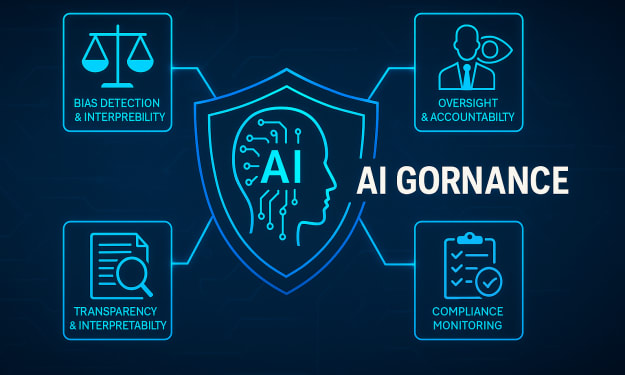
AI Governance Platforms: Ensuring Ethical AI Deployment in Modern Enterprises
Why Your Company Needs Guardrails Before the Algorithms Take Over In a world increasingly powered by artificial intelligence, one question looms large: Can we trust the AI we build? From customer service bots to algorithmic hiring tools, artificial intelligence is no longer just a buzzword — it’s embedded in the very fabric of modern business. Yet, with power comes risk. Bias, opacity, ethical lapses, and unregulated autonomy are just a few of the growing pains facing enterprise AI today.
By Md Ajmol Hossain2 years ago in Futurism