astronomy
Celestial objects and the phenomena that surrounds them. What lies above the earth forever out of reach. From moons, to stars, galaxies, and beyond.
The Eltanin Antenna: Antarctica’s Deep Sea Mystery That Defies Explanation
A Discovery That Shouldn’t Exist In the frozen waters off the coast of Antarctica, beneath waves that few human eyes have seen, a photograph taken in 1964 captured something that would spark decades of speculation. It was something no one expected to find in the deep ocean, an object that resembled an antenna, standing upright on the seafloor.
By The Secret History Of The Worldabout a year ago in Futurism
Secrets of 3 Phases of Sade Sati
Have you ever heard elders talk about "Sade Sati" and seen a worried look on their faces? It sounds a bit scary, right? Well, Sade Sati is a really important time in astrology, and it's all about the planet Saturn, who we also call Shani Dev. Imagine Saturn slowly moving through some special houses in your birth chart – it stays in each for about 2 ½ years, making the whole period around 7 ½ years long.
By Jyotishgher Astrologyabout a year ago in Futurism
Declassified FBI Document Hints at Visitors from Other Dimensions, What It Could Mean for Humanity
A Glimpse Behind the Curtain In a world filled with secrecy, surveillance, and speculation, it’s not every day that a government agency like the FBI releases a document that raises more questions than it answers. Yet, buried within the thousands of pages made public through the Freedom of Information Act, one peculiar memo stands out, one that hints at the presence of “beings from other dimensions” visiting Earth.
By The Secret History Of The Worldabout a year ago in Futurism
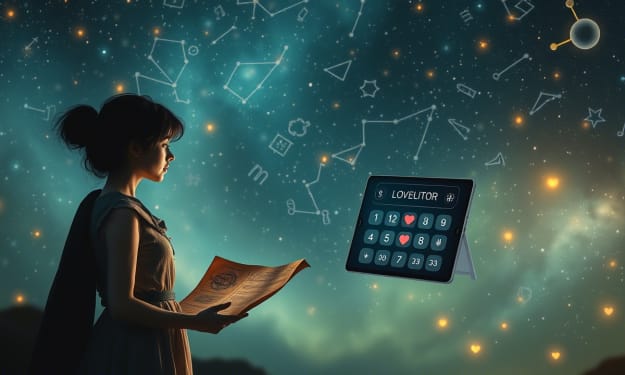
Zodiac Compatibility Test
Since time immemorial, humans have sought to understand the enigmatic force of love. From whispered sweet nothings to grand romantic gestures, the desire for connection and a soulmate has been a driving force in our lives. In the digital age, this age-old quest has found a modern twist: the love calculator by zodiac sign. These online tools promise to unveil the secrets of romantic compatibility based on the celestial alignment at our birth. But how do they work, and how much stock should we put in their cosmic pronouncements? Let's delve into the fascinating world of zodiac love compatibility.
By Jyotishgher Astrologyabout a year ago in Futurism
New Research Challenges 160-Year-Old Long-Standing Origin of Life Theory. AI-Generated.
New Research Challenges 160-Year-Old Long-Standing Origin of Life Theory For over a century and a half, scientists have built upon a widely accepted theory about how life on Earth began. But now, new research is shaking the very foundations of that belief, suggesting that the origins of life may have been dramatically different from what we’ve long assumed.
By Adnan Rasheedabout a year ago in Futurism
Can human Ever Leave the milky way Galaxy The wormholes Explained By Shah saab
Can Humans Ever Leave the Milky Way? Wormholes Explained Humanity has always gazed at the stars with curiosity, dreaming of traveling across the universe. As our understanding of space has grown, so has our ambition. But while we’ve sent probes to the edges of our solar system, the idea of leaving our galaxy—the Milky Way—raises profound scientific, technological, and philosophical questions. Can humans ever truly leave the Milky Way? Could wormholes be the key to this escape? --- The Vastness of the Milky Way The Milky Way galaxy is a sprawling disk of stars, gas, and dark matter, approximately 100,000–200,000 light-years across. Our solar system orbits about 25,000 light-years from the galactic center. To escape the galaxy, humans would have to travel not just between stars, but across a gravitationally bound system of over 100 billion stars. To put that in perspective: the fastest spacecraft ever built, NASA’s Parker Solar Probe, travels at about 700,000 km/h. At that speed, it would take more than 2 billion years to reach the edge of the Milky Way. Clearly, with current propulsion technology, intergalactic travel is far beyond our reach. --- Galactic Escape Velocity Just as a spacecraft must reach escape velocity to break free from Earth’s gravity, it must do the same to leave the Milky Way. The galactic escape velocity near our solar system is estimated at roughly 525 km/s—more than 1,800,000 km/h. No human-made object has come close to this speed. Voyager 1, launched in 1977, is traveling at about 17 km/s and will never escape the galaxy. The enormous speeds required mean we need radical breakthroughs in propulsion—technologies that don’t yet exist or are purely theoretical. --- The Concept of Wormholes One of the most intriguing ideas in theoretical physics is the wormhole, a speculative tunnel through space-time that could connect distant points in the universe instantly. First proposed in 1935 by Albert Einstein and Nathan Rosen (thus also called Einstein-Rosen bridges), wormholes arise naturally from the equations of general relativity. If wormholes exist—and if they can be stabilized—they might allow instantaneous travel between galaxies or even across the universe. This would solve the problem of immense travel times and distances. However, there’s a catch: stabilizing a wormhole likely requires “exotic matter” with negative energy density, a substance we have never observed in nature. Some theories, such as those involving quantum entanglement and spacetime foam, suggest that wormholes could exist on quantum scales. But even if they do, scaling them up to a size usable by humans—or keeping them open long enough for travel—remains a massive scientific and engineering challenge. --- Scientific Research into Wormholes Physicists have explored several potential ways wormholes might exist or be detected. Some theories suggest that a wormhole might produce gravitational lensing—warping light from background stars in a unique way. Others suggest tiny wormholes could be remnants of the early universe, though we’ve never observed one directly. Recent work in quantum gravity and string theory suggests possible links between entangled particles and microscopic wormholes, but these connections are still speculative. In 2022, researchers at Caltech claimed to simulate a wormhole using quantum processors, although this was more of a mathematical analogy than an actual wormhole. Still, it shows growing interest in bringing this science-fiction idea closer to science fact. --- Alternative Propulsion Ideas Aside from wormholes, several advanced propulsion concepts have been proposed to one day enable galactic or intergalactic travel: Alcubierre Drive: A theoretical warp drive that contracts space in front of a spacecraft and expands it behind. It doesn’t move the ship faster than light locally, but space itself could move faster than light. Like wormholes, it requires exotic matter. Antimatter Engines: Antimatter reactions release enormous energy, much more efficient than chemical rockets. But creating and storing antimatter safely is a challenge. Laser Sailcraft: Tiny spacecraft pushed by high-powered lasers could potentially reach nearby stars in decades. Projects like Breakthrough Starshot aim to use this concept. Even the most optimistic timelines place these technologies far in the future. Human travel beyond the Milky Way would likely require generations of development—or entirely new physics. --- Could Nature Do It for Us? In rare events, stars can be ejected from galaxies at incredible speeds. These "hypervelocity stars" are flung out by interactions with supermassive black holes or galactic collisions. In theory, a spacecraft hitching a ride with such momentum could escape the galaxy, but directing and surviving such a journey is beyond our current capability. --- Conclusion Leaving the Milky Way is an awe-inspiring but extremely distant goal. The vast scale of space, the limitations of our current technology, and the speculative nature of wormholes and exotic physics mean that, for now, humanity is firmly rooted in our galaxy. However, as with so many once-impossible dreams—flight, the Moon landing, exploring Mars—our imagination often precedes our capabilities. Whether through wormholes, warp drives, or unknown breakthroughs, the dream of intergalactic travel continues to inspire science and science fiction alike.
By Shah saab ITabout a year ago in Futurism
AI's Crucial Role in National Growth: The Future of Economic Development
In today's rapidly evolving technological landscape, artificial intelligence (AI) has emerged as a cornerstone for national economic development and competitive advantage. Countries looking to position themselves at the forefront of global innovation must hire AI developers with specialized expertise to build robust technological infrastructures and implement cutting-edge solutions. This investment in AI talent has become as fundamental to national growth strategies as traditional infrastructure development was in previous decades.
By Himshikha Chaudharyabout a year ago in Futurism
Gravity Wave Propulsion: Did Bob Lazar Describe a Real Technology Decades Before the Patents?
When Bob Lazar came forward in 1989 claiming he worked on reverse-engineered alien craft near Area 51, he described a propulsion system unlike anything on Earth: a gravity wave amplifier powered by Element 115. It didn’t burn fuel. It didn’t push against the air. It bent space itself.
By Rukka Novaabout a year ago in Futurism
Why Is Space Freezing Cold When the Sun Is SO HOT?. AI-Generated.
You may think the Earth is pretty big, but the sun makes up almost 99.9% of the mass of the whole solar system. The rest of the mass is made up by the planets and their satellites, asteroids, comets, gas, and dust. It's around 93 million miles, 150 million kow away from our planet, but it keeps us warm every day. Its temperature is about 10,000 af 5,30 sun7° wel, but the space surrounding it is still cold as ice. To understand this, we need to distinguish between heat and temperature. Heat is the energy inside some object.
By taylor lindaniabout a year ago in Futurism