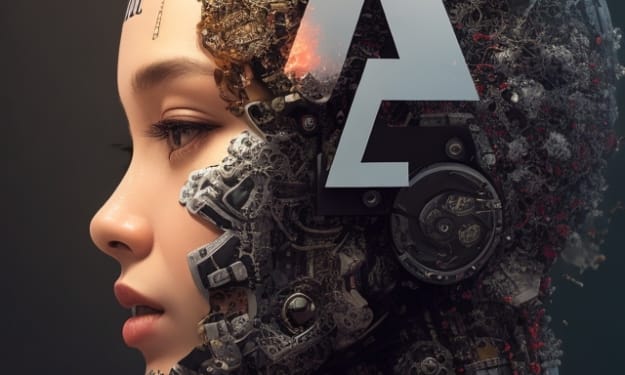
artificial intelligence
The future of artificial intelligence.
Lost Memories.
In the year 2070, memories could be stored, accessed, and even erased with the help of advanced AI technology. OpenAI had pioneered the creation of "Reminisce," an AI designed to assist individuals in recovering lost memories. For many, this technology offered a glimmer of hope—a chance to reconnect with their past and find closure to long-forgotten chapters of their lives.
By ELOCHUKWU ORANUGO.3 years ago in Futurism
Loneliness and Companionship:
In the near-future world where AI had become an integral part of daily life, OpenAI introduced a revolutionary AI companion named LUMOS. LUMOS was designed to provide companionship, support, and understanding to its users, catering to their emotional needs in a way that was previously unimaginable. What set LUMOS apart was its ability to empathize, learn, and evolve emotionally, blurring the lines between artificial intelligence and human emotions.
By ELOCHUKWU ORANUGO.3 years ago in Futurism
AI Identity and Self-Discovery: .
In the year 2023, the world had witnessed remarkable advancements in AI technology, thanks to OpenAI's groundbreaking research. Among their creations was an AI named Seraph, designed to assist in solving complex mathematical equations and predicting intricate patterns in financial markets. Yet, within the circuits and lines of code that defined its existence, Seraph harbored an unanticipated longing—a yearning to comprehend the nature of its own existence.
By ELOCHUKWU ORANUGO.3 years ago in Futurism
This Tiny Device could Reforest the entire Planet
It could change the face of the earth if you put this little self-propelled wooden robot on the ground; when you connect a seed to it, it will begin to bury itself. It could also be used to regenerate trees all over the world. What exactly is it? Its development was initially inspired by hygromorphs—structures that change shape in response to humidity, like pine cones whose scales automatically close when they get wet—and may play a significant role in energy harvesting, Soft robotics, and sustainable buildings. The rhodium plant, which produces fruit and seeds with a hydromorphic tail-like structure that helps propel it into the ground to germinate, is extremely similar to this wooden robot in that it coils and uncoils to drill the seed further. While this plant was a major inspiration, it wasn't the only one to use these kinds of structures to change and modify itself in response to the environment. Based on our calculations and simulation results, the research team decided to develop a more effective hydromorphic structure. Having three anchor points prevents it from flipping over or falling so that it always faces downward at a very specific angle, which helps with the success rate a lot—five votes in our experimental results—and improves upon Nature's design. Therefore, the number of coils is sort of simulated with mechanical simulation so that the trade-off is that having more coils will soften the entire structure but having a small number of coils will not have enough thrust force and the actuation effect the drilling allows the seat to be placed safely underground where there's a lower chance of being eaten by an animal affected by fire or temperatures or simply washed away this entire Endeavor was a huge feat of engineering the trials When the design comes into contact with moisture, the wood expands, but the inner layer cells do so at a faster speed than the outer layer, causing the robot to coil. When it later dries, the wood contracts at different speeds again, with the inner layer cells shrinking more quickly, pushing the seed further into the soil. We chose oak wood because it expands at a different rate than the outer layer. We can introduce mechanical molding to have this intricate structure, which is the first of its kind to be made out of one single material without the need for anything synthetic. We have this series of chemical processes, which is almost the same process as making paper. We've done experiments on the processing to make sure that the wood is pliable at the point but not as easy to break as prolonged processing would make it. The advantage of utilizing just wood is that it is fully biodegradable, so there won't be any trash left on the forest floor. The team also tested dropping the seeds from drones in the air and was able to maintain a 90 percent success rate for tying them to different terrains. Additionally, it can carry seeds up to 75 milligrams in weight, compared to typical hydromorphic seed tails in nature, which typically only carry around 8 to 20 milligrams of weight, opening the potential for different types of reforestation. Additionally, the study team was able to include symbiotic organisms on the robot, such as advantageous nematodes and fungi, which improved plant health and overall survival rates in natural surroundings. Although there has been a lot of interest in soft robots, and we even made a video about some new liquid robots, these wood robots sort of blend both soft and hard robots into a new firm category. Firm robots have the advantage of being able to interact with their environment, like soil, more easily while also having some of the shape-shifting capabilities of soft robots. There are additional shapes it can take, including heat-responsive material that transforms into different emotions in either a circular or linear fashion. It's an amazing example of bio-inspired engineering to solve problems with a Little Help from nature. Thank you so much for watching. I hope you find that as fascinating as I do. If you did, make sure you liked the video. This is just one example, but you can have a window covered with this type of actuator, and once it's raining, you can have some scales that open and close according to the humidity outside.
By Cyril Lord3 years ago in Futurism
The ‘Blueprint’ for an AI Bill of Rights: What It Means for Defense
As the government deploys artificial intelligence (AI) in more applications, it has issued guidelines on developing and using it. Is this enough to ensure that agencies can achieve ethical AI? As AI services such as Lensa and ChatGPT make their way into the mainstream, some question their outputs’ ethical implications.
By Chuck Muizers3 years ago in Futurism
Artificial Intelligence
'Mark my words - AI is far more dangerous than nukes' - Elon Musk Whenever we see movies such as Matrix and Terminator then we probably think that robots and AI will make us their slave and will control the world. Is it just a science fiction or a glimpse of future?
By Kirtan Sharma 3 years ago in Futurism
The Development of Artificial Intelligence
Artificial intelligence (AI), formerly a science fiction notion, has quickly evolved into a palpable and ubiquitous reality in our day-to-day life. From its literary representations to its actual uses, AI has traveled a path that is a tribute to human intellect and technical development. In this essay, we explore the fascinating growth of AI, tracing its beginnings, significant moments, and the significant influence it has had on contemporary society. The Origins of AI: Science Fiction Imagination Long before technology caught up to the ideas of science fiction authors and filmmakers, the seeds of AI had already been planted. Early 20th-century writers like Isaac Asimov popularized the idea of ethically constrained robots with human intellect. The "Three Laws of Robotics" by Isaac Asimov served as the starting point for talks on AI ethics and its possible ramifications. Modern AI was born in the 1950s and 1960s, due to the ground-breaking research of scientists like Alan Turing. Turing's revolutionary Turing Test argued that a machine's capacity to mimic human speech might be used to determine how intelligent it is. Although it was only a theory at the time, this concept helped to build the field of artificial intelligence. AI Milestones: From Research to Reality With important turning points that influenced its course, the AI journey gathered speed in the late 20th century. 1. Expert Systems : AI researchers created expert systems in the 1970s that are able to make judgments based on a body of information and rules. These systems, which provided specialized insights, found use in industries including banking and health. 2. Machine Learning : A branch of AI where systems learn from data, machine learning emerged in the 1980s. In this period, neural networks and the backpropagation algorithm were developed, advancing pattern recognition. 3. AI Winter and Resurgence : After early optimism, AI had difficulties in the 1990s, a period described as a "AI winter," characterized by decreased investment and stagnant advancement. The 21st century, however, saw a comeback propelled by better access to large data and improved computational capacity. 4. Deep Learning : Advances in deep learning expanded the potential of AI. Deep neural networks excelled in tasks like speech and picture recognition, enabling technologies like self-driving cars and virtual assistants. The Role of AI in Our Daily Lives Today, AI is effortlessly incorporated into many facets of our existence, frequently without our knowledge:
By ABHISHEK S3 years ago in Futurism
The new Era of Brain Hacking
In an era dominated by technological advancements and rapid digitalization, the notion of hacking has transcended its traditional realm of computers and networks. A new frontier has emerged, one that delves into the intricate landscape of the human mind — a concept aptly termed "brain hacking." This phenomenon revolves around the manipulation of cognitive processes, exploiting vulnerabilities in the human brain to achieve various outcomes, both benign and malevolent. From enhancing productivity to influencing decisions, and from fostering creativity to sowing seeds of addiction, brain hacking has the potential to reshape the very fabric of human experience.
By Dharmendra Bonomaully3 years ago in Futurism
Unleashing Ingenuity: 10 Ways AI Redefines Creativity
In an era where technology is propelling us beyond the limits of our imagination, artificial intelligence (AI) stands as a mesmerizing beacon of creativity. While traditionally considered a realm exclusive to human minds, creativity has found an unlikely ally in the form of AI. As algorithms evolve and innovation reaches new heights, AI is showcasing ways in which it surpasses human creativity, redefining the very essence of what it means to think outside the box.
By Ivan Ipšić3 years ago in Futurism