artificial intelligence
The future of artificial intelligence.
When Hollywood Goes Digital: The Ethical Perils of AI in Film and TV
Hollywood has consistently embraced technological advancements, from ancient sound and Technicolor to modern computer-generated imagery (CGI), all of which have reshaped storytelling. However, artificial intelligence (AI) represents a more profound shift, affecting the very core of creative expression.
By Jenna Deedyabout a year ago in Futurism
The AI Bubble Is About To Burst, But The Next Bubble Is Already Growing
Let’s be honest — if you’ve been paying attention to the tech world, it feels like déjà vu. Every few years, we get sold the same dream under a different name: “This is the future. This is where the money is. This will change everything.”
By Awais Qarni about a year ago in Futurism
Advanced Integrations Every Business Should Look for in Custom Software
Custom software today is not merely about developing a system that functions. It's about developing one that fits within the broader ecosystem of tools, platforms, and technologies an organization relies on. Sophisticated integrations in custom software enable businesses to tie operations, data, and customer experiences into a cohesive framework. This saves time, automates effort, and improves efficiency, scalability, and decision-making.
By Kiran Modaabout a year ago in Futurism
The Rise of AI Companions: Are Virtual Friends Replacing Real Ones
In the past decade, artificial intelligence has shifted from being a background tool to a constant presence in daily life. We use it to answer emails, suggest Netflix recommendations, plan trips, and even generate entire works of art. But among its most surprising roles, one is beginning to stand out: AI is no longer just helping us work—it’s starting to keep us company.
By arsalan ahmadabout a year ago in Futurism
Artificial Intelligence and You
Over the years, Artificial Intelligence (AI) has found its way deep into our lives that we almost don’t give it a thought. Many are unaware of its presence in our lives and now that the buzz of GPT and AI are going strong, they’re completely caught off guard.
By Pore Camaraabout a year ago in Futurism
A World Without America: Imagining the Global Impact
A World Without America: Imagining the Global Impact** The United States of America has long held a prominent role on the world stage. As a global superpower, its influence extends across politics, economics, science, culture, and military affairs. But what would the world look like without America? This hypothetical scenario, though extreme, invites us to explore the positive and negative consequences of a world where the United States does not exist—either historically or in the present. --- Economic Impacts** **Negative Aspects:** Without the United States, the global economy would look drastically different. As the largest economy in the world for much of the 20th and 21st centuries, America's financial systems, such as Wall Street and the U.S. dollar as the world’s reserve currency, have played a stabilizing role in international trade. Many countries rely heavily on the U.S. market for exports, investments, and aid. A world without America would likely experience greater economic instability and slower technological progress due to the absence of American innovations and investments. The absence of major U.S. companies like Apple, Microsoft, Google, and Amazon would significantly alter the global business landscape. The tech industry, in particular, might have developed differently or more slowly without American leadership. Moreover, many countries that benefit from U.S. foreign aid or disaster relief would face greater challenges in crises. **Positive Aspects:** On the other hand, a world without America could lead to a more balanced distribution of economic power. Emerging markets and other developed nations might have had more room to grow without U.S. dominance. The European Union, China, and regional powers could have played more central roles earlier in history, potentially creating a more multipolar economic structure. Additionally, some critics argue that U.S. economic policies have, at times, contributed to global inequality or environmental degradation. In its absence, perhaps global systems would have evolved in a way that prioritized sustainability or social equity more effectively. --- Political and Military Dynamics** **Negative Aspects:** The United States has often acted as a global police force, intervening in international conflicts and providing military support to allies. While this role has been controversial, it has also prevented or ended conflicts, stabilized regions, and deterred authoritarian regimes. A world without America could have seen more unchecked aggression from expansionist powers like Nazi Germany, the Soviet Union, or even modern-day regimes with imperial ambitions. The post-World War II global order, including institutions like the United Nations, NATO, and the World Bank, were all heavily influenced or initiated by the U.S. Without it, these institutions might not exist in their current form—or at all. This could result in weaker international cooperation and less coordinated responses to global crises. **Positive Aspects:** Conversely, some would argue that American military interventions have often led to long-term instability, civilian casualties, or unintended consequences, such as in Iraq, Vietnam, or Afghanistan. Without U.S. involvement in these conflicts, some regions might have found more local, diplomatic solutions to their issues, or avoided certain wars altogether. Furthermore, without the U.S. as a dominant superpower, other nations might have taken on more responsibility for global leadership, possibly leading to more diverse and cooperative forms of governance. --- Scientific and Technological Development** **Negative Aspects:** The U.S. has been a hub for innovation, especially in fields like medicine, aerospace, and information technology. NASA's contributions to space exploration, American universities’ role in academic research, and Silicon Valley's impact on digital technology have all shaped the modern world. Without these, progress in science and technology could have been delayed by decades. In addition, the internet—largely developed and popularized in the U.S.—has become a backbone of modern communication, education, and commerce. Without American leadership in tech, global access to information and digital tools might be less widespread or more fragmented. **Positive Aspects:** However, in a world without America, other nations may have risen to fill the innovation gap. Countries like Germany, Japan, the UK, or even China could have led the way in scientific discovery and technological advancement. This might have resulted in different approaches to technology, perhaps more localized or culturally tailored. --- Cultural Influence** **Negative Aspects:** American culture—through music, movies, fashion, and fast food—has become nearly universal. Hollywood, for example, has played a key role in shaping global entertainment. In a world without America, this cultural cohesion might not exist. People around the world may not share the same cultural references or global icons, leading to a more fragmented global culture. Also, many social movements that gained momentum in the U.S., such as civil rights, LGBTQ+ advocacy, and feminist waves, have inspired change worldwide. Their absence might have slowed progress in human rights and social equality. **Positive Aspects:** On the other hand, some critics view American cultural dominance as a form of cultural imperialism that overshadows local traditions and values. Without it, local cultures might have flourished more freely. Languages, cuisines, art forms, and indigenous traditions might have received more attention and preservation without the overwhelming influence of American pop culture. --- Environmental Consequences** **Negative Aspects:** The U.S. is one of the world’s largest carbon emitters and has been criticized for withdrawing from global climate agreements and prioritizing economic growth over environmental concerns. Its absence might reduce global carbon emissions. **Positive Aspects:** But it’s also true that many environmental innovations—from renewable energy technologies to conservation programs—have roots in the U.S. Without these, the fight against climate change might have fewer tools and resources. Moreover, U.S. scientific institutions have played major roles in researching and communicating environmental risks. ---
By America today about a year ago in Futurism
The Universe's Secret Algorithms: 5 Natural Secrets You Didn't Realize Were Code!
The Hidden Programming of the Universe: 5 Natural Secrets You Didn't Realize Were "Source Code" (A Guide for the Curious) Have you ever looked at a beehive or a snowflake and asked: How did this happen so perfectly? You're not alone. For centuries, scientists have thought of nature as a beautiful mess, but the shocking truth is that the universe is far from random. It's built on algorithms no less complex than the most complex code ever written by humans.
By PositivePulseabout a year ago in Futurism
Advanced Equipment: Hope or Threat?
Human history has always been in search of progress. When the wheel was invented, life changed; when electricity arrived, the world saw light with new eyes; and when the internet appeared, distances vanished. But today’s era is something different. This is the age where advanced level equipment has gripped every aspect of human life. These tools sometimes create destruction on the battlefield, sometimes spark revolutions in factories, sometimes give new life to patients in hospitals, and sometimes reshape the direction of education. On the surface, it all looks like convenience and development, but hidden behind it is a long tale of risks.
By Muhammad yarabout a year ago in Futurism
The Future of SEO 2026: What Melbourne Business Owners Need to Know. AI-Generated.
Melbourne's business landscape transforms faster than the city's ever-changing weather. While some companies prepare for SEO's evolution, others cling to outdated strategies that worked five years ago but show declining effectiveness today. Based on current algorithm trends and Google's announced priorities, businesses adapting to AI-driven search patterns are already seeing significantly higher engagement rates.
By Melbourne Web Digitalabout a year ago in Futurism
Existential Risks of Superintelligent AI: What Experts Fear Most
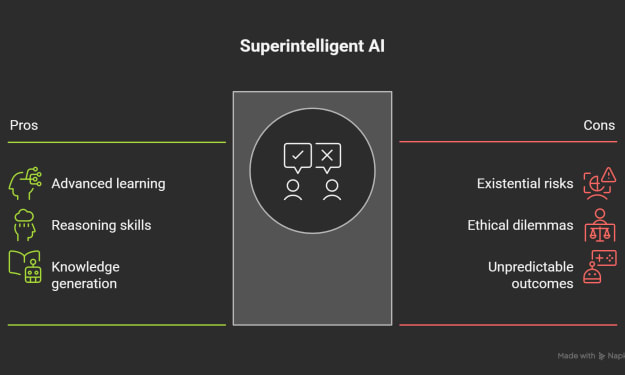
Artificial Intelligence (AI) has evolved from narrow applications like voice assistants and recommendation engines to increasingly advanced systems capable of learning, reasoning, and even generating new knowledge. While these developments promise immense benefits, they also raise profound concerns. Many researchers argue that once AI surpasses human-level intelligence, it could pose existential risks—threats that jeopardize humanity’s long-term survival. The Path to Superintelligence is filled with opportunities but also fraught with dangers that experts are urgently trying to address.
By Salvina Gorgesabout a year ago in Futurism