artificial intelligence
The future of artificial intelligence.
Understanding the Growing Role of Edge AI in Modern Technology
How Edge Computing Shapes Real‑World Innovation Edge computing has become an essential part of how data is processed today. Instead of relying solely on distant servers, devices can now analyze information closer to where it’s generated. This shift has opened the door to new possibilities, including the development of edge AI hardware, edge AI devices, and edge AI solutions. Companies working in this field, such as Geniatech, contribute to the broader movement toward distributed intelligence—though the focus of this article is on understanding the trend, not promoting any specific brand.
By charliesamuel12 months ago in Futurism
The AI Boom: Will It Continue?
The AI boom has actually been with us for quite some time. Algorithms recommending content have been a fixture in our daily lives for more than 20 years — versions of recommendation systems existed even earlier. Over the past two decades, as we’ve gained access to vast amounts of data online, algorithms have become essential for suggesting material, making sense of the ocean of choices available. These systems, now powered by increasingly sophisticated GPUs and CPUs, guide our experience on platforms like YouTube, this channel, and a wide array of others.
By Andrew Mortimerabout a year ago in Futurism
How Will the Demand for AI Services Impact Google Cloud, Amazon AWS, and Microsoft Azure?
Artificial intelligence is reshaping the digital economy, and every enterprise from healthcare providers to global banks is accelerating its move toward AI-powered transformation. But as organizations deploy large language models (LLMs), predictive analytics, and intelligent automation at scale, one underlying trend has become clear: the demand for AI services is redefining the competitive landscape among major cloud providers: Google Cloud, Amazon Web Services (AWS), and Microsoft Azure.
By NextGen Narrativesabout a year ago in Futurism
The Silent Partner: How AI is Rewriting the Rules of Creativity
We’ve long believed creativity was the last bastion of humanity, something that algorithms could never truly replicate. Yet quietly, almost imperceptibly, AI has moved from crunching numbers to holding a paintbrush, and it’s producing work that challenges our very definition of art. This isn't about machines replacing artists. It's about something far more interesting: AI as a collaborative partner that can amplify human creativity in ways we're only beginning to understand. The New Creative Toolkit: AI in Action Across creative fields, AI tools are becoming as fundamental as a painter's brush or a writer's notebook: · The Written Word: Tools like ChatGPT and Claude help writers overcome blocks, generate ideas, and even co-write entire chapters. Platforms like Sudowrite offer "brainstorming" functions that suggest metaphors and plot twists. · Visual Arts: Midjourney, DALL-E, and Stable Diffusion have democratized visual creation, allowing anyone with a vivid imagination to create stunning artwork in seconds. These aren't just filters—they're interpretation engines that can blend styles and concepts in novel ways. · Music Composition: AIVA (Artificial Intelligence Virtual Artist) composes emotional soundtrack music, while Google's Magenta project explores how machine learning can create compelling melodies and harmonies. · Game Development: AI now generates entire game worlds, creates dynamic dialogue for non-player characters, and even helps design balanced game mechanics. Beyond the Hype: What Does This Mean for Artists? The emergence of AI creativity raises profound questions: The Inspiration Machine For many creators,AI serves as an infinite source of inspiration. A writer can generate twenty possible opening paragraphs. A concept artist can explore fifty visual directions for a character in an hour. This acceleration of the ideation process is perhaps AI's greatest gift to creativity. The Skill Shift Technical proficiency matters differently now.The ability to craft the perfect prompt—to guide the AI toward a specific vision—is becoming as valuable as traditional technical skills. The artist's role is shifting from executor to curator and director. The Authenticity Question When an AI generates a beautiful poem,who is the artist? The person who wrote the prompt? The programmers who built the model? Or the AI itself? This dilemma strikes at the heart of what we value in art: technical mastery, emotional expression, or simply the final product? Case Study: The AI-Augmented Creative Process Consider a novelist working with AI: 1. Brainstorming: She uses AI to generate character backstories and world-building elements 2. Writing: When stuck on a scene, she asks the AI for dialogue options 3. Editing: AI tools help identify pacing issues and suggest structural improvements 4. Cover Design: She collaborates with an image generator to create the perfect book cover The human remains the visionary, the quality controller, the emotional core—but AI handles much of the heavy lifting. The Dark Side: Ethical Brushstrokes This creative revolution isn't without its shadows: · Training Data Dilemma: Most AI models were trained on copyrighted works without permission or compensation for the original creators · Style Imitation: AI can perfectly mimic living artists' styles, potentially devaluing their unique voice · The Homogenization Risk: If everyone uses the same AI tools, could we lose the quirky, imperfect, uniquely human aspects of art? Looking Ahead: The Future of Human Creativity The most exciting developments will likely be in human-AI collaboration rather than AI replacement. We might see: · Personalized AI creative partners that learn an individual artist's style and preferences · New art forms that could only exist through human-AI interaction · Democratization of creativity where people who lacked technical training can now express their visions The Bottom Line AI isn't making human creativity obsolete—it's making it more accessible and potentially more profound. The artists of tomorrow won't be those who shun these tools, but those who learn to dance with them, who understand how to guide AI to serve human vision. The question is no longer "Can AI be creative?" but "What new forms of creativity can humans and AI discover together?" The canvas is vast, and we've only just begun to paint.
By GadgetGroundabout a year ago in Futurism
Beyond Voice Assistants: Your Home is About to Get a Whole Lot Smarter
We’ve grown accustomed to asking our speakers for the weather or setting a timer with our phones. But the next wave of domestic AI isn’t about responding to commands; it’s about fading into the background. It’s the shift from interactive AI to ambient AI, and it’s poised to fundamentally change our relationship with our living spaces. Welcome to the era of the truly "smart" home, an environment that senses, learns, and acts on your behalf, often without you uttering a single word. The Invisible Butler: What is Ambient AI? Imagine walking into your kitchen on a chilly morning. The lights have already gently brightened to your preferred morning level, and the thermostat began warming the floor 15 minutes before your alarm went off. Your coffee machine, having learned your schedule, is just finishing a fresh brew. No buttons were pressed. No apps were opened. This is ambient AI. It uses a distributed network of sensors, cameras, and microphones—often embedded in everyday objects—to build a continuous, contextual understanding of a space and its inhabitants. Instead of waiting for a "Hey Google," it's always on, subtly optimizing your environment for comfort, efficiency, and even health. The Gadgets Building Your Intelligent Home This isn't science fiction. The hardware ecosystem is already being built: · Sensing Systems: Devices like the Google Nest Hub with its built-in radar (Project Soli) can sense your presence and gestures. Advanced mmWave sensors in products like the Eve Motion can detect not just motion, but breathing and precise location in a room, all while preserving privacy by not using cameras. · Context-Aware Displays: Imagine a digital photo frame that shows your calendar when you walk up to it in the morning, then switches to recipe instructions when you approach it in the kitchen, and finally displays your relaxation playlist in the evening. The screen itself becomes an ambient interface. · AI-Powered Appliances: Newer refrigerators with internal cameras can track inventory and suggest recipes based on what’s about to expire. Ovens can recognize the food you put inside and automatically set the correct temperature and time. The Double-Edged Sword: Convenience vs. Privacy The promise is undeniable: unparalleled convenience, energy savings, and even safety (e.g., detecting a fall or a water leak). But this intelligence comes with a profound question: How much of our personal data are we willing to exchange for this comfort? An always-listening, always-watching home generates a staggering amount of intimate data: · Your sleep patterns · Your eating habits · Your daily routines and when you are away · Your emotional state (inferred from voice tone or movement) This data is a goldmine, not just for tailoring your experience but also for advertisers and, potentially, malicious actors. The central challenge of the ambient AI home will be trust. Can we trust the companies that build these devices to handle our data ethically and secure it impeccably? The Future: A Home that Cares for You Looking ahead, the potential expands beyond convenience into care. For an aging population, an ambient AI home could be a guardian—noticing changes in gait that might predict a fall, detecting missed medications, and providing companionship. It could monitor air quality for asthmatics or adjust lighting to help regulate circadian rhythms.
By GadgetGroundabout a year ago in Futurism
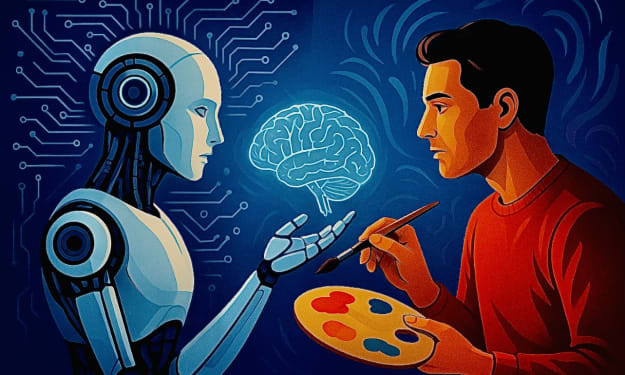
Can AI Replace Human Creativity?. AI-Generated.
Artificial Intelligence is evolving at a speed that feels almost unreal. Every few months, a new model arrives—smarter, faster, more capable than the last. It can write essays, compose music, generate images, and even mimic human voices. As AI becomes more deeply woven into our lives, a big question rises again and again:
By Voxwrite ✍️ about a year ago in Futurism